
Finding an industrial cleaning method that is fast, affordable, and eco-friendly can be challenging. While plasma cleaning is known for precision, fiber laser cleaning offers a superior alternative: extreme speed on common metals with no ongoing consumable costs or chemical waste. By combining power, precision, and a completely dry process, it delivers unmatched efficiency. If you want to reduce processing time, eliminate recurring expenses, and achieve exceptional results on metal surfaces, fiber laser cleaning is the clear choice. See why modern industry prefers it for surface preparation.
Fiber Laser Cleaning Vs Plasma Cleaning: A Direct Comparison
| Comparison Dimension | Fiber Laser Cleaning | Plasma Cleaning |
| Core Principle | Laser Ablation | Plasma Activation |
| Processing Speed | Extremely Fast | Slow |
| Initial Investment | Wide Range, Low Entry | High (especially vacuum systems) |
| Operational Cost | Very Low (electricity only) | Medium-High (gas & energy) |
| Environmental Impact | Zero Pollution, No Waste | Exhaust Treatment Needed |
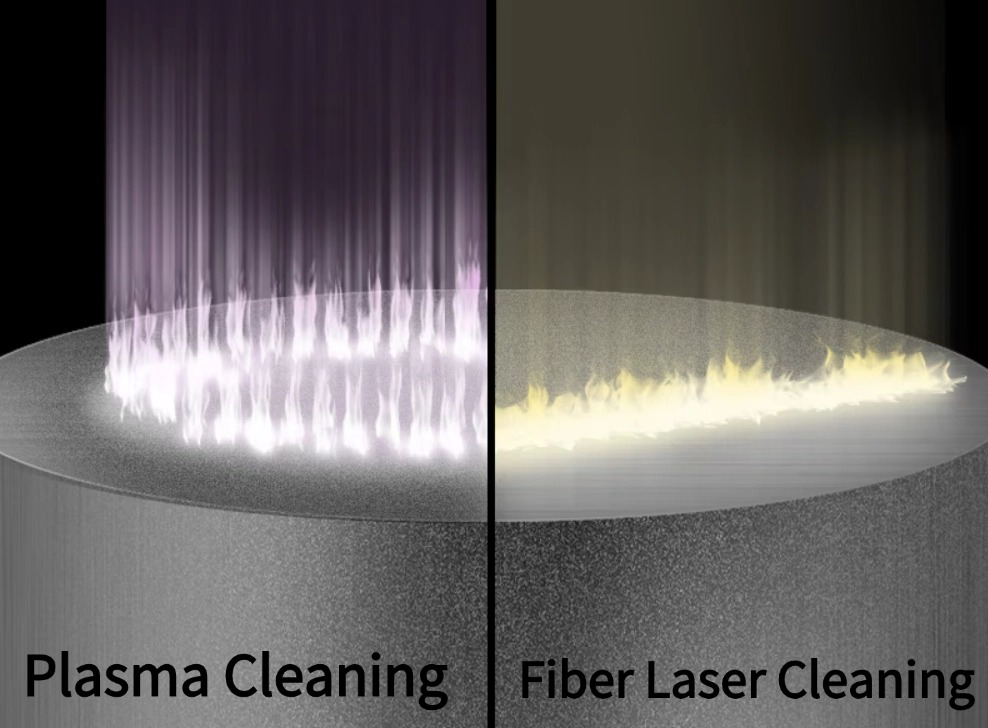
Fiber Laser Cleaning Technology
Core Working Principle and Technical Specifications
Fiber laser cleaning machine is an advanced, non-contact technology. It uses a 1064 nm wavelength laser to emit precise nanosecond pulses. These pulses target contaminants like rust or paint, which absorb the energy more easily than the underlying metal, causing them to instantly vaporize.
The core of the process is controlling energy density. Operators work within a precise “processing window”—applying enough energy to remove the contaminant but not harm the base material. This achieves highly localized removal with minimal heat transfer to the part.
Key parameters like laser power, pulse energy, and spot size are adjustable. The beam is delivered via flexible fiber optics and directed by high-speed galvanometer scanners, enabling precise and automated cleaning over various surfaces.
Key Advantages of Fiber Laser Cleaning
Fiber laser cleaning offers a compelling set of benefits for industrial applications:
-
High Precision and Control: The laser spot can be focused down to 50-200 µm (and even to 10-50 µm for high-precision setups), allowing for selective cleaning of specific areas without masking. Adjacent surfaces remain untouched. Advanced closed-loop systems can even use spectroscopy (LIBS) or imaging to monitor cleanliness and stop automatically.
-
Material Selectivity: By tuning parameters like pulse energy and duration, operators can selectively remove contaminant layers while preserving the base material, a crucial advantage for restoring valuable components.
-
Minimal Thermal Impact: Despite the intense pulses, the extremely short interaction time (nanoseconds) and rapid scanning prevent heat from accumulating in the substrate. The overall part temperature often remains below 50°C, protecting material properties.
-
Environmental and Operational Friendliness: The process is completely dry, eliminating the need for chemical solvents, abrasive media, or water. This results in zero secondary waste, no toxic fumes, and a safer working environment. It also removes the costs and logistics associated with consumable procurement and disposal.
-
Ease of Automation: The laser head is lightweight and can be easily integrated with robotic arms or CNC gantries. Pre-programmed cleaning paths ensure consistent, repeatable results, making it ideal for high-volume production lines.
MAXWAVE’s Answer to High Costs
MAXWAVE Laser leaning machines fundamentally redefine traditional perceptions of laser technology. Starting at a highly competitive price of $4,300, they make exceptional performance truly accessible. Take the MW-LCW1500 model as an example: it delivers outstanding processing speeds—removing contaminants like paint at 10–20 m²/h and handling rust at approximately 5–10 m²/h—while integrating eight preset intelligent cleaning modes for exceptionally easy operation. More importantly, it completely eliminates the reliance on consumables required by traditional methods, achieving truly zero ongoing costs in cleaning production. For small workshops and diverse applications, an efficient, economical, and precise cleaning solution has now become an accessible reality.
Industrial Applications and Case Studies
Fiber laser cleaning has proven its value across numerous sectors:
-
Automotive Manufacturing: Used for pre-weld cleaning of aluminum body panels (improving bond strength by 40-60%), and paint stripping from fixtures and tools at speeds of 3–8 m²/h.
-
Aerospace & Defense: Selectively stripping paint and coatings from aircraft skin and components without damaging the underlying aluminum alloy, significantly reducing turnaround time compared to chemical stripping.
-
Precision Parts & Tooling: Efficiently removes microscopic burrs, oxides, and contaminants from intricate molds, engine components, and surgical instruments, restoring critical surface finish without altering part dimensions or tolerance.
-
Heavy Industry and Shipbuilding: High-power (2000-3000W) systems efficiently remove thick rust, mill scale, and coatings from ship hulls, structural steel, and pipelines at rates exceeding 15-25 m²/h.
-
Cultural Heritage Restoration: Low-power pulsed lasers delicately remove soot, pollution crusts, and corrosion from stone sculptures and historical metal artifacts, preserving the original patina.

Plasma Cleaning Technology
Core Working Principle and Technical Specifications
Plasma cleaning works by creating a reactive ionized gas (plasma) inside a vacuum chamber or through an atmospheric jet. Process gases like oxygen or argon are energized by RF power, generating active species that clean surfaces through a dual action: a chemical reaction that breaks down organic contaminants into harmless vapors, and physical sputtering where ions bombard away fine particles. Key settings like chamber pressure, gas type, RF power level, and treatment time are precisely controlled to match the specific cleaning task.
Key Advantages of Plasma Cleaning
Plasma cleaning excels in areas where laser technology has limitations:
-
Molecular-Level and Nano-Particle Removal: It is exceptionally effective at removing ultra-thin organic films, molecular residues, and sub-100 nm particles, achieving cleanliness levels essential for high-tech industries.
-
Superior Surface Activation: Beyond cleaning, plasma treatment functionalizes surfaces. It introduces polar chemical groups (e.g., -OH), dramatically increasing surface energy and wettability. This turns hydrophobic surfaces hydrophilic, boosting adhesion for paints, coatings, inks, and adhesives by 200-400%.
-
Omnidirectional and Complex Geometry Penetration: As a gaseous process, plasma flows uniformly over all surfaces, penetrating into microscopic pores, under components, and deep into complex 3D structures—areas a line-of-sight laser cannot reach.
-
Genuine Low-Temperature Process: The bulk substrate temperature rarely exceeds 80-100°C, making it safe for heat-sensitive materials like plastics, polymers, and precision electronics.
-
Minimal Waste Generation: It is a dry process with minimal consumables (only small amounts of gas). By-products are primarily gaseous and easily managed, aligning with stringent environmental and cleanroom standards.
Inherent Limitations of Plasma Technology
Despite its strengths, plasma cleaning has specific constraints:
-
Limited Speed for Large Areas: Atmospheric plasma line speeds are generally between 0.1-2 m/s, making it less suitable for rapid, large-scale surface cleaning compared to lasers. Vacuum systems are batch processes with cycle times.
-
Poor Efficiency on Thick Layers: The etch rate for organic materials is relatively slow (typically 10-200 nm/min). Removing layers thicker than a few microns becomes prohibitively time-consuming.
-
System Complexity: Vacuum plasma requires chamber, pumps, and gas supply infrastructure. Atmospheric systems need exhaust management. This increases setup complexity and footprint.
-
Potential for Over-Treatment: Excessive treatment can degrade sensitive polymer surfaces or alter surface properties beyond the desired state.
-
Integration Constraints: While in-line atmospheric systems exist, integrating a vacuum chamber into a continuous production line can be challenging and may create a bottleneck.
Typical Applications and Case Studies
Plasma cleaning is indispensable in industries demanding ultimate surface purity and activation:
-
Semiconductors and Microelectronics: Critical for removing photoresist residues, cleaning bond pads before wire bonding, and surface preparation prior to thin-film deposition. It is a standard step in over 75% of chip fabrication processes.
-
Medical Device Manufacturing: Used to clean and activate surfaces of catheters, implants, and syringes, ensuring biocompatibility and enhancing the adhesion of lubricious or drug-eluting coatings.
-
Precision Optics and MEMS: Cleans delicate optical components and micro-electromechanical systems without physical contact or thermal stress.
-
Plastics and Packaging: Treats automotive interior parts, consumer product casings, and packaging films to ensure paint adhesion, prevent print smearing, and enable strong sealing.

Why Our Fiber Laser Cleaners Are the Optimal Industrial Solution
Based on the objective analysis above, fiber laser cleaning emerges as the superior choice for the vast majority of industrial material removal tasks—offering unmatched speed, precision, and operational simplicity. Our solutions are engineered not just to meet, but to exceed the inherent advantages of this technology.
Technological Edge
Our fiber laser cleaners are designed with cutting-edge technology that solidifies their leadership:
-
Unmatched Efficiency & Reliability: With wall-plug efficiency exceeding 35%, our lasers consume up to 70% less power than legacy CO2 systems for the same output, dramatically reducing operating costs. Built around industry-leading fiber laser sources, they guarantee over 100,000 hours of maintenance-free operation—a testament to legendary reliability that minimizes downtime.
-
Intelligent Precision: We integrate advanced scanning systems and intuitive software that allows for effortless programming of complex cleaning patterns. Features like automatic focus following and optional real-time process monitoring (LIBS) ensure perfect results on curved or uneven surfaces, maximizing the technology’s precision and selectivity.
-
Robust and User-Friendly Design: From compact, air-cooled 300W units to powerful 3kW water-cooled systems, our portfolio is built for the shop floor. Sealed optical paths keep critical components clean, while rugged industrial designs ensure longevity. They are engineered for easy integration into both manual workstations and fully automated robotic cells.
A Complete Solution, Not Just a Product
We understand that adopting a new technology requires support. That’s why we offer a comprehensive partnership:
-
Application Development: Our experts work with you to develop and optimize cleaning parameters for your specific material and contaminant, delivering a turnkey process recipe.
-
Seamless Integration Support: We provide the technical guidance needed to integrate the laser cleaner into your existing production line or workflow, ensuring a smooth transition.
-
Global Service and Support: Our worldwide network ensures prompt service, spare parts availability, and ongoing technical support to keep your productivity at its peak.

Summary
When selecting between fiber laser and plasma cleaning, the decisive factors are speed, cost, and versatility. For removing rust, paint, and oxides from metals, fiber laser cleaning stands unmatched, delivering incredible speed with minimal ongoing costs. Choose superior productivity and value—explore our range of high-performance fiber laser cleaning machines today.