
Choosing the right welding gas is a critical step for achieving strong, clean welds. For DIY enthusiasts and workshops, it’s not just a technical detail—it affects project feasibility, cost, and final results. This article breaks down traditional gas selection for MIG welding and reveals how a handheld laser welder offers a revolutionary, simplified approach that makes professional-grade welding accessible to everyone.
Key Decision Comparison: MIG vs. Handheld Laser Welding
| Comparison Dimension | Traditional MIG Welding | Handheld Laser Welder |
| Learning Curve | Requires months of training | Master basic operation in 5-10 minutes |
| Gas Configuration | Requires 3-5 mixed gases | One gas, not complex mixtures |
| Preparation Work | Complex parameter tuning | One-touch start, automatic matching |
| Weld Quality | Depends on welder skill | System ensures consistency |
| Post-processing | Requires grinding, polishing | Weld-ready finish, no additional processing |
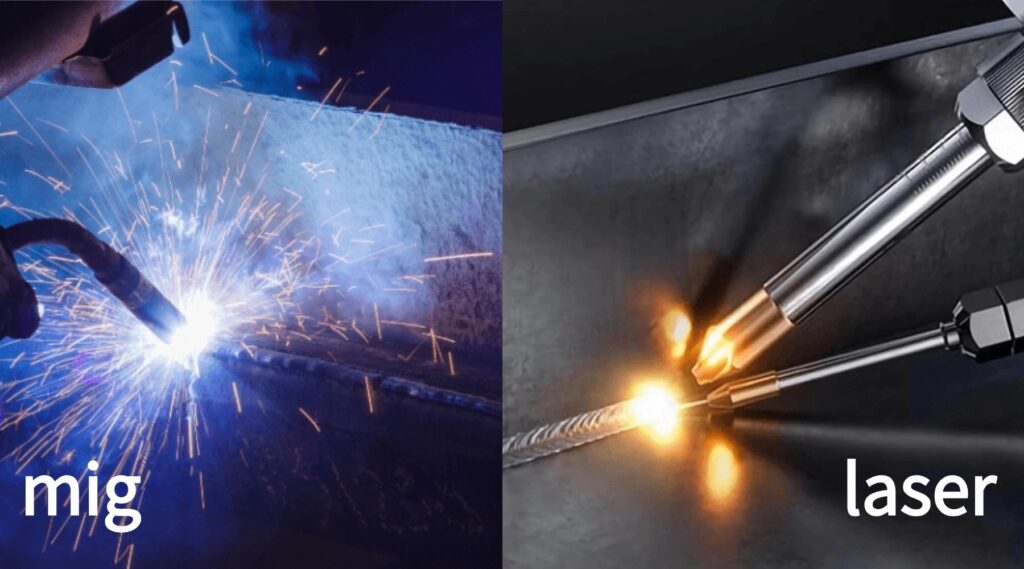
MIG Welding: The Traditional Gas Selection Logic
MIG welding uses argon-based gas as a shield, keeping air away from the molten metal. The gas you pick affects how deep it welds, how much it spatters, how fast you can go, and how the bead looks. Get it right for solid, clean welds; get it wrong and you’ll end up with weak, porous joints that won’t hold up.
Standard Gas Mixtures
Three main mixes dominate DIY use:
-
Pure Argon (100%): Best for non-ferrous metals (aluminum, copper, thin stainless steel). Produces smooth, spatter-free beads but slows travel on steel, making it less suitable for thick sections.
-
Argon + CO₂ (75/25 or 80/20): The go-to choice for mild and carbon steel. CO₂ boosts penetration and allows faster travel, ideal for thicker, structural work.
-
Argon + CO₂ (90/10): Suited for stainless steel. Reduces oxidation while maintaining good penetration, minimizing discoloration and spatter.
Gas Flow Requirements
Flow rate is another critical factor:
-
Thin materials (<1mm): 15–18 L/min
-
Moderate thickness (1–3mm): 18–22 L/min
-
Thicker sections (>3mm): 22–25 L/min
Insufficient flow causes porosity; excessive flow creates turbulence, drawing in air and reducing quality.
Spatter and Quality Trade-offs
CO₂ percentage controls the spatter versus penetration balance:
Higher CO₂ percentages (>25%) increase spatter. But they boost penetration on thick steel sections. Are you making heavy structural parts? Appearance matters less than strength here. Accept the extra spatter cleanup. You get deeper fusion.
Pure argon cuts spatter on non-ferrous metals. But it needs slower travel speeds on steel. The lower penetration makes it hard to use on thick steel. You’ll need multiple passes.
Argon + CO₂ (75/25) hits the sweet spot for general DIY steel work. You get reasonable spatter levels plus good penetration. Single-pass welds work on 2–4 mm material.
Core Challenges & Limitations
While MIG welding is more forgiving of surface contaminants, its complex gas matrix, constant need for parameter adjustment, and relatively high skill barrier present significant hurdles for DIY users. The requirement to memorize and select different gas mixes and flow rates based on material type, thickness, and project adds to the learning curve and ongoing consumable management.
In contrast, laser welding machine requires clean surfaces but simplifies everything else: one gas, auto settings, and no cleanup. For prepared projects, it removes gas and tuning complexity—delivering consistent, quality welds in minutes.

Handheld Laser Welding: Simplified Process and New Perspectives on Gas Selection
Tired of complex gas mixture charts and parameter adjustments? Handheld laser welding offers an efficient solution by significantly simplifying process setup. Its core advantage lies in greatly reduced dependence on shielding gas types, allowing a single gas (such as nitrogen) to handle many common scenarios, which dramatically lowers operational complexity.
Optimized Gas Strategies
Our equipment recommends efficient and economical gas strategies for common metals. Nitrogen is often the preferred choice for most situations due to its cost advantage and good performance, though best practices vary slightly for specific materials:
-
Stainless Steel (0.8-3.0mm):Using ≥20 L/min nitrogen with focus on the material surface yields high-quality, nearly discoloration-free welds.
-
Carbon Steel (2.0-4.0mm):The same nitrogen flow, combined with laser oscillation, enables efficient welding with near-zero spatter.
-
Aluminum Alloy (1.0-2.0mm):For optimal results, argon is recommended. If using nitrogen, raising the focus by 3-5mm while maintaining ≥20 L/min flow can effectively control fumes and porosity.
Intelligent Operation Lowers the Barrier
The true simplification comes from intelligent system design:
-
One-Touch Start: Select material, input thickness, and the system auto-matches core parameters like power and speed.
-
Real-Time Adaptation: Continuously monitors and fine-tunes during welding for consistent quality.
-
5-Minute Mastery: An intuitive interface allows complete beginners to produce their first qualified weld in minutes.
Unmatched Economy & Durability
-
Extended Lifespan: Core light source rated for 100,000+ hours, designed to last for decades.
-
Minimal Consumables: Primary consumable is an inexpensive protective lens; no ongoing need for MIG consumables like contact tips, nozzles, or liners.
-
Significantly Lower Gas Costs: In most applicable scenarios, nitrogen is cheaper than various argon mixes, leading to substantial long-term savings.
Practical Application Scenarios
Home Repair Scenario:
User Mr. Zhang learned the operation in just 8 minutes and successfully repaired a crack in a 0.8mm thick stainless steel sink. The weld was aesthetically pleasing without grinding, with the nitrogen cost for the entire process less than $0.15.
Small Workshop Case:
A metal processing shop switched to our equipment, enabling new employees to start working the same day. The weld qualification rate increased from 75% to 98%, with monthly gas and consumable savings reaching $180.
Outdoor Operation Advantage:
Even in slightly breezy conditions, optimized gas flow field design allows the equipment to maintain stable welding quality—something traditional MIG welding struggles to achieve.
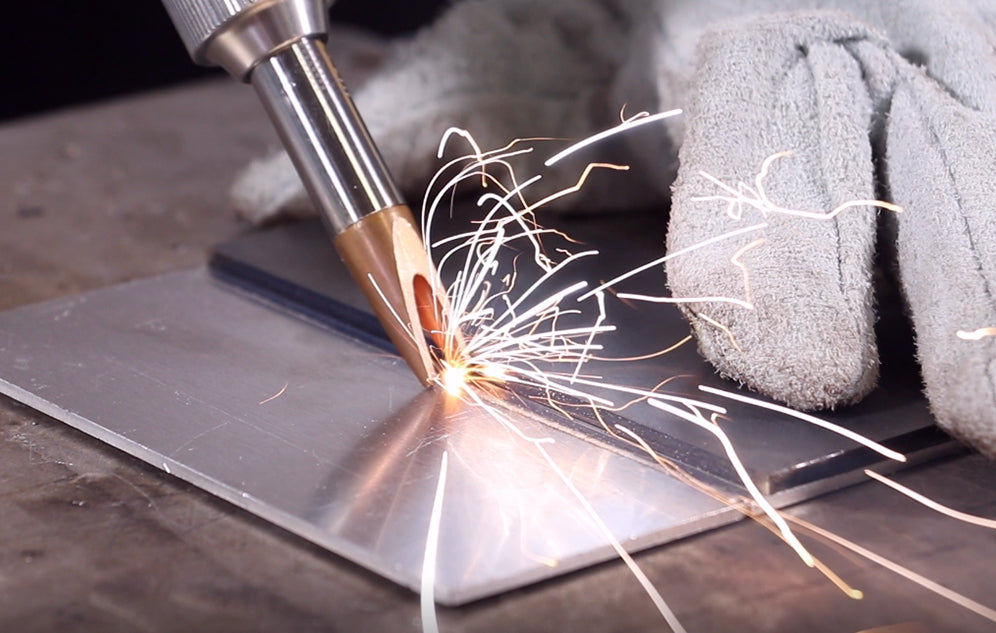
Economic Analysis Comparison
Based on an estimated annual welding volume of 5000 meters:
-
Annual MIG Welding Cost: Mixed gases $450 + Welding wire $225 + Component replacement $120 = $795
-
Annual Laser Welding Cost: Nitrogen $150 + Protective lenses $30 = $180
-
Annual Savings: $615 (typical investment payback period 1-2 months)
Your Decision Framework
Choose MIG welding if your priority is handling imperfect, real-world conditions.You frequently work with rusty, oily, or unprepared materials; operate mostly outdoors or in uncontrolled environments; require maximum versatility for welding thick plates; and are already invested in MIG equipment and expertise.
Choose laser welding if your core goal is pursuing the efficiency and simplicity of modern technology.You can commit to thorough pre-weld cleaning and precise fit-up; value time savings and consistent results over material tolerance; want to eliminate the complexity of shielding gas selection entirely; and seek professional-grade weld quality with minimal training investment.
Our handheld laser welder not only lowers the welding barrier through intelligent and simplified operation but also delivers tangible economic benefits via its ultra-long lifespan design and minimal maintenance requirements. Whether you’re a DIY enthusiast, small workshop, or repair service provider, it enables you to quickly achieve professional-grade welding results without worrying about a steep learning curve or high operating costs.
Conclusion: The Choice for the Future
While traditional MIG welding retains value in specific, high-forgiveness scenarios, the expertise, preparation, and ongoing consumables it demands can hinder many enthusiasts’ progress.The handheld laser welder represents a paradigm shift: it transforms welding from a craft reliant on prolonged experience into a highly efficient, precise, and user-friendly modern fabrication tool. It simplifies the process through technology, guarantees results through intelligence, and reduces the total cost of ownership through durability.