
Have you ever ruined a delicate piece because traditional welding methods were too harsh? The precision of a jewelry laser welder changes everything, but its success hinges on one critical factor: choosing the right metal. Not all that glitters is equally weldable. This definitive guide cuts through the uncertainty, detailing exactly which metals you can weld, which ones require special care, and how to ensure flawless results every time.
Jewelry Laser Welding: Metal Suitability Guide
| Metal Type | Suitability | Main Challenge | Key Technique |
| K Gold | Excellent | Softness (24K); Alloy porosity | Match filler; Control energy |
| Platinum | Excellent | High density/melting point | Use pure Pt filler; Perfect alignment |
| Sterling Silver | Very Good | High heat conductivity | Use argon gas shield |
| Palladium | Excellent | Oxidation during cooling | Ensure gas coverage for cooling |
| Stainless Steel | Very Good | Reflective surface layer | Test parameters; Adjust energy |
| Titanium | Difficult | Extreme oxygen reactivity | Mandatory full gas shielding |
| Brass/Bronze | Good | Zinc vaporization (Brass) | Fast pulses; Moderate power |
Most Suitable Common Jewelry Metals for Laser Welding
1. Gold and Its Alloys
Suitability Overview:
Pure gold (24K) is weldable but challenging due to its softness. In contrast, gold alloys (like 18K, 14K) are highly recommended and represent the most common application for jewelry laser welders. The added alloying elements dramatically improve strength and weldability.
Key Characteristics & Welding Data:
The alloy composition directly dictates the welding parameters. For instance, the copper content in red or rose gold requires slightly higher energy due to copper’s higher thermal conductivity. A common 14K yellow alloy (58.5% Au, 25% Ag, 11.85% Cu, 4% Zn, 0.5% Co) welds robustly, while alloys with elements like aluminum need precise control to prevent porosity.
Welding Preparation & Techniques:
Successful welding requires matching the filler material to the alloy’s karat and color. For repairs, always clean the area thoroughly to remove oils and oxides. Use lower pulse energy for pure gold and fine details, while standard K gold alloys can withstand standard parameters, making them ideal for everything from ring resizing to chain repairs.
Common Applications & Notes:
Used for all types of jewelry repair, sizing, setting rebuilding, and manufacturing. The versatility of K gold alloys makes them the foundational metal for laser welding work. Note that regional purity standards (e.g., 22K in Middle East vs. 14K in Europe) require no machine adjustment, only parameter fine-tuning.
2. Platinum (Pt950, Pt900)
Suitability Overview:
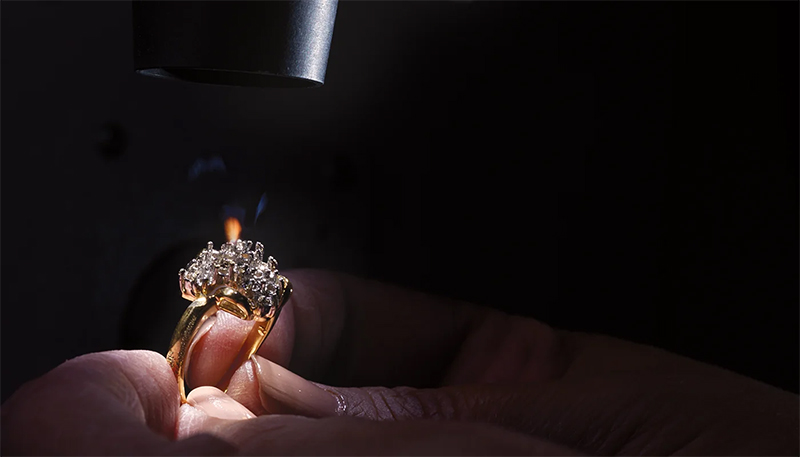
Platinum is exceptionally suitable and considered a premium metal for laser welding. Its high melting point (1,768°C) is effortlessly handled by the laser’s concentrated energy, making it a top choice for high-integrity work.
Key Characteristics & Welding Data:
Its high density (21.45 g/cm³) and melting point require laser settings with sufficient power density to achieve proper fusion. Compared to gold, platinum absorbs laser energy differently, often necessitating slightly higher peak power or longer pulse widths to create a deep, strong weld nugget.
Welding Preparation & Techniques:
Meticulous cleaning is paramount. Due to its high value and use in critical settings, precise beam alignment is crucial to avoid damaging nearby gemstones. It often performs best with a pure platinum filler wire, especially for building up worn prong tips or adding material.
Common Applications & Notes:
The premier choice for high-end repair, especially for securing platinum prongs holding valuable diamonds, and for manufacturing fine jewelry. Its resistance to oxidation during welding results in clean, strong joints with minimal post-processing.

3. Silver (925 Sterling Silver)
Suitability Overview:
Sterling silver (92.5% Ag) is very suitable for laser welding. The 7.5% copper content improves its weldability compared to pure silver, creating more stable joints.
Key Characteristics & Welding Data:
Silver’s primary challenge is its extreme thermal conductivity, which is about 60% higher than gold. This causes heat to dissipate rapidly from the weld zone, often requiring a moderate power increase or slightly longer pulse duration compared to gold of similar thickness to achieve proper fusion.
Welding Preparation & Techniques:
To prevent oxidation and resulting firescale (discoloration), the use of an inert gas shield (argon) is strongly recommended. The joint area must be perfectly clean. Quick, confident welding pulses yield better results than hesitant, low-energy attempts.
Common Applications & Notes:
Ideal for repairing chains, clasps, rings, and hollow silver items. The speed and precision of laser welding minimize heat distortion on delicate silver pieces. Rising silver material costs make the precision and low waste of laser welding particularly valuable.
4. Palladium (Pd950)
Suitability Overview:
Palladium shares excellent weldability with platinum, offering a lighter, often more affordable, white precious metal option for high-quality jewelry.
Key Characteristics & Welding Data:
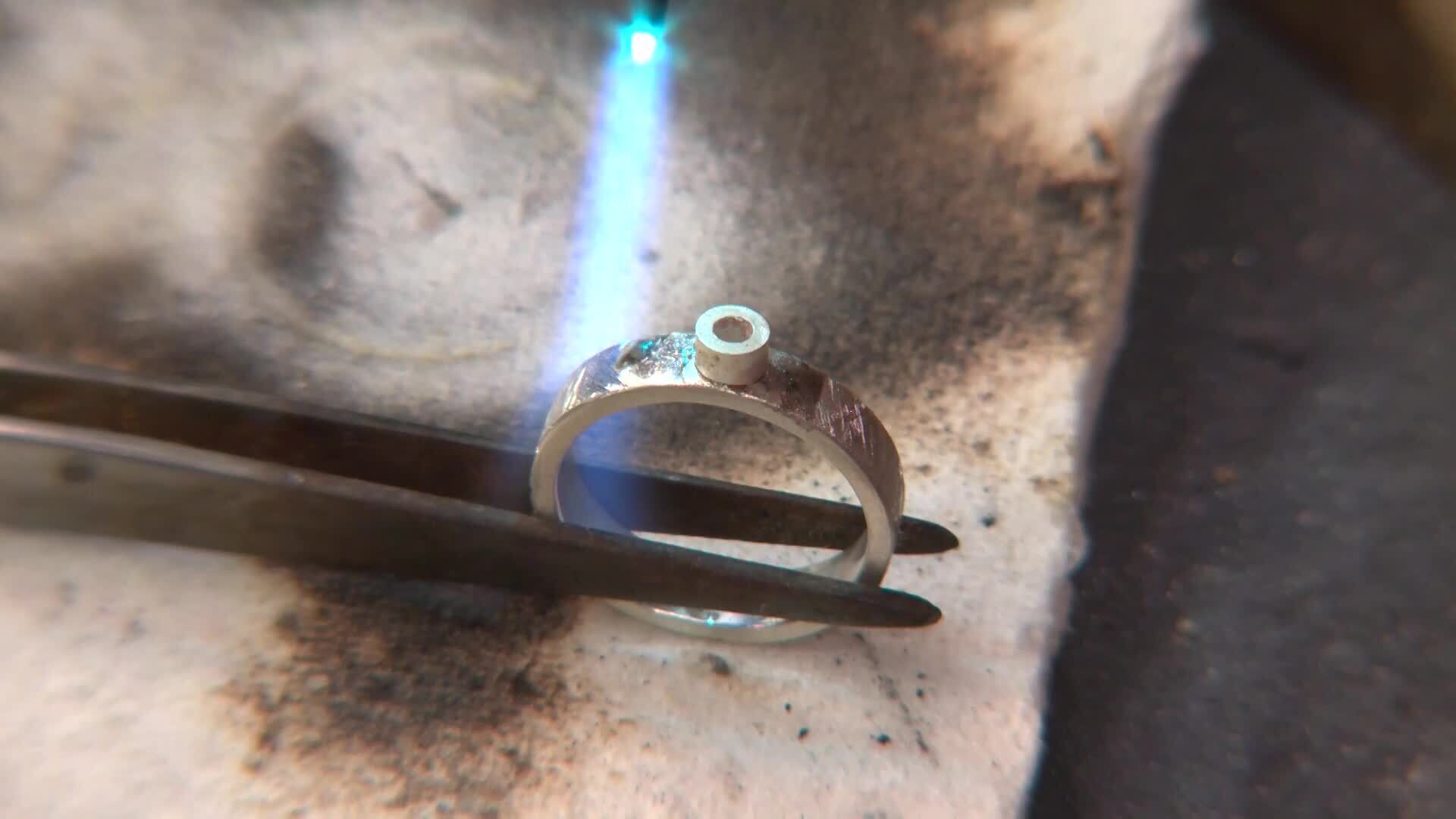
Although similar to platinum, palladium has a lower density (12.02 g/cm³) and melting point (1,555°C). This means it generally requires slightly lower energy input. However, it is more prone to oxidation during the cooling phase than platinum, requiring good gas coverage.
Welding Preparation & Techniques:
The key technique is controlled cooling under a consistent inert gas flow to prevent surface oxidation that can dull the weld. Using a matching palladium filler wire ensures color and integrity match. Parameters should be fine-tuned to avoid excessive heat input.
Common Applications & Notes:
Used in modern white gold-style jewelry and wedding bands. It is an excellent metal for creating strong, white, hypoallergenic pieces. Its welding behavior is very predictable once optimal parameters for a specific alloy are established.
Weldable Specialty and Base Metals
1. Stainless Steel
Suitability Overview:
Stainless steel is readily weldable with a jewelry laser welder and favored for contemporary, industrial, or budget-friendly jewelry components due to its strength and corrosion resistance.
Key Characteristics & Welding Data:
Different grades require adjustments. Grade 316L (with Molybdenum) is preferred for skin-contact items. Its protective chromium oxide layer has high reflectivity, so initial pulses may need slightly higher energy to “break through” and establish stable absorption, after which welding proceeds smoothly.
Welding Preparation & Techniques:
No special preparation beyond standard degreasing is needed for most grades. The primary technique is parameter experimentation: start with medium power/short pulse settings for thin sheets and adjust based on penetration and bead appearance. Filler wire is rarely needed for simple joins.
Common Applications & Notes:
Perfect for watch cases, bracelet links, bold rings, and structural findings. It allows for durable jewelry at a lower material cost. Note that welds on stainless steel can be slightly more visible post-polishing compared to precious metals.
2. Titanium
Suitability Overview:
Titanium is weldable but is classified as a high-difficulty operation due to its extreme reactivity with oxygen at high temperatures.
Key Characteristics & Welding Data:
Its low thermal conductivity (11.4 W/m·K) causes heat to concentrate in the weld zone. The critical data point is its oxidation threshold: above 400°C, it rapidly absorbs oxygen and nitrogen from air, becoming brittle and discolored.
Welding Preparation & Techniques:
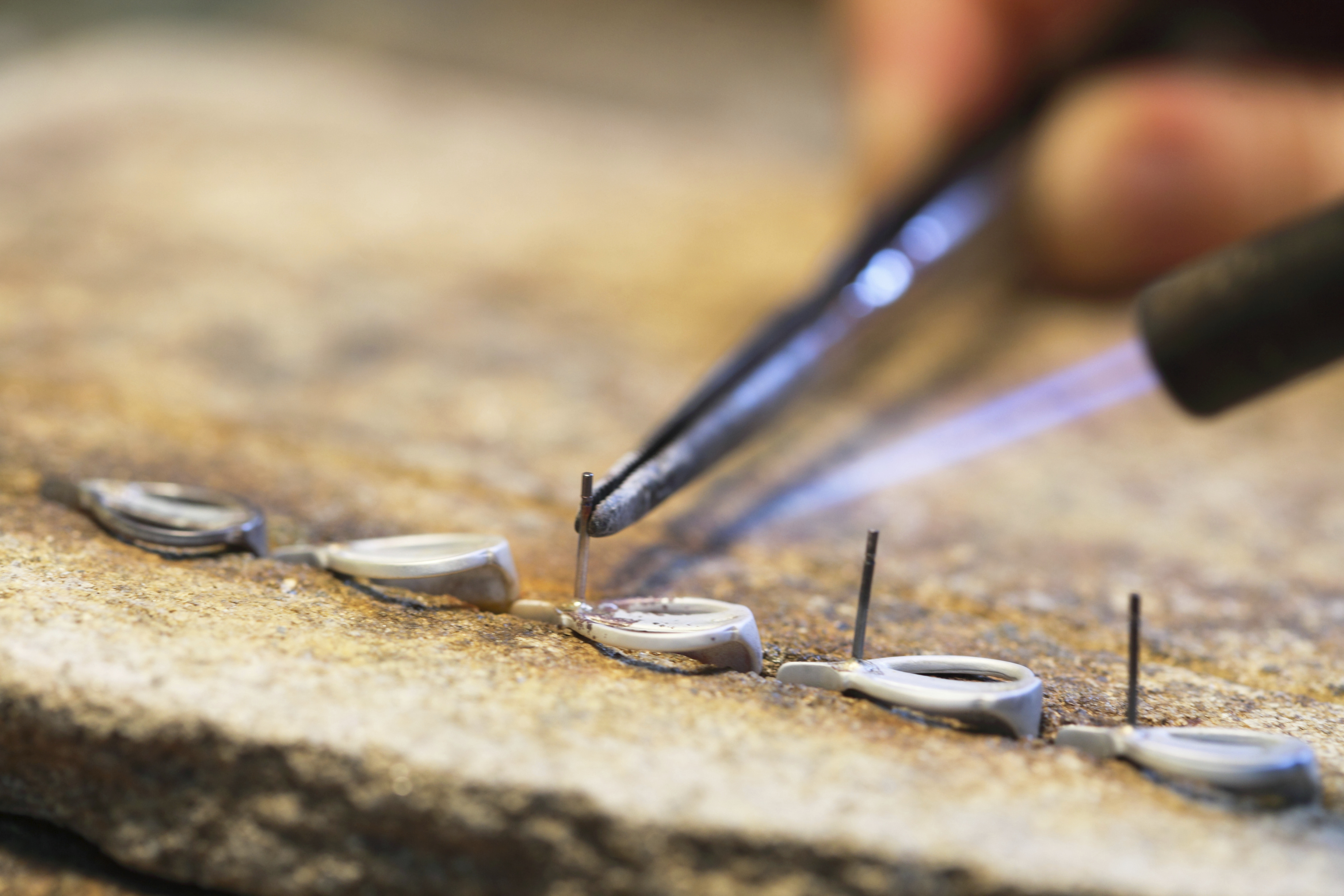
This process absolutely requires rigorous inert gas shielding. Use high-purity argon (99.995%) covering both the top and, if possible, the backside of the weld. Fixturing the piece to allow full gas coverage is as important as the laser settings themselves. Use shorter, more intense pulses.
Common Applications & Notes:
Used for body jewelry, lightweight wedding bands, and aerospace-inspired designs. Anodized colors can be preserved or locally re-anodized after welding. Success yields incredibly strong, biocompatible joints.

3. Brass and Bronze
Suitability Overview:
These copper-based alloys are generally weldable and popular for decorative elements, offering a classic gold-like appearance at lower cost.
Key Characteristics & Welding Data:
The main challenge is zinc vaporization in brass (Zn boils at 907°C). This can lead to porosity and spatter. Bronze (copper-tin alloy) is typically easier to weld than brass. Both have high infrared reflectivity, similar to pure copper.
Welding Preparation & Techniques:
Optimizing parameters is key: use faster pulse durations (e.g., 3-6 ms) and moderate peak power to minimize zinc loss in brass. Pre-cleaning is essential. A slightly oxidizing flame or chemical cleaner can help reduce surface reflectivity slightly for better initial beam coupling.
Common Applications & Notes:
Ideal for clasps, decorative filigree, cufflinks, and costume jewelry components. Welds may require more post-weld cleaning and polishing compared to precious metals due to potential oxidation and spatter.
Conclusion
Mastering your material is the first step to mastering the craft. While this guide outlines the core capabilities, the optimal settings for your specific projects can vary. To ensure you are maximizing the return on your investment, reach out to our team for a complimentary consultation on how our advanced Jewelry Laser Welder can be tailored to your unique workshop needs and metal portfolio.