
Many welders struggle as soon as they pick up a handheld fiber laser welder: inconsistent seams, excessive spatter, and a perfect weld on Monday that turns into a mess on Tuesday. The problem is never the machine itself — the key to handheld laser welding lies in precise parameter matching and proper operating techniques. Laser power, welding speed, beam angle, and focus distance must work in perfect harmony. Master this, and flawless seams become a given, not a stroke of luck.
These 5 pro tips will cut your learning curve in half. Whether you’re tackling stainless steel laser welding for the first time and struggling with penetration depth, or facing issues with aluminum welding, this guide will give you a clear roadmap to unlock the full potential of your handheld fiber laser welder.
| Tip | Focus Area | Key Outcome |
| 1 | Laser power & speed calibration | Eliminate burn-through and cold welds |
| 2 | Beam angle control | Consistent welding seam quality |
| 3 | Focus distance management | Precise penetration depth |
| 4 | Material-specific settings | Optimized aluminum and stainless steel laser welding |
| 5 | Motion technique | Smooth, ripple-free bead geometry |
What Makes Handheld Laser Welding Different
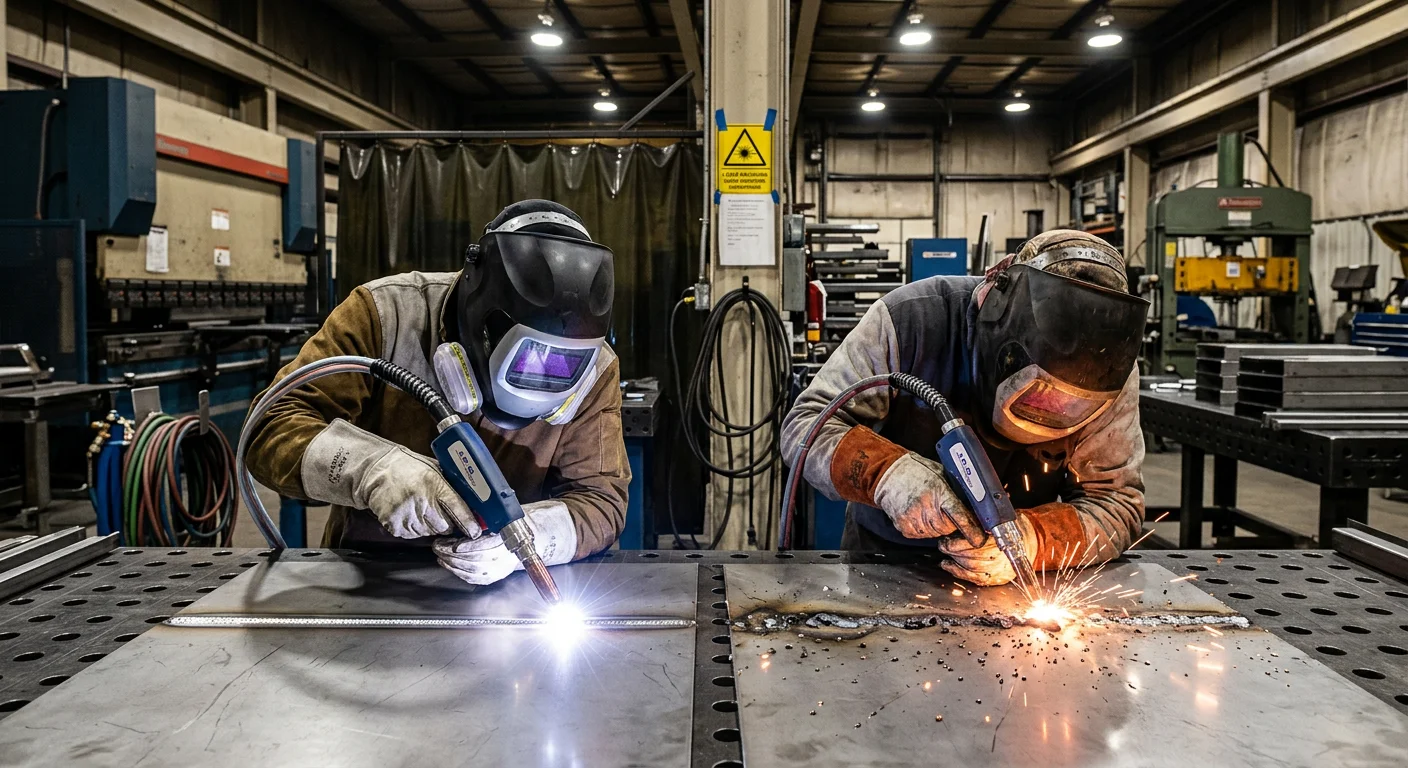
Here’s an uncomfortable truth about handheld laser welding: two operators, same machine, same material, same day — one produces a flawless seam, the other generates scrap.
The equipment isn’t the variable. The operator is.
Handheld fiber laser welders run on different physics than TIG or MIG. The beam delivers precise, concentrated heat. The heat-affected zone is much smaller — distortion stays under 1mm, compared to several millimeters with traditional arc welding. Spatter drops below 1% surface area affected, versus 5–10% with TIG. Weld speed reaches up to 100 inches per minute. The basics take 5–30 minutes to pick up, not months.
But “easier to learn” doesn’t mean “impossible to get wrong.”
The margin for technique error is tight. Here’s what you need to hold:
- Hand speed: 0.5–1.5 m/min
- Torch angle: 5–15°
- Stand-off distance: 5–10mm
Drift outside those ranges and quality drops fast. Novice operators see inconsistent seams on 20–50% of runs. Productivity falls 30–50%.
The equipment gives you capability. Technique determines whether you use it.
Pro Tip 1: Dial In Your Laser Power and Welding Speed Like a Formula — Not Guesswork

Power and speed work together. Ignore that, and your welds will keep failing in ways that feel random — but they’re not.
The math is simple: Energy per unit length = Power (W) ÷ Speed (mm/s). That ratio drives everything. It sets penetration depth, bead width, heat input, and whether you get solid fusion or blow a hole right through. Push power too high with slow speed — you burn through. Run high power with moderate speed — the bead spreads wide, heat stacks up, and distortion follows. Drop power too low with fast speed — the joint looks sealed but isn’t. Cold lap, weak fusion, hidden failure.
Start Here: The Incremental Tuning Method
Don’t start at full power. Ever.
- Set power to 60–70% of rated output — on a 2kW machine, that’s 1,200–1,800W
- Baseline speed: 50–200 mm/s — run a test bead on scrap first
- Increment power in 10–20% steps until you see proper fusion and bead formation
- Adjust speed — up to reduce heat input, down to increase penetration; stay between 10–200 mm/s
- Fine-tune focus position from 0 to –2mm and confirm zero distortion
Reference Parameters by Material Thickness
- <2mm thin sheet: 500W + 200mm/s or higher, ideal for conduction welding;
- 2-5mm standard materials (stainless steel/aluminum/mild steel): 1000-2000W + 50-200mm/s;
- >5mm thick plate: 2000-3000W + 10-50mm/s for deep penetration welding.
Find a combination that works? Log it. Write down the material, thickness, power, speed, and focal position — every variable, every time. Shops that build this kind of parameter database cut trial time by over 50% on repeat jobs. That’s not a minor win. It’s the gap between a shop that grows and one that keeps solving the same problem from scratch.
Pro Tip 2: Master the Gun Angle and Standoff Distance — The Variables Most Beginners Ignore

Two variables. Overlooked by most beginners. They cause more ruined seams than any power setting ever will.
Gun angle and standoff distance aren’t flashy adjustments. Nobody posts about them. Nobody brags about nailing their 15° tilt correction. Go into any fabrication shop and watch a struggling operator — nine times out of ten, the torch angle is wrong and the nozzle is drifting all over the place. That’s the problem. Right there.
Gun Angle: The Range That Works
Hold the torch between 45° and 70° from the workpiece surface. That range isn’t random. It controls three things at once:
– How the reflected beam exits the melt pool
– Which direction the molten metal flows
– Whether your shielding gas covers the weld zone or just blows past it
Go vertical — straight 90° — on aluminum or copper and reflected laser energy shoots back into the optics. That’s not a quality problem. That’s a hardware damage problem.
Drop below 30° and the melt pool loses direction. Porosity creeps in. Fusion weakens.
Stay in the window. 45°–70°. Every pass.
Your welding position shifts the target angle too:
- Flat welding: 45°-60°, suitable for push or pull welding;
- Vertical welding: 70°-80°, tilted upward;
- Overhead welding: 60°-70°, use a drag angle.
Standoff Distance: Closer Than You Think
Keep the nozzle 1–2mm from the workpiece. That gap does more for focus consistency than most operators expect.
The fix is straightforward. Slide your knuckle or fingertip along the base material as a physical guide. It sounds basic. It works. Support tools and edge guides do the same job on longer runs — they remove the guesswork and keep that distance locked in.
Let it drift past 2mm and the focal point shifts. The beam defocuses. Penetration drops. The seam degrades with no clear cause — that’s why beginners miss this variable for so long. There’s no loud warning sign. The quality just quietly falls apart.
Pro Tip 3: Surface Preparation and Shielding Gas — The Foundation Every Perfect Seam Is Built On
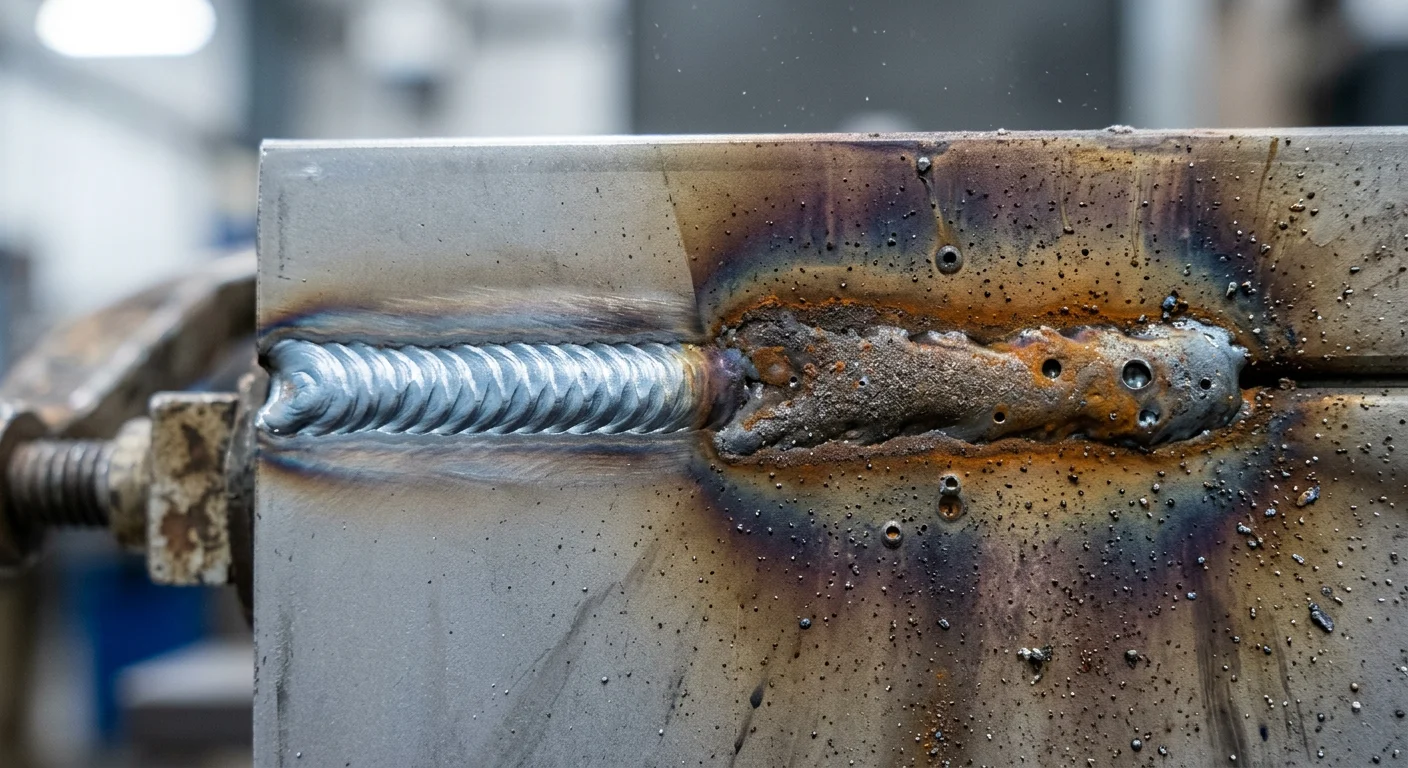
Dirty metal lies. It looks weldable. It accepts the arc. It lets you run the bead — and then, three days later or three months later, the seam fails and nobody understands why.
Surface contamination and bad shielding gas cause more hidden weld defects than any parameter mistake you’ll ever make. The damage doesn’t always show up right away. It hides inside the joint as porosity, inclusions, and cold fusion — invisible until the part is in use and the consequences are real.
Clean the Surface. No Shortcuts.
Laser welding has zero tolerance for surface contamination. Oil, oxidation, mill scale, rust — each one pushes gas pockets into the melt pool. Those pockets become voids. Those voids become failure points.
The cleaning sequence is fixed. Follow it every time:
- Degrease first — wipe down with acetone or isopropyl alcohol before anything else. Do this even on metal that looks clean. Fingerprints carry enough oil to cause porosity.
- Remove oxides second — use a stainless wire brush or angle grinder on rust and heavy scale. On aluminum, chemical oxide removal is the better option. Mechanical methods leave scratches that scatter the beam.
- Inspect before you strike — the surface should be bright, dry, and uniform. Any discoloration or residue means you’re not done.
Shielding Gas: Purity and Flow Rate Are Not Optional
Argon is the standard choice for most handheld fiber laser welding applications. Helium boosts penetration depth and works well on thicker sections. Nitrogen is fine on stainless steel, but it will make carbon steel brittle — know your material before you connect the line.
Two requirements with no exceptions:
- Purity ≥ 99.99%;
- Flow rate 15-25L/min.
Too little flow and the melt pool oxidizes. The surface shows it fast — blackening or blue discoloration around the seam means your shielding coverage failed. Too much flow creates turbulence that pulls atmospheric air back into the weld zone. More gas is not better gas.
Check your lines for leaks before every session. A pinhole fitting leak at 20 L/min pulls in enough oxygen to ruin every seam you run that day. It fails without warning, seam after seam. The problem looks like a power or speed issue until you trace it back to the gas line.
Prep the surface. Verify the gas. Then weld. That order exists for a reason.
Pro Tip 4: Achieve Precise Laser Focus — The Difference Between a Sharp Weld and a Blurry One

Focus separates a 0.1mm precision seam from a blown-out mess. Most operators never touch it after the initial setup.
Focus drift hits hard. Penetration drops 20–30%. Bead width balloons by up to 300%. Spatter jumps 25–40%. Your defect rate climbs past 25%. A beam locked on focus keeps defects below 5%. That gap isn’t small. It’s the line between a production-grade weld and scrap.
Understand the Effects of Three Focus Positions
- On focus: Maximum penetration (up to 25mm), seam width 0.05-0.2mm, spatter <10% — the optimal choice;
- Above focus: 20-30% lower penetration, 15-25% wider seams, 40% more spatter;
- Below focus: 10-20% lower penetration, 30% wider seams, 25% more spatter.
Spot Size Matters for Your Material
Don’t run a 0.2mm spot on thick plate. Don’t run a 2mm spot on thin sheet. The logic is straightforward:
- 0.2mm spot — thin material under 2mm, precision seams, gap bridging ≤ 0.5mm. Power density exceeds 10⁶ W/mm². HAZ shrinks 70%, distortion drops 90%.
- 1–2mm spot — material 2–30mm thick, wider seams, single-pass penetration up to 40mm. Oscillation mode pushes width tolerance up by 300%.
The Three-Step Scrap Test
Never assume focus is correct. Verify it on scrap before every critical run:
-
Dot test — fire a single pulse at 1,200W. Measure the spot diameter. Target: 0.05–0.2mm. Anything over 0.5mm puts you out of focus.
-
Line comparison — run three passes at 30–50mm/s. Do one above focus, one on focus, one below focus. The best pass is the deepest, narrowest, and cleanest — no spatter, sharp edges.
-
Keyhole check — watch the melt pool during the on-focus pass. A stable keyhole has sharp, defined edges. A blurry pool with wide spread means you need to adjust ±0.1mm until it locks in.
Watch Your Lens
A dirty lens looks just like defocus. Most operators blame their laser welding settings and never check the optics. Spot diameter growing more than 20% (0.2mm → 0.24mm), penetration falling 10%, spatter spiking 35% — those are your warning signs. Catch them fast. Clean or replace the lens before it wipes out a full production run.
Pro Tip 5: Read the Weld Pool in Real Time — And Adjust Before Problems Become Defects

The weld pool tells you everything — if you know how to read it.
A healthy pool has a specific look: symmetrical teardrop shape, bright mirror-like surface, uniform ripple pattern, and a tail width at 1.5–2.5x the front width. That combination means your laser welding parameters are dialed in and fusion is happening as it should. That picture changes? A defect is forming. Not has formed — is forming. That’s your window.
Here’s what the early warnings look like:
- Irregular ripples — porosity is building inside the joint
- Dim or dull surface gloss — heat input has dropped below fusion threshold
- Tail width exceeding 3x the front — burn-through is seconds away
Adjust Fast. The Pool Won’t Wait.
Spot a problem — fix it within 1–3 seconds. These are the adjustments that work:
- Too narrow seam: Reduce speed by 10-20%;
- Too wide seam: Increase speed by 15-25%;
- Excessive spatter: Lower power by 10-15% or raise pulse frequency by 20-50Hz;
- Unstable molten pool: Check shielding gas flow (15-25L/min) and clean the nozzle.
After each adjustment, a stable pool should return within 10 seconds. No improvement in 10 seconds? The variable you changed wasn’t the cause. Go back and look at something else.
Fatigue Kills Your Read Rate
Here’s a number most operators never track. After two hours of continuous pool observation, defect detection accuracy drops 25–40%. Porosity misses rise 15–20%. A study of 1,200 weld samples found fatigue-linked misreads in 30% of long sessions.
The fix is straightforward — and not optional. Rest every 45–60 minutes. A 15-minute break brings back about 90% of your visual accuracy. Keep continuous pool observation under 90 minutes per shift.
Scan the pool every 2–5 seconds — shape, gloss, tail width. Keep tail width variance under 10%. Ripple speed should sit at 1–2x your travel speed. That’s the rhythm of a clean seam. Drift from it, correct fast, and the weld tells you when it’s back on track.
Avoid These Mistakes: The Most Common Handheld Laser Welding Errors

Bad seams aren’t caused by one big mistake, but by a stack of small ones. These high-frequency errors trip up both beginners and intermediate welders — memorize the solutions:
- Excessive power: Burn-through, dents, weak structure → Lower power and refocus to on position;
- Low power + fast speed: Dark seam, shallow penetration → Increase power and slow down;
- Too slow speed: Bulbous, sagging seam → Speed up welding;
- Wrong focus: Uneven penetration, deep craters → Set to on focus, max scan height 3-5;
- Unclean base material: Spatter, slag inclusions, porosity → Clean before welding — no exceptions;
- Dirty lens/low coolant/bent fiber: Issues that look like technique errors, but are equipment faults → Inspect the machine first, then adjust parameters.
Handheld Laser Welding Reference Parameters for Different Materials

We’ve compiled universal parameters for 1000-2000W fiber laser welders with argon shielding, covering the commonly used 0.5-3mm thickness range — MaxWave handheld laser welder is fully compatible with these settings:
Stainless Steel
0.5mm: 450-600W + 8-10mm/s|1mm: 600-800W + 6-8mm/s|2mm: 800-1200W + 4-6mm/s|3mm: 1200-1500W + 3-5mm/s
Mild Steel
0.5mm: 500-700W + 8-12mm/s|1mm: 700-900W + 6-10mm/s|2mm: 900-1300W + 4-7mm/s|3mm: 1300-1600W + 3-5mm/s
Aluminum Alloy
(High reflectivity requires higher power)
0.5mm: 600-800W + 10-15mm/s|1mm: 800-1200W + 8-12mm/s|2mm: 1200-1800W + 5-8mm/s|3mm: 1500-2000W + 4-6mm/s
Galvanized Steel
(Watch for zinc fumes, ensure good ventilation)
0.5-1mm: 600-900W + 6-10mm/s|≥2mm: Switch to nitrogen shielding and remove the coating in advance.
Conclusion
Perfect seams don’t happen by accident. You build them decision by decision — from the moment you set your laser power settings to the second you read the weld pool and adjust mid-pass.
This guide keeps coming back to one truth: handheld fiber laser welding rewards operators who treat technique as a system. Not a series of isolated steps. Dial in your parameters. Respect your angles. Prep your surfaces well. Do all that, and the machine delivers what you ask. Every single time.
Now it’s your turn. Run the test welds. Build the muscle memory. Use the settings reference chart as your starting point — not a shortcut.
Still looking for a machine that gives you real control at this level? MaxWave handheld fiber laser welders are built for operators who won’t settle for less than perfect.