
Choosing between framed and frameless canvas wall art always feels trickier than it should be. Pick the wrong one, and even a gorgeous print will look out of place on your wall; get it right, and a plain wall becomes the focal point of the room. This choice isn’t just about looks—it impacts cost, installation, how the art fits your space, and even durability, whether you’re sprucing up your living room, designing a hotel lobby, or running a canvas printing business.
The best part? A modern UV wall printer (like MaxWave’s professional wall printing machines) lets you create both framed and frameless canvas art with a single device, so you never have to compromise on style or practicality. Let’s break down the key differences between the two styles and how a wall printer elevates your canvas art creation game.
Framed vs Frameless Canvas Wall Art Core Comparison Table
| Comparison Dimension | Framed Canvas Wall Art | Frameless Canvas Wall Art (Gallery Wrapped) |
| Structural Features | Printed canvas paired with a decorative frame, with borders and optional glass/acrylic cover | Frame-free with edge-to-edge printing; stretched and fixed on 1.5-inch thick wooden stretcher bars, artwork wraps around the sides for a 3D sculptural finish |
| Cost & Price | 20%-50% more expensive than frameless versions of the same size, with additional costs for frame materials, packaging and shipping | More cost-effective, no frame-related expenses, and the price advantage is more obvious for large sizes |
| Visual Effect | Polished and neat with a traditional gallery aesthetic, formal and elegant, with a clear visual boundary | Modern and minimalist with a strong immersive feel, no visual boundaries, high integration with walls, suitable for minimalist spaces |
| Glare Issue | Glass/acrylic cover is prone to glare and highly affected by light | No cover, glare-free at all angles and in all lighting conditions |
| Protection & Durability | Excellent protection; the frame blocks dust and bumps, and the cover shields the printed surface for high wear resistance | The print itself is scratch and fade-resistant, but exposed edges collect dust easily and corners are prone to bumps; canvas fibers are affected by humidity and may loosen over time |
| Installation & Transportation | Heavy weight with complex packaging and transportation; installation requires frame-matched fixing methods and is slightly more difficult | Light weight with simple packaging and transportation; installable with a standard hook for easy operation |
| Suitable Spaces | High-traffic areas (homes with kids/pets, shopping malls, corridors); formal scenes (hotel lobbies, Chinese/classic style living rooms, office reception areas); display scenes requiring long-term collection and preservation | Low-traffic, humidity-stable spaces; modern/Scandinavian/industrial/minimalist style spaces; bright spaces where glare is undesirable; large-size wall decoration scenes |
| Budget Compatibility | Ideal for those with sufficient budget pursuing an exquisite display effect | Ideal for those on a limited budget, or those needing bulk customization and large-size decorations |
| UV Wall Printer Compatibility | Precisely prints the main canvas body, matches frame sizes, and delivers high color/detail reproduction | Higher compatibility; edge-to-edge printing aligns with the device’s advantages, and high resolution perfectly presents edge details without the need for frame-matched cutting |
Framed vs Frameless Canvas: Core Differences in Structure
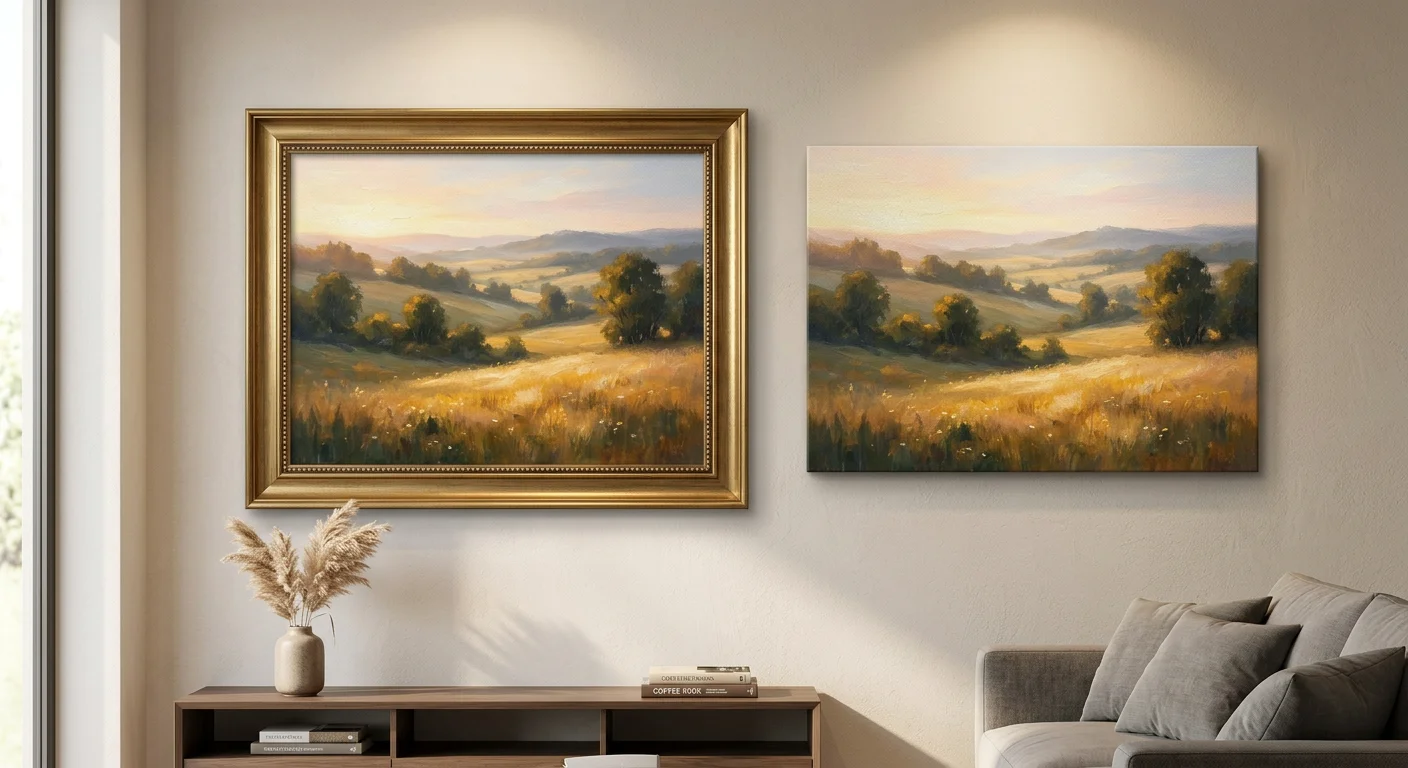
First, let’s get the basics straight—they’re built totally differently, and that sets the tone for everything else.
-
Framed canvas: It’s a printed canvas paired with a decorative frame, which adds sharp visual definition, edge protection, and a formal vibe. The downside? The frame adds extra weight and bumps up shipping costs, and the glass/acrylic cover can create glare.
-
Frameless canvas (gallery wrapped): The image prints edge-to-edge, then the canvas is stretched and stapled over 1.5-inch thick wooden stretcher bars—no frame, no border, just art wrapping around the sides. This gives it a 3D, sculptural look that feels modern and immersive. The 1.5-inch bars are non-negotiable: they keep large pieces tight and prevent sagging over time, the hallmark of a quality gallery wrap.
Cost: Frameless Wins for Budget and Large Sizes

When it comes to money, frameless canvas is the clear winner for most people—especially for larger pieces. Ditching the frame cuts both material and shipping costs, and framed canvas can cost 20–50% more than a comparable frameless piece.
A quick cost benchmark:
-
Under $100 for a large piece? Go frameless.
-
Over 40 inches wide? Frameless is smarter (lighter, cheaper to ship, easier to hang).
-
Only splurge on framed if you need a formal presentation or long-term preservation—its higher price is justified for archival or client-facing spaces.
If you’re a business or furnishing a big space, the savings add up fast: ordering five large frameless pieces can save enough to cover a sixth one, a game-changer for print-on-demand services or commercial interior design.
Visual Impact: Match the Style to Your Space

This is where personal taste and your room’s aesthetic take center stage—there’s no “one size fits all,” just what works for your space.
-
Framed canvas: Polished, finished, and classic. It’s the traditional “gallery wall” look, with borders, matting, and glass/acrylic covers. Perfect for classic, transitional, or formal interiors (think dining rooms with crown molding or office lobbies). The only catch: glare in bright, sun-filled rooms.
-
Frameless canvas: Modern, immersive, and glare-free—you can view it from any angle, in any lighting. The edge-to-edge print and subtle texture fit seamlessly with modern, Scandinavian, industrial, or minimalist spaces (open-concept living rooms, lofts, modern cafes). It doesn’t just hang on the wall—it becomes part of the wall.
Pro tip: Don’t mix styles! A single bold frameless piece anchors a modern room, while a set of framed prints defines a traditional one—mixing creates messy visual tension.
Durability & Protection: Framed for High-Traffic, Frameless for Calm Spaces

Both styles hold up well—if you put them in the right spot. The big difference is protection:
-
Framed canvas: The frame shields edges from dust and bumps, and the glass/acrylic cover protects the print surface. This makes it ideal for high-traffic areas (homes with kids/pets, busy hallways, retail spaces) where wear and tear is inevitable.
-
Frameless canvas: Edges are exposed, so dust can build up and corners can get nicked. But the print itself is tough: fade-resistant inks and scratch-resistant coatings keep it looking sharp for years. Just stick it in low-traffic, humidity-controlled spaces—canvas fibers expand/contract with moisture, which can loosen tension in coastal or damp homes.
Quick Decision Guide: Framed or Frameless?
| Your Situation | Best Choice |
| High-traffic room (kids/pets/busy spaces) | Framed |
| Large piece (>40″) or bright, glare-prone room | Frameless |
| Budget-conscious or ordering multiple pieces | Frameless |
| Formal setting or long-term archival preservation | Framed |
| Modern/minimalist/industrial interior | Frameless |
Wall Printers for Canvas Art Creation

Here’s something that changes the whole conversation: you don’t have to commit to one style. A modern UV wall printer handles both framed and frameless canvas art. It does this with a level of technical precision that would have seemed impossible just a few years ago.
That’s the real shift happening in custom canvas wall decor right now.
One Machine, Every Style
A wall art printing machine like the MaxWave runs on a simple idea: bring the printer to the surface, not the surface to the printer. Direct to wall printing lets you work at scale — full walls, canvas panels, large-format pieces — without the production bottlenecks that come with traditional canvas print workflows.
The specs back this up.
Resolution tops out at 2880 DPI across most models. Select configurations reach 9600 DPI (PE-S80). That level of detail holds up at close range — brush texture, gradient depth, fine linework. This matters a great deal for stretched canvas printing, where the material’s natural grain becomes part of the visual. At frameless gallery-wrapped scale, every pixel counts more.
Speed is just as serious. Standard models output 12–15 square meters per hour. High-performance configurations like The Wall Printer push 860 square feet per hour — about 80 m²/h. Running a canvas printing business or outfitting a commercial interior? That throughput changes what’s financially practical.
Color That Holds Its Ground
Color fidelity is where canvas art display options live or die. The UV CMYK five-color ink system — combined with white ink — delivers vibrant, accurate color across both matte and textured surfaces. Some models support 8-color configurations for an even finer tonal range.
Ink consumption runs 6–10 ML per square meter, with 400 ML tank capacity standard. That’s a clear, predictable cost structure. It matters when you’re quoting custom canvas wall decor for clients or scaling production volume.
UV-cured inks mean the output is scratch-resistant and fade-resistant from the moment it dries. No waiting. No laminating. No second step.
The Intelligence Built Into the Machine
Modern direct to wall printing stands apart from earlier equipment because of the sensor system built into it.
Ultrasonic sensors scan wall surfaces up to 4 inches out. An infrared cross-light positioning system handles alignment with accuracy that manual setup simply can’t match. The machine adjusts for wall slope and height variation on its own — critical for canvas art mounting styles where even slight misalignment looks like amateur work at scale.
The Z-axis travel covers 150 mm of distance from wall, with a spray distance of 0.5–2.0 cm. That range means the same machine works on flat canvas panels, textured wall surfaces, tile, glass, and rice paper. The canvas art doesn’t have to fit the machine’s limitations. The machine adapts.
Setup and Practical Reality
One person. A few minutes. That’s the installation window.
The folding design keeps the footprint compact — 400mm × 320mm collapsed. Power requirements run from 110V to 220V, compatible with mobile power sources. Noise in ready mode stays below 20 dBA.
The 10-inch industrial touch-screen runs the full workflow. Supported file formats include JPG, BMP, TIFF, PDF, AI, PSD, and CDR. Your designer hands off a file and production starts. No format conversion delays. No compatibility issues slowing things down.
For interior wall art decoration projects running on tight deadlines, that kind of simple operation isn’t a luxury. It’s the baseline expectation.
Conclusion
Framed and frameless canvas wall art both have their place—framed for structure, durability, and formality; frameless for affordability, modern style, and scale. The real breakthrough is that you don’t have to pick anymore: a MaxWave UV wall printer turns the framed vs frameless debate into a creative choice, not a logistical one.
Whether you’re a homeowner sprucing up a corner, an interior designer outfitting a hotel, or a business owner running a canvas printing service, MaxWave’s professional wall printing machines give you the flexibility to create exactly what your space (or your clients) need—on demand, at scale, with unbeatable quality.