
Grab two pieces of metal — one aluminum, one steel — and try fusing them together. What you’ll get isn’t a weld. It’s a brittle, crumbling disaster that’ll fail under the first real load you put on it. And yet, manufacturers do it every single day in aerospace, automotive, and heavy fabrication. So what’s the secret?
The question can you weld aluminum to steel has a deeper answer than most welding forums will admit. Traditional arc welding is what most people grab first — and that’s the core reason so many attempts end in frustration. Those methods simply don’t work for this metal pairing.
This guide cuts through the metallurgy, the myths, and the marketing. You’ll see what works in 2026 — and which equipment choices separate clean, durable bonds from expensive scrap metal.
Can You Weld Aluminum to Steel?
The short answer: Yes, but not with your grandfather’s welder.
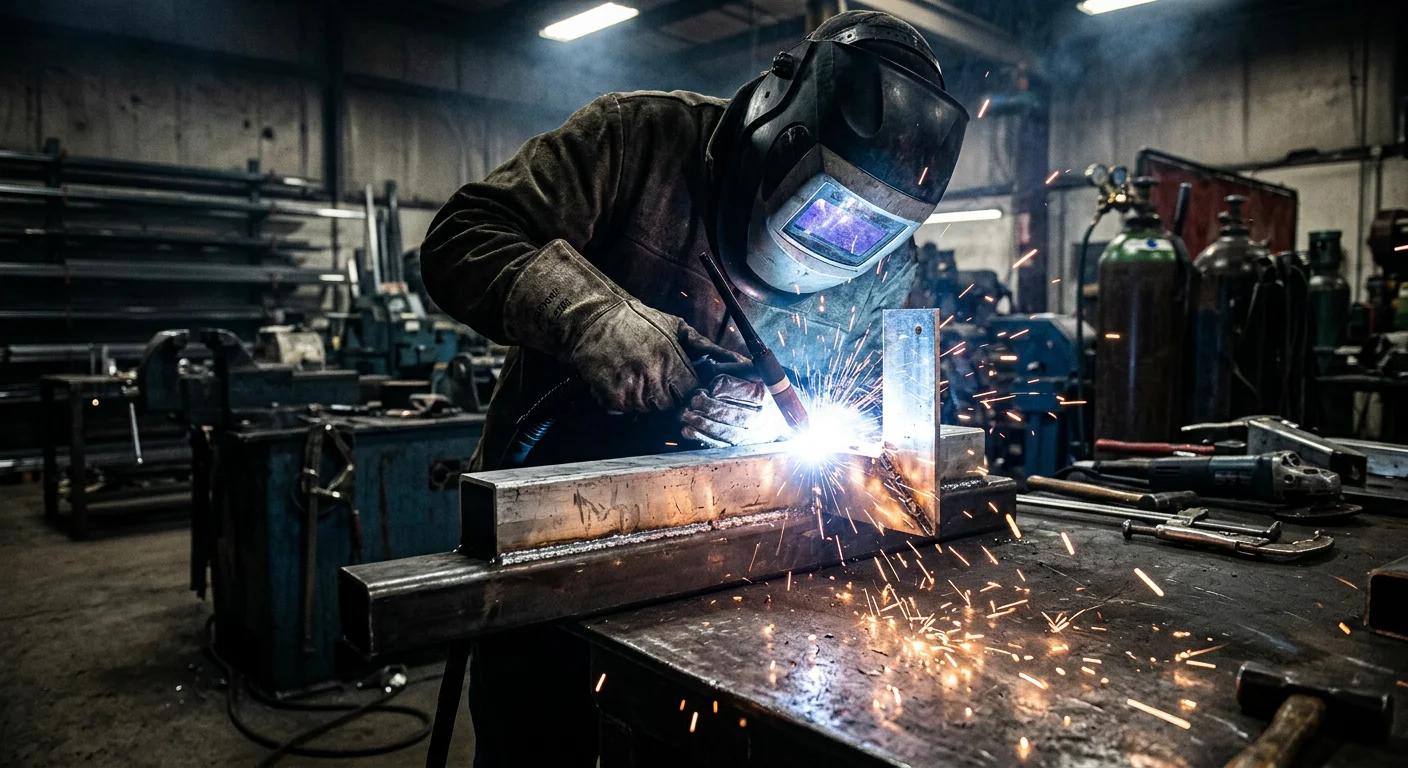
Here is the plain truth: if you try to join them using traditional MIG or TIG, you aren’t creating a bond—you’re creating a time bomb.
Why Traditional Methods Fail
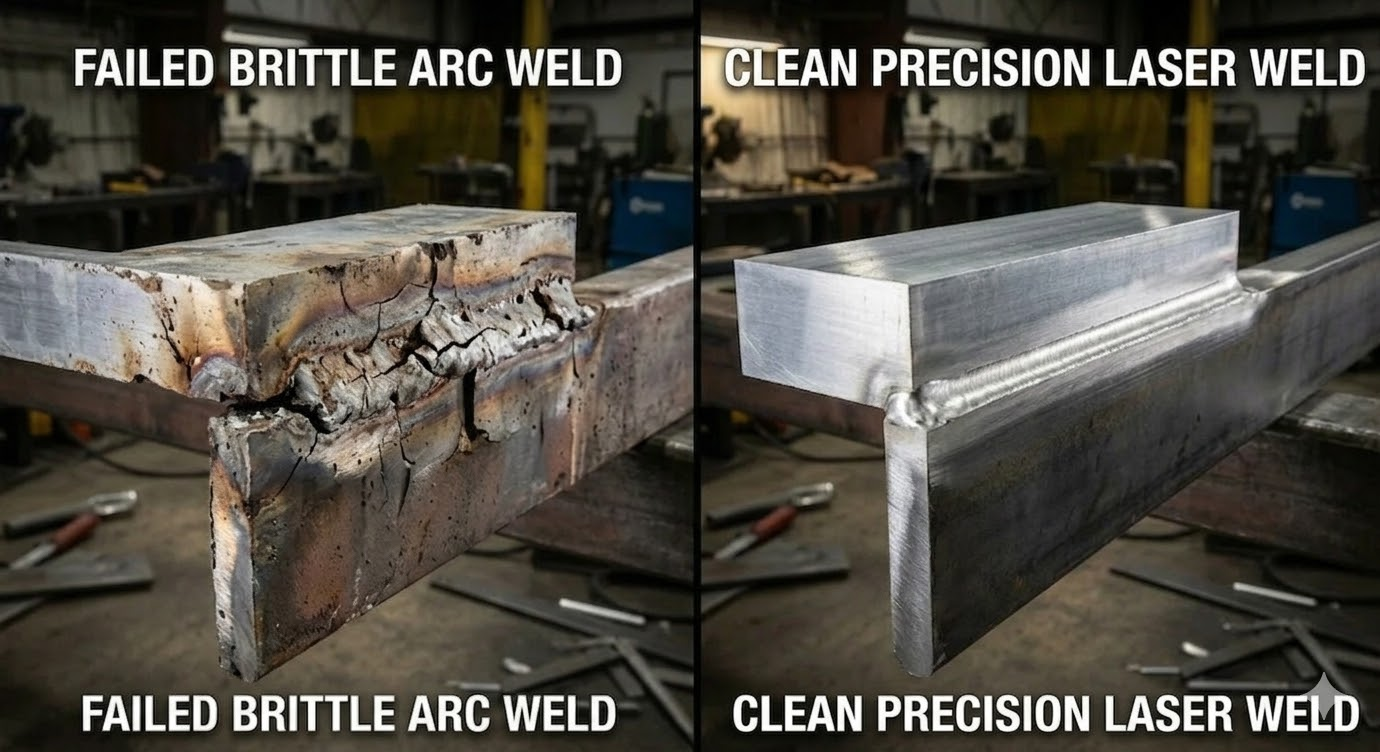
Standard welding melts both metals. When molten aluminum and steel mix, they don’t form a strong alloy; they create a brittle “crust” called intermetallics.
The Analogy: Imagine putting a layer of thin glass between two bricks. It looks attached, but it has zero flexibility. Under load, the joint doesn’t bend—it shatters. This is the primary hurdle for anyone wondering if you can weld aluminum to steel using fusion methods.
How Modern Tech Changes the Game
In 2026, we don’t fight the metallurgy; we outrun it.
Friction Stir Welding: We “knead” the metals together without fully melting them. The joint becomes so strong that the aluminum base metal will snap before the weld does.
Laser Precision: This is the “Special Ops” of welding. A laser beam is so fast and concentrated that the bond is finished before the brittle crust has a chance to grow.
It’s All About the “Flash”
The secret to success in welding aluminum to steel or stainless steel isn’t raw heat—it’s reaction time. Successful methods work because they slash the “heat window.”
By utilizing MaxWave’s 2026-grade control intelligence, we eliminate the failure point entirely. If someone tells you that joining these two metals is “impossible,” they are simply stuck in the past. What used to be a laboratory headache is now a standard, high-margin factory profit center.
Why Traditional Arc Welding Methods Fail: The Metallurgy Behind the Problem
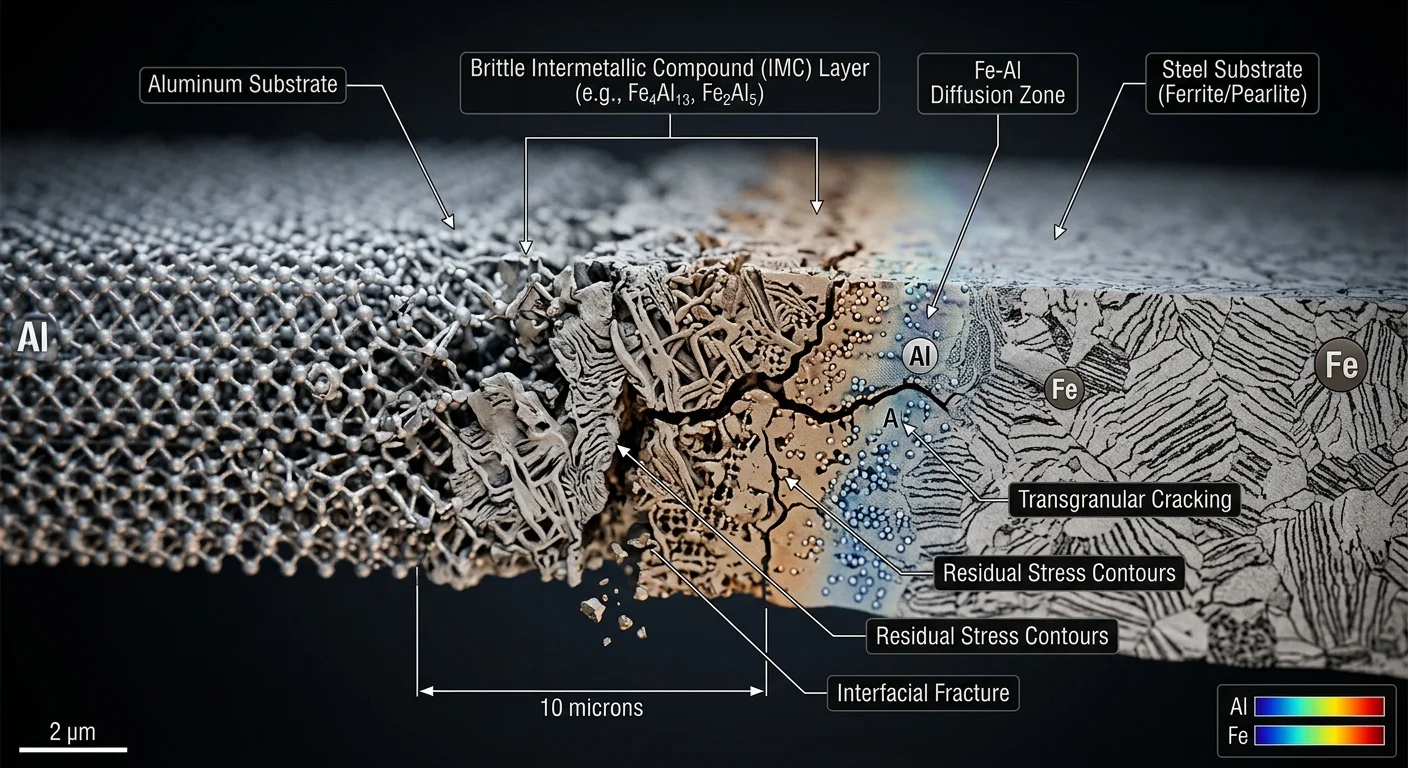
The failure of an aluminum-to-steel arc weld isn’t random. It is driven by fundamental thermodynamics, and the “damage” is usually finalized in under two seconds.
The Brittle IMC Layer: “Glass” Inside Your Weld
When liquid aluminum contacts solid steel under the intense heat of an arc, they react to form a brittle intermetallic compound (IMC) called Fe₂Al₅. This is the primary “joint killer.”
- The 10μm Rule: Engineering data shows that once this layer exceeds 10μm in thickness, the joint loses all ductility and becomes brittle.
- Runaway Growth: Under standard arc heat, this layer grows at a staggering rate of 8μm/s.
- The Reality: In a typical MIG/TIG weld, the IMC layer consistently hits 22μm—more than double the failure threshold. Before a welder moves the torch an inch, the joint has already “crystallized” into a failure.
The Melting Point Gap: An 800°C Incompatibility
Aluminum melts at 660°C, while steel doesn’t reach fusion temperature until roughly 1,500°C. This massive gap creates a physical paradox.
- The Trap: To get the steel surface hot enough to bond, the aluminum must stay in a liquid state for an extended period.
- The Consequence: This prolonged liquid-phase exposure acts as a catalyst, allowing iron and aluminum atoms to migrate and thicken the brittle IMC layer like wildfire.
Thermal Expansion: The 2:1 “Self-Tearing” Effect
Aluminum expands and contracts at a rate of 23.1, while steel sits at 11–13. This is a near 2:1 mismatch—one of the highest in metal fabrication.
- Cooling Conflict: As the weld cools, the aluminum shrinks twice as fast as the steel.
- Locked-in Stress: This contraction creates massive residual tensile stress right at the interface. Since the brittle IMC layer cannot absorb this stress, the joint often cracks internally before it even leaves the cooling bench.
The Oxide Barrier: The Armor That Won’t Melt
Aluminum is naturally coated in Al₂O₃ (Aluminum Oxide), which has a melting point of 2,072°C—three times higher than the aluminum itself.
- Arc Failure: Standard arc welding lacks the concentrated energy density to fully “shatter” this microscopic armor across the entire bond area.
- Defect Loop: Trapped oxide fragments become pockets of porosity. Furthermore, iron oxides on the steel side break down and release oxygen, creating new aluminum oxides inside the weld pool. The problem literally rebuilds itself.
| Parameter | Traditional Arc Reality | Failure Threshold |
| IMC Layer Thickness | Up to 22μm | >10μm = Failure |
| Formation Window | 1.7–2.0 Seconds | Within standard arc dwell time |
| Expansion Ratio | ~2:1 (Al to Steel) | Drives spontaneous cracking |
| Oxide Melting Point | 2,072°C | Survives arc heat intact |
Failure in aluminum-to-steel arc welding isn’t about operator skill or machine quality. It is simply physics doing exactly what physics does. If you use 20th-century tools for 21st-century dissimilar metal challenges, thermodynamics will fail you every single time.
How Will the Experts Weld Aluminum and Steel in 2026?
Today, fiber laser welding is the gold standard for joining these incompatible metals. It’s less like a torch and more like a nanoscale surgical procedure.
The Core Logic: Winning the Race Against Time
The secret to welding aluminum to galvanized steel or stainless steel is thermal velocity.
- Microsecond Temperature Control: The high energy density of a fiber laser allows for extreme welding speeds (typically 3–8 m/min). The weld pool solidifies so fast that the brittle FexAly compounds simply don’t have the time to grow.
- The 5μm Threshold: While traditional arcs often create brittle layers exceeding 20μm, 2026 laser systems consistently keep the IMC layer under 5um. This is well below the 10μm failure threshold, ensuring the joint retains its structural ductility.
The 2026 Game Changer: Beam Oscillation (Wobble Technology)
Modern laser heads in 2026 have evolved beyond simple linear paths; by oscillating the beam in high-frequency patterns such as circles or “figure-8s,” the process achieves a powerful micro-stirring effect. This acts as a high-speed mixer that breaks up the distinct boundary between the aluminum and steel, creating a “mechanical interlocking” interface rather than a flat, weak bond. Furthermore, this wobble technology significantly enhances gap bridging by widening the effective melt pool, allowing the equipment to accommodate real-world manufacturing tolerances without sacrificing the final joint strength.
Laser Braze-Welding: The Art of Not Melting the Steel
This is the dominant process for 2026 EV battery trays and automotive “Body-in-White” applications:
- The Principle: The laser focus is offset toward the aluminum side. The goal is to melt the aluminum (which has a lower melting point) so it “wets” the steel surface.
- The “Glue” Effect: In this mode, the steel remains solid while the molten aluminum acts as a high-strength liquid adhesive. Because the steel never fully melts into the aluminum, the formation of massive brittle phases is stopped at the source.
Real-Time AI Closed-Loop Monitoring: Zero-Defect Manufacturing
In 2026, top-tier laser systems come with integrated “sensory” intelligence:
- Spectral Analysis: Sensors analyze the light emitted from the plasma. If the system detects excessive iron vaporization (meaning the steel is getting too hot), the AI adjusts the laser power in milliseconds.
- Visual Seam Tracking: The system automatically compensates for thermal distortion in the aluminum plate, ensuring the beam stays perfectly positioned for an aerospace-grade finish.
| Parameter | Recommended Setting (1-3mm Sheet) | Primary Objective |
| Laser Type | CW Fiber Laser (Continuous Wave) | Maximum power stability |
| Wobble Frequency | 150 – 300 Hz | Grain refinement & crack inhibition |
| Shielding Gas | 99.99% High-Purity Argon or Helium | Preventing rapid aluminum oxidation |
| Beam Profile | Ring Mode / Adjustable Beam Profile | Reducing center temp to prevent burn-through |
| Gas Delivery | Lateral Cross-Jet + Backside Purge | Evacuating zinc vapors (for galvanized steel) |
For MaxWave customers, laser beam welding isn’t just about “making it stick.” It’s about speed, repeatability, and eliminating post-weld grinding. It turns a “specialty lab process” into a standard, high-yield factory floor operation.
Three Practical Tips for Getting the Job Done (No Fluff)
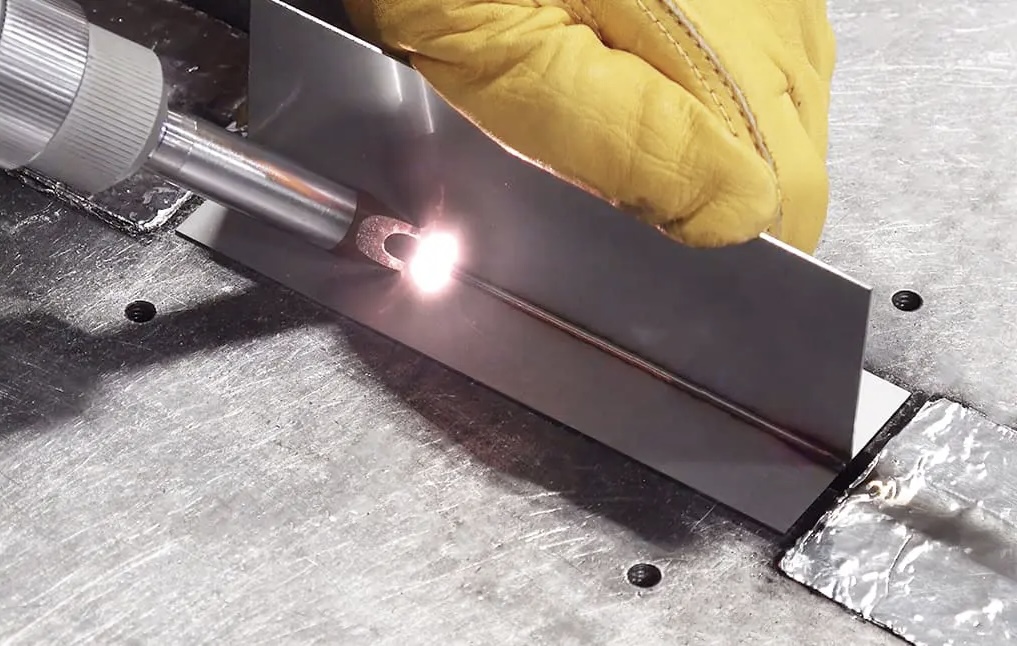
Whether a joint holds or fails isn’t just about your technique in the moment—it’s about the decisions you make before the beam even fires. These three rules are backed by real-world fabrication data and fiber laser welding research, not forum guesswork.
Tip 1: Outrun the “Thermal Death” Window — Speed is Life
Every extra second of heat exposure works against you. The lethal Brittle Intermetallic Layer (IMC) doesn’t wait for you to make a mistake; it starts forming within 1.7 seconds and grows aggressively from there. Your entire workflow must revolve around one goal: Minimizing the Heat Window.
The Laser Rule: Never “dwell” or pause. In aluminum-to-steel work, dwell time is your greatest enemy. Move fast and stay steady.
Pre-Cool the Steel: Ensure the steel workpiece is cool to the touch before starting. A lower surface temperature on the steel side slows down the migration of iron atoms into the weld zone.
Think “Sprints,” Not “Marathons”: Use short, planned laser pulses or segments rather than one long, continuous run. Every time you stop, you let the heat dissipate, preventing the IMC from reaching its “growth spurt” phase.
Tip 2: Surface Prep is Half the Battle — It’s Not a Suggestion, It’s a Law
If you treat surface prep as a five-second afterthought, you are burying your own weld. The Aluminum Oxide layer (Al2O3, with a melting point of 2072°C) begins to reform within hours of cleaning. This isn’t a warning; it’s a hard physical limit.
The “Right Before” Rule: Clean the aluminum surface with a dedicated stainless steel wire brush immediately before welding—not the day before, and not an hour before.
Acetone is Mandatory: Follow the brushing with an acetone wipe to remove skin oils and residual contaminants.
The 30-Minute Window: Aim to finish the weld within 30 minutes of prep. If you miss that window, the oxide has already won. Re-clean or prepare for failure.
Tip 3: Never Let the Beam Hit Bare Steel — Zero Exceptions
This is the one rule experienced aluminum-to-steel fabricators never break. In this specific application, a direct strike on bare steel causes a violent, high-temperature reaction that ruins the joint’s chemistry instantly.
The “Hot Melt” Technique: Direct your laser focus toward the aluminum side. Let the molten aluminum flow onto the steel surface like a high-strength adhesive. The steel should be “wetted” by the aluminum, not melted by the beam.
Aluminum Side First: If you are using bimetallic inserts, always weld the aluminum-to-aluminum side first. Let the entire assembly cool to room temperature before you ever touch the steel side.
One Rule, No Exceptions: A strong joint is built by a technician who never bends the rules. One stray arc on the steel side, and the part is scrap.
Equipment Choice: Don’t Just Check Power — Check the “Brain”
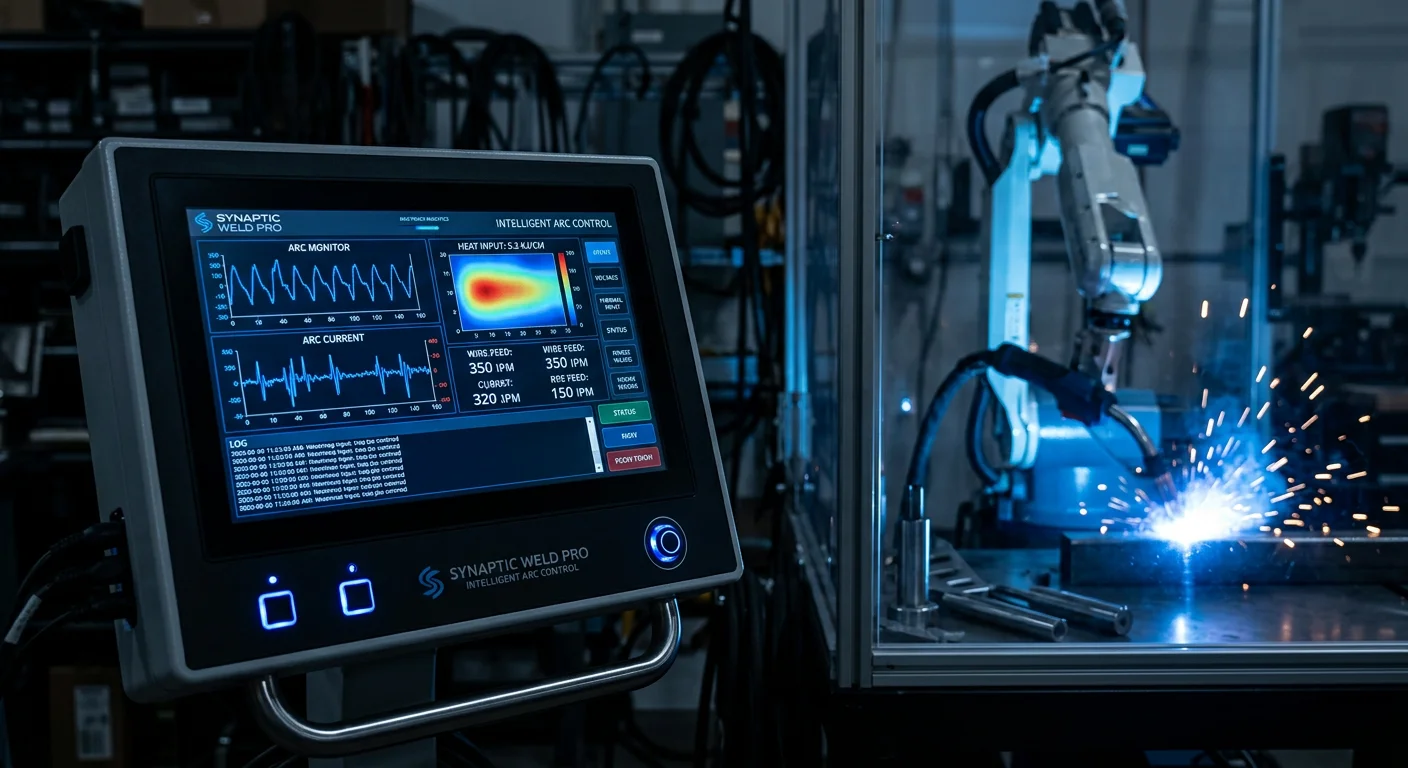
In 2026, the machines winning the aluminum-to-steel laser welding game aren’t winning on raw wattage. They are winning on Control Intelligence.
Adaptive Logic vs. Raw Power
Modern systems built for dissimilar metals use Real-Time Adaptive Processors. They don’t review the weld after it’s done; they monitor the melt pool every single millisecond.
Basic Machines: They deliver exactly what you set, regardless of what’s happening. If the steel starts overheating and the brittle IMC layer spikes, a basic machine won’t stop it.
Smart Machines: They detect thermal drift before it pushes into the “danger zone” (IMC growth) and adjust the laser output on the fly.
The Three Pillars of a “Smart” Controller:
Precision Waveform Shaping: You need a machine that lets you “sculpt” the energy. Programmable pulse waveforms allow you to melt the aluminum thoroughly without ever reaching the melting point of the steel. This is the difference between a structural bond and a “glass” joint.
Microsecond Feedback Loops: Look for closed-loop systems that read plasma behavior and self-correct instantly. Open-loop machines hold a setting while the joint fails underneath; closed-loop machines adapt to the material’s reality.
Thermal Threshold Tracking: Advanced units log cumulative heat input. They flag warnings as you approach the 10 micron limit where Fe2Al5 growth accelerates. This real-time visibility prevents bad welds before they happen.
Don’t Fall for the Low-Price Trap: Check the “Process Library”
The hidden cost of cheap equipment is the “testing tax.”
Budget Machines: You get the hardware, but no instructions. You’ll spend weeks (and thousands in scrap material) trying to find the magic parameters for aluminum-to-steel.
Premium Systems (like MaxWave): They come with Verified Process Libraries. Select your materials and thickness, and the machine loads lab-tested pulse profiles instantly. You aren’t buying a laser welder; you’re buying a finished production line.
Ready to Stop Guessing and Start Joining?
In 2026, the question is no longer “Can you weld aluminum to steel?”—it is a matter of how precisely you can control the science. At MaxWave, we don’t just sell raw power; we provide the “brains,” the fiber laser welding algorithms, and the verified process libraries that turn complex metallurgical hurdles into repeatable profits.
Don’t waste another cent on scrap material. Contact our application engineers today for a free feasibility study or send us your samples for a professional cross-section test. Let’s prove the strength of your next joint together.