
Stainless steel has a reputation for being unforgiving — and it’s earned. The properties that make it corrosion-resistant and beautiful also make it hard to weld. Low thermal conductivity traps heat. It warps and discolors easily. And it has zero tolerance for contamination.
Get it wrong, and you’re looking at sugaring on the back side, a warped panel, or a weld that looks like it was done in the dark. Get it right, and stainless rewards you with clean, strong, professional-grade joints that last decades.
This guide covers the complete picture — whether you’re choosing between a TIG, MIG, or laser setup, dialing in your welding stainless steel parameters for the first time, or troubleshooting discolored welds on 304 stainless steel. You’ll find process comparisons, real settings, common failures, and how to fix them.
How To Weld Stainless Steel: The Ultimate Guide (TIG, MIG & Laser Compared)
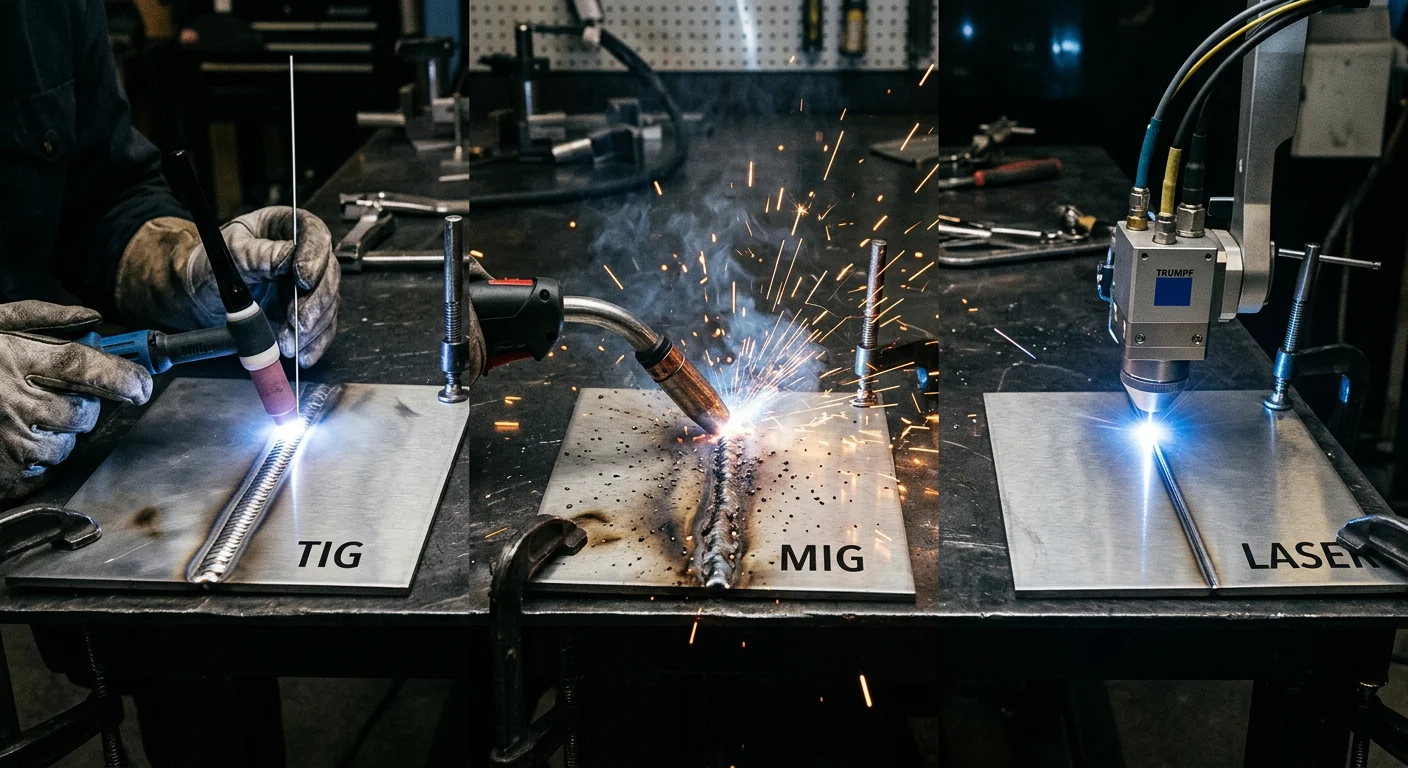
Three processes. One material. Very different outcomes.
This guide covers TIG, MIG, and laser welding across every dimension that matters — speed, distortion, skill level, material thickness, and stainless-specific performance. You get a clear breakdown to help you choose the right process before you strike your first arc.
Here’s what each section covers:
-
Process deep-dives: How TIG, MIG, and laser work on austenitic stainless steel, with real parameters for 304 and 316
-
Head-to-head comparison: Precision, HAZ size, spatter, ease of use, and thickness range — all in one table
-
Settings reference: Dialing in stainless steel weld settings by thickness and process
-
Shielding gas and filler metal: The right stainless steel welding wire and shielding gas for stainless steel combinations
-
Troubleshooting: Stainless steel weld discoloration, warping, and back purging stainless steel — solved
Running thin-gauge panels on a laser? TIG-welding artistic joints on 304 stainless steel? You’ll find the answer you need right here.
Why Stainless Steel Is Harder to Weld Than Regular Steel
Thinking of stainless steel as just “shiny regular steel” is a costly mistake. The physics of the material change the game before you even strike an arc. Here is why stainless is notoriously stubborn:
-
The Heat Trap (Thermal Conductivity): Stainless steel is a terrible heat conductor ($15$–$20$ W/m·K vs. $50$ W/m·K for carbon steel). Instead of flowing away, the heat stays trapped right where you’re welding. This “hot spot” is what causes thin panels to warp like a potato chip and structural joints to crack.
-
The “Shifting” Metal (Thermal Expansion): It expands 30–50% more than regular steel. As the temperature spikes, the metal moves hard and fast. If your heat input isn’t precise, your distortion rates will be 2 to 5 times higher than what you’re used to. That means more time spent straightening parts—or worse, scrapping them.
-
The Chromium Trap (The Ruined Finish): At $400$°C, the chromium that protects your metal starts reacting with air, creating that “rainbow” heat tint. But the real danger is in the $500$–$800$°C zone. This triggers sensitization, where the chromium is sucked out of the metal’s structure. The result? Your “stainless” steel can now rust 100x faster, and the back of your weld turns into a black, crusty mess known as “sugaring.”
The Bottom Line: You aren’t just welding; you’re managing a delicate thermal balance. This is exactly why the “old way” (MIG/TIG) often fails where Precision Laser Welding excels—by getting in and out before the heat can do its damage.
What You Need to Weld Stainless Steel: Equipment, Materials & Safety
Your results are decided before you even strike an arc. Depending on your precision needs and budget, you have three distinct paths:
1. The Equipment: From Tradition to Innovation
-
TIG (The Scalpel): $1,500 – $5,000. Requires tungsten electrodes (2% thoriated or lanthanated), foot pedals, and high-precision gas regulators. Best for artistic, low-volume work.
-
MIG (The Workhorse): $800 – $3,000. The lowest entry price and fastest to set up (under 5 minutes). Great for thick structural steel, but prone to spatter on stainless.
-
Handheld Laser (The Game Changer): Starting at just $3,000. While industrial systems can reach $150,000, modern handheld laser welders have become incredibly accessible. At the $3,000–$8,000 range, you get a tool that is 4–10x faster than TIG, requires zero specialized training, and eliminates nearly all post-weld grinding.
2. The Consumables: Don’t Skimp on the Details
Choosing the right filler metal is non-negotiable. Match your wire to your base material:
-
ER308L: For the common 304 Stainless.
-
ER316L: For marine-grade 316 Stainless.
-
ER309L: For joining stainless to carbon steel.
-
Pro Tip: Ensure your carbon content is below 0.03% to prevent future corrosion.
3. The Gas: Your Shield Against “Sugaring”
-
TIG: 10–20 CFH of Pure Argon.
-
MIG: Ar/2% $O_2$ for clean beads or Ar/25% $CO_2$ for deeper penetration.
-
Back Purge: For any stainless thicker than 1mm, you must use a back-purge gas (5–15 CFH Argon) to prevent the root from turning into a black, crusty mess.
4. Safety: The Non-Negotiables
Expect to spend $300 – $800 on a complete PPE kit. Stainless steel fumes contain Hexavalent Chromium—you don’t want to breathe that in.
-
Respirator: NIOSH P100 rated.
-
Helmet: Auto-darkening, Shade 9–13 (For Laser, you need specific OD7+ Laser Safety Goggles).
-
Gloves: Flame-resistant leather rated for 1000°F.
How to Prepare Stainless Steel for Welding (The Step Most Beginners Skip)
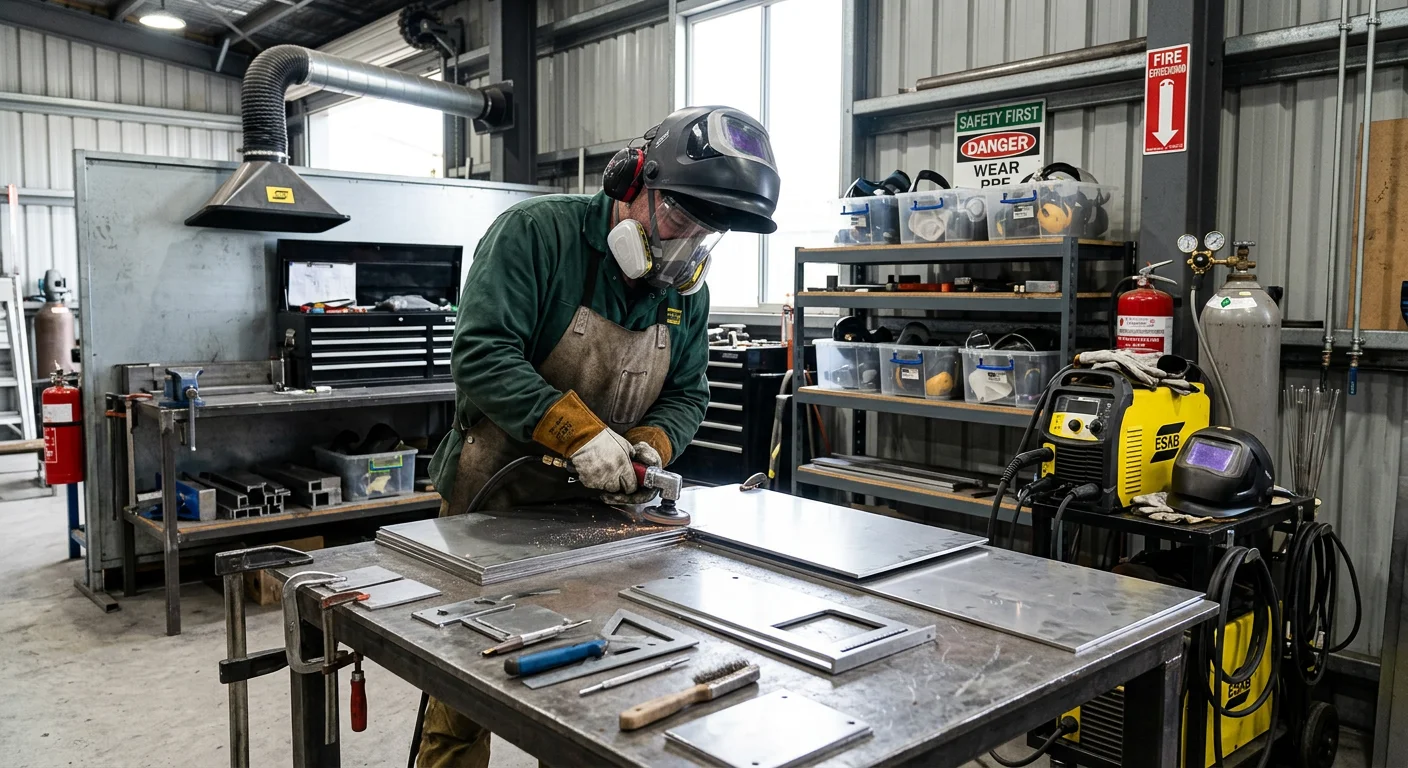
Bad welds start before the arc does.
Most beginners lose the battle at prep — and with stainless steel, there’s no room for error. Contamination doesn’t just hurt appearance. It breaks down corrosion resistance at the molecular level.
Clean It Like You Mean It
Wipe every surface with acetone first. No moisture. No grease. No exceptions.
Then grab your brush — but use a stainless steel wire brush, not carbon steel. Carbon steel tools drop tiny particles onto the surface. Those particles embed and trigger oxidation. That defeats the whole point of welding stainless.
Keep dedicated tools for stainless work. Store them separate from your carbon steel tools to avoid cross-contamination.
Joint Setup and Heat Strategy
If you are just learning how to weld stainless steel, start with flat or horizontal butt welds. Gravity helps hold the puddle in place, giving you far more control over the arc.
On thicker stock, bevel your edges to 60 degrees. Run multiple passes instead of pushing more amperage. High heat is the enemy here. Stainless warps faster than most people expect.
Run lower amperage than you would on mild steel — about one-third less. Distortion shows up? You’re already running too hot.
Step-by-Step TIG Welding Stainless Steel (GTAW)
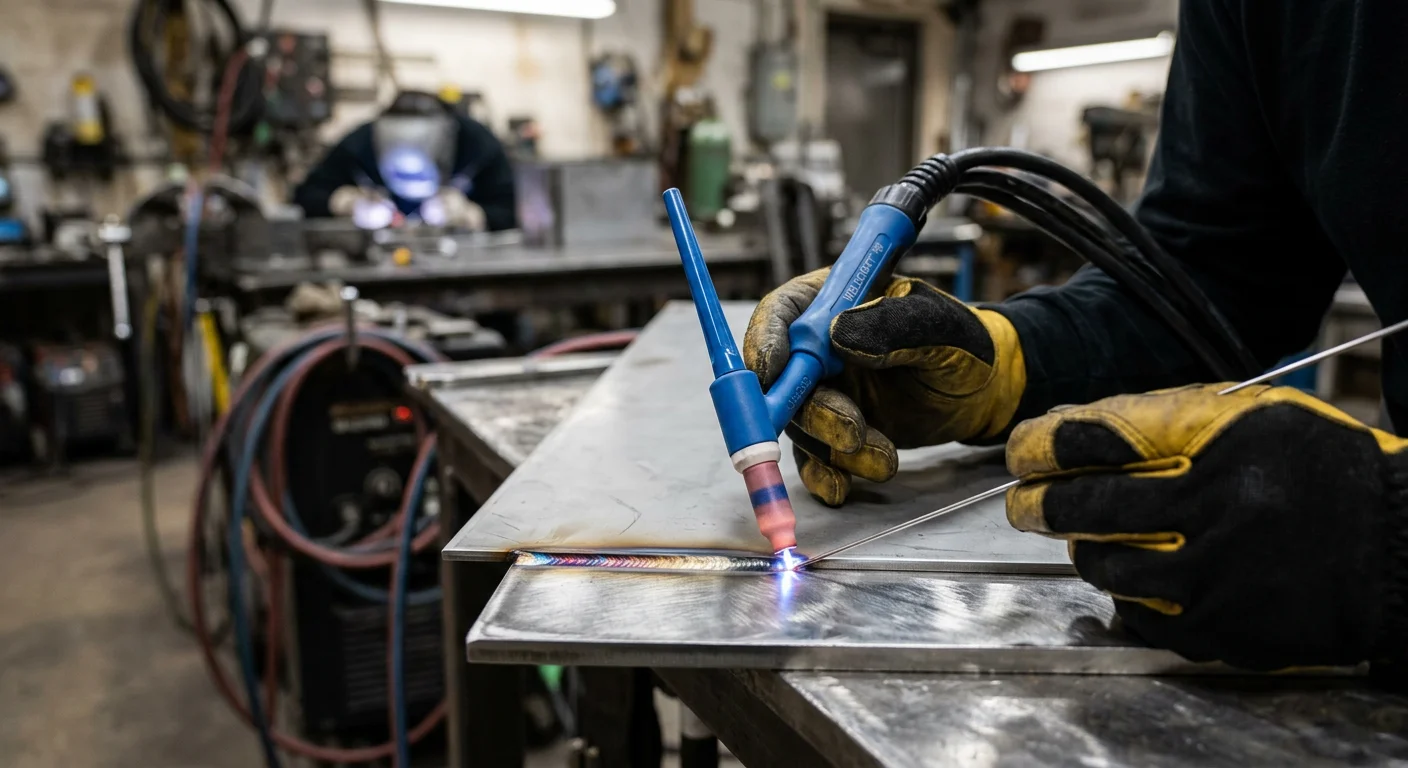
TIG welding is like surgery on metal. It requires extreme precision—which is exactly why it’s the gold standard for stainless steel. Every variable is in your hands: heat input, travel speed, and filler metal.
Done right, you get a beautiful, “rainbow” stack of dimes. Done wrong, every mistake is visible. Here is how to master it.
1. Prep Your Tungsten: The “Needle” Tip
-
The Right Electrode: Use a 2% Lanthanated Tungsten (Blue Tip). It holds a stable arc and resists contamination better than pure tungsten.
-
The Grind: Use a 200-grit wheel to grind it to a sharp point. Grind longitudinally (lengthwise), not in circles. The taper should be about 2.5 times the diameter of the electrode.
-
Stick-out: Your needle should not stick out more than 1/4 inch past the edge of the gas cup.
2. Striking the Arc: Keep it Tight
-
The Setup: Set your machine to DCEN (Direct Current Electrode Negative) and use High-Frequency (HF) start.
-
Pre-flow: Set a 1-second pre-flow of Argon. This clears the oxygen out of the cup before the spark jumps.
-
Angles: Hold your torch at a 70° angle. Feed your filler wire at a shallow 10–25° angle.
-
The Golden Rule: Keep your arc length tight—about 1/8 inch (3mm). If the arc is too long, the heat spreads out, and you’ll burn the “stainless” right out of the steel.
3. Control the Heat: It’s All in the Foot Pedal
-
Watch the “Puddle”: The puddle should be the size of your material thickness. If the puddle starts to grow and look “watery,” it’s getting too hot. Ease off the pedal immediately and speed up your travel.
-
Find Your Rhythm: “Dab” the filler wire with a steady beat. Experienced welders aim for 30–35 dabs per minute for a consistent bead.
-
The Finish: Don’t just pull the torch away when you’re done. Slowly taper off the pedal and keep the Argon flowing (post-flow) until the weld and the tungsten have cooled down.
4. Quick Settings for 304/316 Stainless
|
Thickness |
Amperage |
Tungsten |
Filler |
Gas Flow |
|---|---|---|---|---|
|
~2.0mm (0.08″) |
50–80A |
3/32″ |
Slightly thinner than base |
20–30 CFH |
Pro Tip: Use ER308L for 304 stainless and ER316L for 316. The “L” stands for Low Carbon, which is your best defense against rust.
5. Don’t Forget the Backside (Back Purge)
Stainless steel is famous for “Sugaring”—that black, crusty oxidation on the back of the weld.
-
Back Purging: If you are welding pipe or thin sheets, you must fill the back of the joint with Argon.
-
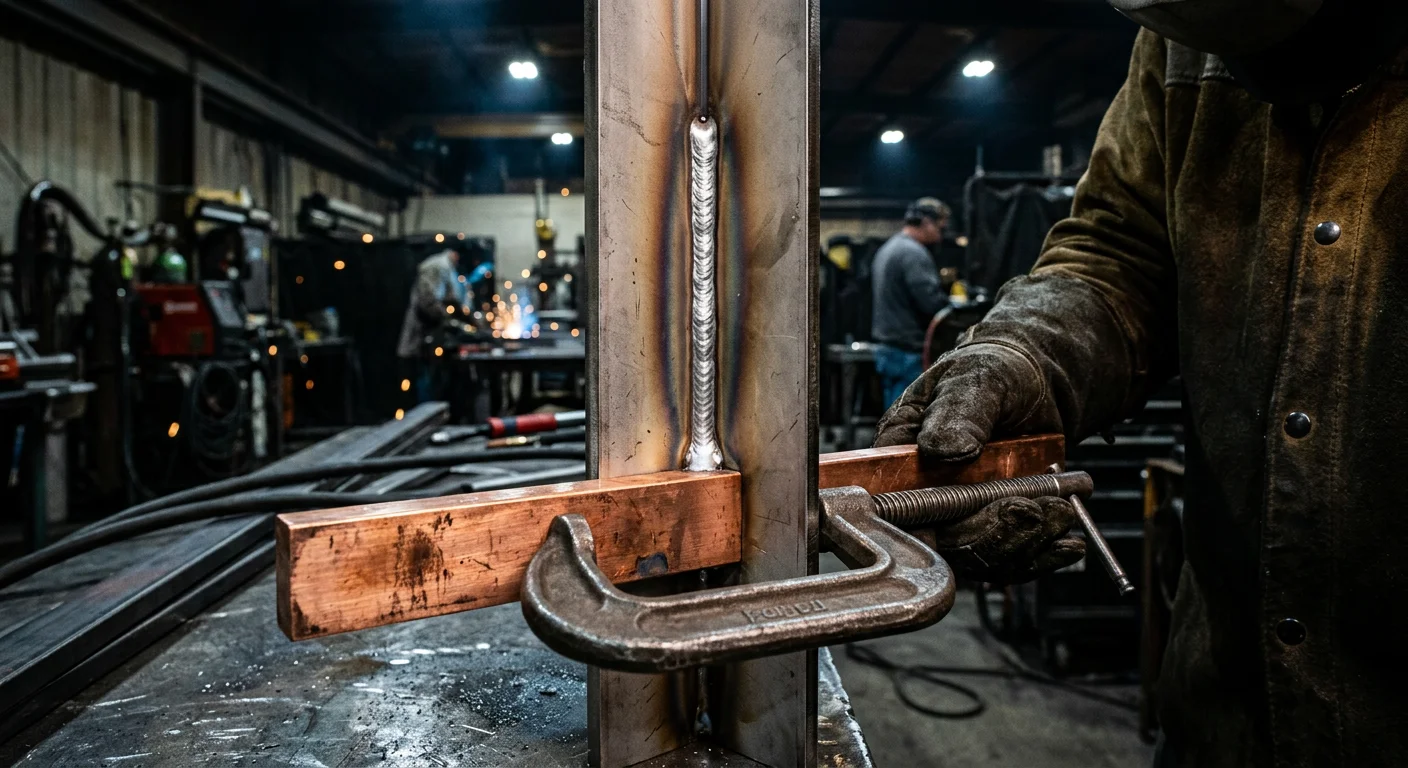
The “Heat Sink” Hack: If you can’t purge with gas, clamp a Copper or Aluminum backing bar tightly against the back of the seam. These metals act like “fire extinguishers” for heat, soaking it up before it ruins the backside of your weld.
Step-by-Step MIG Welding Stainless Steel (GMAW)
MIG welding is the workhorse. It’s faster than TIG and more affordable than Laser. But don’t let the ease of “point and shoot” fool you—stainless steel is less forgiving than mild steel. If your settings are off, it will warp, spatter, and rust.
Here is the “No-Nonsense” guide to doing it right.
1. The Setup: Wire & Gas
Don’t just grab whatever wire is in the shop. Match your wire to your metal:
-
The Wire: Use ER316LSi. The “Si” stands for silicon, which helps the molten metal flow smoother and leaves a cleaner finish.
-
Thin Sheet (0.5–0.7mm): Use 0.6mm wire.
-
Medium Stock (0.8–1.2mm): Use 0.8mm wire.
-
Heavy Duty (1.5mm+): Use 0.9mm wire.
-
-
The Gas: You need a specific mix. Plain CO2 will make your stainless rust. Run 98% Argon / 2% Oxygen. That tiny bit of oxygen is the “secret sauce” that stabilizes the arc without ruining the finish.
-
Stick-out: Keep about 10–12mm of wire sticking out from the nozzle. Too short? You’ll overheat the tip. Too long? The arc will dance around and lose focus.
2. The Technique: Push, Don’t Pull
-
The Angle: Hold a 10–15° PUSH angle. You want to push the shielding gas ahead of the weld pool to keep the air out.
-
Move Fast: This isn’t carbon steel. You need to move fast. If you linger too long in one spot, the heat builds up, and the metal will warp like a pretzel.
-
Pro Tip: If your machine has a “Pulsed MIG” setting, use it! It’s like a heartbeat for your welder—it lets the metal cool down between every drop of wire, which is a lifesaver for thin sheets.
-
3. Pro Secret: Stringers, Not Weaves
Forget the “fancy” zig-zag or C-pattern weaving you do on regular steel. On stainless, run straight lines (Stringer beads). Weaving spreads the heat too wide, which is the #1 cause of warping. Keep it thin, keep it fast, and keep it straight.
4. Troubleshooting: Fast Fixes for Common Headaches
|
Problem |
Likely Cause |
he “Quick Fix |
|---|---|---|
|
Too much spatter |
Voltage is too high |
Turn down the volts and wire speed. |
|
“Cold” weld (No fusion) |
Not enough heat |
Bump up the voltage or slow down slightly. |
|
Burn-through |
Moving too slow |
Speed up! Or switch to Pulsed MIG. |
|
Warping |
Too much heat |
Use clamps and “Tack” the metal every few inches. |
Step-by-Step Laser Welding Stainless Steel

If TIG is a manual scalpel and MIG is a hammer, Laser Welding is a precision laser-guided missile. It’s the only method that rewards you with professional results even if you’ve never held a torch before.
The physics are simple: The beam is so focused ($0.2$–$0.6$mm) that the heat goes only where it’s needed. The result? A Heat-Affected Zone (HAZ) so small that warping is practically eliminated.
1. Choose Your “Secret Weapon” Mode
Two modes define how you weld stainless steel with a laser:
-
Conduction Mode (For Thin Sheets): Perfect for material under 1mm. It melts the surface gently for a flawless, aesthetic finish.
-
Keyhole Mode (For Deep Power): This “punches” through the metal, allowing you to weld up to 4mm in a single pass. No more multi-layer MIG welding; just one zip and you’re done.
2. The “Point-and-Shoot” Process
Step 1: The Fit-Up (Crucial!)
Laser beams are tiny, so they don’t like gaps. Clean your edges until they shine.
-
Pro Tip: If you aren’t using filler wire, keep your gap under $0.1$mm. If you use the auto-wire feeder, you can handle gaps up to $0.5$mm.
Step 2: Dial in the Power
Here is a quick cheat sheet for a standard 800W–1200W MaxWave system:
|
Thickness |
Power Setting |
Scan Frequency |
Wire Speed |
|---|---|---|---|
|
0.5mm |
23–30% |
100–150 Hz |
No wire needed |
|
1.0mm |
38–40% |
100 Hz |
15–18 mm/s |
|
2.0mm |
45–50% |
40 Hz |
10–12 mm/s |
|
4.0mm |
75% |
25 Hz |
6 mm/s |
Step 3: The Weld (The Fast Lane)
Move the torch at a speed of 50–150mm/s. You’ll notice it feels 4x to 10x faster than TIG. Keep your shielding gas (Argon or Nitrogen) flowing at $20$ L/min to keep the weld silver and bright.
Step 4: Inspect & Relax
Because the heat is so concentrated, you’ll have zero warping and almost no spatter. In most cases, you can skip the grinding wheel entirely. Just wipe it down, and it’s ready for the customer.
TIG vs MIG vs Laser: Head-to-Head Comparison (Which One Is Right for You?)
The right process isn’t some abstract choice. It comes down to your hands, your budget, and what you’re building.
Here’s how all three stack up on stainless steel:
|
Dimension |
TIG |
MIG |
Laser |
|---|---|---|---|
|
Speed |
Slowest (baseline) |
2–4x faster |
4–10x faster |
|
Weld Quality |
Excellent, precise |
Good, moderate cleanup |
Smooth seams, 70% smaller HAZ vs MIG |
|
Distortion |
Moderate |
Higher |
90% less on thin sheet |
|
Thickness Range |
Thin to 5/8″ |
Very thin to 1/2″+ |
0.1mm to 5/16″ (up to 25mm high-power) |
|
Skill Required |
High — hardest to learn |
Moderate — 1–2 weeks |
Lowest — 1–2 days |
|
Post-Weld Cleanup |
Moderate grinding |
High (spatter) |
Minimal — 80% less grinding |
|
Equipment Cost |
$1,500–$5,000 |
$800–$3,000 |
$3,000+ (dropping fast) |
Which Process Fits Your Situation
You’re a beginner or DIYer → Go laser. Two days of training gets you there. Clean results every time. Forgiving on thin hobby metals.
You run a small fab shop → MIG is the smart pick. Low entry cost. Handles mixed thicknesses. No specialist needed.
You weld food-grade or medical stainless pipe → TIG, no question. No other process gives you that level of control on thin-wall joints.
You need precision on thin sheet → Laser wins here. A 70% HAZ reduction and near-zero distortion — the numbers speak for themselves.
You’re in high-volume production → Laser is worth the upfront cost. It cuts energy costs by 60%, drops argon use by 50%, and gives you 20,000+ hours of source life.
One real caveat: laser struggles past 1/2″ thick material. Poor fit-up also hurts results fast. For those conditions, arc processes — TIG and MIG — still hold the edge.
Stainless Steel Welding Parameters Quick-Reference Chart
Stop guessing. These numbers work.
Pull the right setting for your thickness and process, dial it in, and weld.
TIG Parameters — 304/316 Stainless (DCEN)
|
Thickness |
Amperage |
Voltage |
Travel Speed |
|---|---|---|---|
|
0.8–1.6 mm |
20–40 A |
10–14 V |
50–80 cm/min |
|
1.6–3.2 mm |
40–60 A |
14–18 V |
30–50 cm/min |
|
3.2–6.4 mm |
60–80 A |
14–18 V |
20–30 cm/min |
MIG Parameters — Stainless Sheet
|
Thickness |
Wire Dia |
Voltage |
Current |
|---|---|---|---|
|
1.0 mm |
0.6–0.8 mm |
16–18 V |
30–40 A |
|
2.0 mm |
0.8–1.0 mm |
18–20 V |
40–90 A |
|
4.0 mm |
0.8–1.2 mm |
22–24 V |
120–150 A |
|
6.0 mm |
0.8–1.2 mm |
26–28 V |
180–210 A |
Laser Welding Parameters — MaxWave Handheld Series (1200W)
|
Thickness |
Laser Power |
Scan Frequency |
Travel Speed |
Wire Feed (Optional) |
|---|---|---|---|---|
|
0.5–1.0 mm |
25%–40% |
150 Hz |
60–120 cm/min |
No wire needed |
|
2.0 mm |
45%–55% |
80 Hz |
40–60 cm/min |
10–15 mm/s |
|
4.0 mm |
70%–85% |
40 Hz |
15–25 cm/min |
5–8 mm/s |
Special Cases Worth Flagging
Duplex 2205: Cap heat input at 1.0–2.5 kJ/mm. Keep interpass temp under 150°C. Use ER2209 filler — no substitutes.
Stainless-to-carbon steel: Run ER309L. It has a higher Cr/Ni content. That higher content stops dilution cracking at the joint interface.
7 Most Common Stainless Steel Welding Problems (And How to Fix Them)
Every stainless weld that fails leaves evidence. Read it well, and you’ll stop repeating the same mistakes. Understanding these defects is the fastest way to master how to weld stainless steel with industrial-grade consistency.
1. Hot and Cold Cracking
Hot cracks appear the moment the weld solidifies — above 1000°F, right in front of you. Cold cracks are trickier. They show up hours or even days after the weld cools. Hydrogen trapped in the joint drives them. Thick sections are at higher risk because residual stresses build fast.
Fix it: Match your filler metal to your base material. Preheat thick sections before welding. Use post-weld stress relief annealing when the job calls for it.
2. Porosity
Porosity means gas got trapped. The usual suspects:
– Poor shielding gas coverage
– Damp electrodes
– Surface contamination
– Flux moisture in flux-cored wire
Fix it: Clean your base metal well. Keep electrodes dry. Add nitrogen to your shielding gas — it beats straight argon for cutting down porosity. Slow your travel speed and raise your push angle for better arc control.
3. Weld Discoloration
Gold, brown, blue — each color points to deeper chromium oxidation and real corrosion resistance loss. In food processing or medical fabrication, that’s not a cosmetic issue. It’s a compliance failure.
Fix it: Back purge with argon. Keep heat input low. After welding, use pickling paste or passivation treatment to restore the surface.
4. Lack of Fusion and Incomplete Penetration
A root face that’s too thick. A gap that’s too narrow. A bevel angle that’s too small. Any one of these blocks full penetration.
Fix it: Dial in your root gap and face dimensions. Increase arc energy. Size your electrode to match the joint.
5. Distortion and Warping
Stainless conducts heat at about one-third the rate of carbon steel. Heat doesn’t spread — it concentrates in one spot. That leads to uneven expansion and contraction, which pulls panels out of square fast.
Fix it:
– Use short weld passes
– Clamp copper or brass backing bars behind the seam to draw heat away
– Backstep or stagger your welds
– Let the joint cool down between passes before running the next one
6. Sensitization (Carbide Precipitation)
Too much heat in the 500–800°C range causes chromium carbides to form along grain boundaries. Local chromium drops below the 12% mark. Corrosion resistance breaks down — a serious issue in pipeline, marine, and chemical environments.
Fix it: Go with low-carbon grades like 304L or 316L, or stabilized grades like 321 or 347. Watch your interpass temperatures and keep them in check.
7. Sugaring on the Back Side
This came up earlier, but it’s worth saying again. Black oxidation scale on the weld root means your back purge failed — or you skipped it altogether.
Fix it: Run argon back purge at 5–15 CFH. Check the root after welding. Silver means clean. Black means start over.
Welding Stainless Steel: Post-Weld Treatment & Finishing
The weld bead is done. That doesn’t mean the job is.
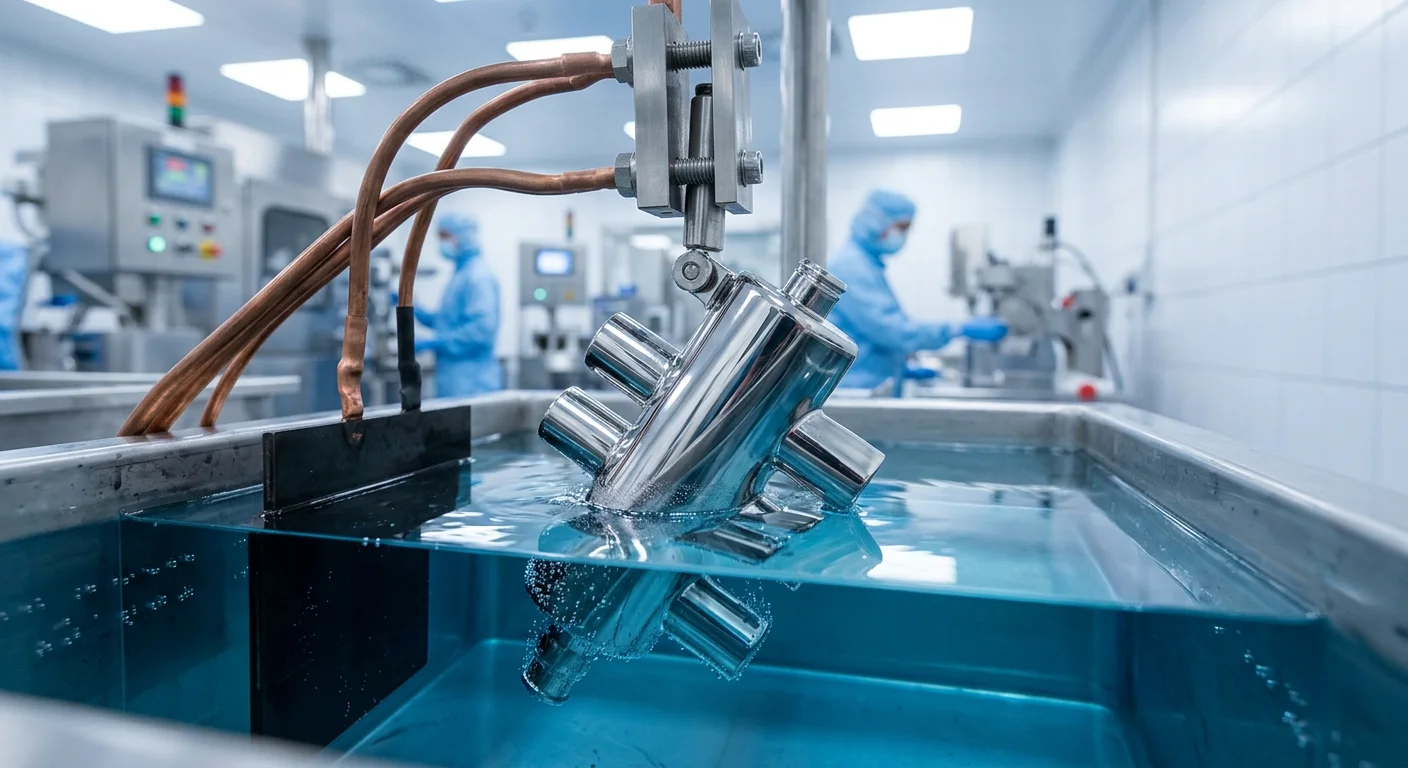
Untreated stainless steel — left in the as-welded state — holds just 28% of its corrosion resistance at 212°F. Post-treatment brings that back to 100%. That gap is the entire argument for post-weld finishing.
Acid Pickling and Passivation
Here’s the standard restore sequence:
-
Degrease the surface — remove all oils and contaminants
-
Apply pickling solution — 10–30% HNO₃ + 2–10% HF — at 60–80°C for 10–60 minutes
-
Rinse with clean water — no residue left behind
-
Passivate with 20–50% HNO₃ at 50–60°C for 30 minutes
-
Final rinse and dry
Full PPE is required at every step. HF absorbs through skin fast. Gloves, goggles, and proper ventilation are non-negotiable — no exceptions.
Mechanical vs. Electrolytic Polishing
|
Method |
Surface Ra (μm) |
Best For |
|---|---|---|
|
Mechanical grinding |
0.8–3.2 |
Weld toe fatigue improvement (+30–60%) |
|
Electropolishing |
0.1–0.4 |
Medical, food-grade, complex geometries |
Food and pharma applications need Ra ≤ 0.4 μm. Electropolishing hits that target. It also adds zero mechanical stress to the part — a clear advantage over grinding.
FAQ: Stainless Steel Welding Questions Answered
Real questions, straight answers — no filler.
Do I need to preheat stainless steel before welding?
For sections under 5mm, skip it. Thicker stock needs 200–300°C preheat. This cuts residual stress and slows the cooling rate.
Which filler metal works for austenitic stainless steel?
Use electrodes with 3–5% ferrite content. This stops sigma phase from forming. It also keeps corrosion resistance intact.
What causes cracking in thick stainless sections?
Coarse grain growth in the HAZ. Keep heat at or below 250°C to control it. Also, consider filler additions like aluminum or vanadium.
Is back purging always required?
On pipe and structural welds above 1mm, yes. Argon at 5–15 CFH prevents root oxidation every time.
Which welding code applies to stainless steel work?
AWS D1.6 and EN 1011-3:2000 are the main references. For marine work, ABS requirements also apply.
Conclusion
Stainless steel doesn’t forgive shortcuts—but it rewards preparation.
Whether you choose the artistic precision of TIG, the speed of MIG, or the game-changing efficiency of a handheld laser, the fundamentals of how you weld stainless steel remain the same: clean metal, correct shielding gas, and disciplined heat control.
But here’s the reality: While tradition demands years of practice, innovation demands only the right tool. If you are tired of fighting heat distortion, spending hours on post-weld grinding, or losing parts to “sugaring,” it’s time to change the game.
Still struggling with the perfect setup? At MaxWave, we don’t just sell equipment; we deliver productivity. Our handheld laser systems are designed to help you weld stainless steel 4x faster with nearly zero warping—even if you’re not a master welder.
Contact our engineering team today for a free consultation. Let us help you find the perfect MaxWave solution to take the headache out of your next stainless steel project.