
Every year, rust costs global manufacturers billions in scrapped parts, delayed production, and acid baths that slowly eat away at the metal they’re meant to clean. Laser cleaning machines are changing that.
A focused fiber laser beam removes rust, oil, and coatings from metal surfaces without contact — and without damaging the substrate. This guide helps you quickly understand: How does laser rust removal work? Which power level do you need? And how much can it actually save you?
Why Is Laser Cleaning Smarter Than Sandblasting?
.webp "New Industrial Rust Removal: Laser Cleaning Machine In Metal Processing 1")
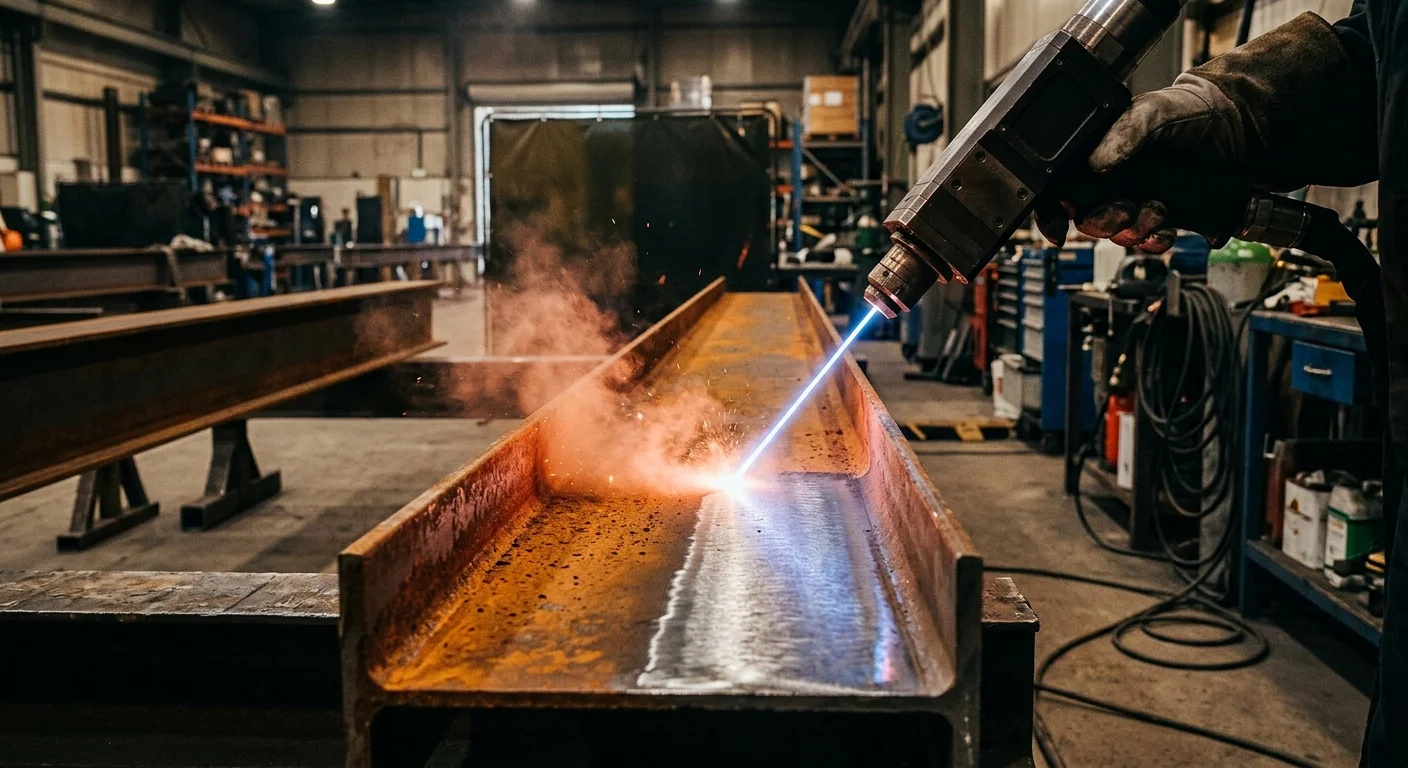
Traditional sandblasting or chemical cleaning trades one problem for another — removing rust but also wearing down the base metal and generating hazardous waste. Laser cleaning works through thermal selectivity:
-
The laser wavelength (e.g., 1064nm) is strongly absorbed by rust (Fe₂O₃), which instantly vaporizes.
-
The underlying metal substrate reflects most of the laser energy, staying largely unaffected.
-
Micro-plasma and shock waves blast the contamination off the surface.
The result: Rust is gone, but the base metal remains intact. For thin sheets under 30mm, precision molds, or aerospace aluminum parts, this is a level of precision sandblasting can never achieve.
Three Core Advantages: Why Factories Are Switching
|
Aspect |
Laser Cleaning |
Sandblasting / Chemical |
|---|---|---|
|
Substrate Damage |
None |
Thinning, micro-pitting, stress |
|
Consumables Cost |
Electricity only |
Ongoing media & chemicals |
|
Waste Output |
Dry powder (non-hazardous) |
Hazardous waste (high compliance cost) |
|
Operating Cost/Hour |
$27 |
$73.50 |
-
Cost drastically reduced: Laser cleaning runs at just $27/hour vs. $73.50 for sandblasting. Over five years, a 200W laser system costs 20-40% less than sandblasting — saving over $20,000 in consumables alone.
-
Throughput increased: One Chinese plant cut pre-weld prep time by 40% after switching. Large structural parts that took days now take hours.
-
Zero consumables, zero hazardous waste: No abrasives. No acids. No chemical disposal. Fully compliant with ISO 14001 environmental standards.
How to Choose the Right Power: A Simple Guide
Choosing the wrong power is the most expensive mistake. Remember this rule: Match power to rust thickness — bigger is not always better.
|
Power Range |
Best For |
Speed Reference |
Price Range |
|---|---|---|---|
|
50-500W |
Thin sheets (<2mm), molds, light rust, precision parts |
100W: 20-30 cm²/s |
$5,000-25,000 |
|
1000-3000W |
Ship plates, pipelines, heavy rust (>5mm), heavy industry |
2000W: Several m²/hour |
Mid-to-high |
|
Handheld |
Irregular parts, on-site repair, parts under 1m² |
Flexible; note >100W requires water cooling |
Custom |
|
Automated |
Assembly lines, robotics, high-volume production |
Highest efficiency |
Inquire |
Power is the core configuration basis:
-
50W–500W: For thin metals, precision parts, light rust and small-batch processing.
-
1000W–3000W: For heavy rust, mill scale, large steel structures and high-volume production.
Configuration selection:
-
Handheld type: Flexible for on-site, irregular parts and mobile services.
-
Automated/robotic type: For assembly lines, fixed processing and high-standard production.
Prioritize beam quality, pulse frequency, cooling system and after-sales support when selecting equipment.
Key Applications & ROI Performance
__1_.webp "New Industrial Rust Removal: Laser Cleaning Machine In Metal Processing 2")
Laser cleaning machines deliver outstanding ROI in metal processing scenarios:
-
Automotive manufacturing: Weld seam prep, battery tray cleaning, improve welding quality and production efficiency.
-
Mold maintenance: Non-destructive cleaning of injection and tire molds, no disassembly needed, extending mold service life.
-
Shipbuilding & heavy industry: Rust removal for hulls, decks and steel structures, suitable for large-area on-site treatment.
-
Pre-weld surface treatment: Remove oxides and contaminants, enhance coating adhesion and welding stability.
-
Aerospace & precision parts: Contaminant removal without changing tolerances, ensuring product stability.
For small and medium manufacturers, payback period is 12-24 months; for large-scale processing enterprises, it can be shortened to 1 year. Many operators expand into mobile cleaning services, charging $80–250 per hour for extra revenue.
Safety and Standards Cannot Be Ignored
Industrial-grade laser cleaning machines are Class 4 laser products and require comprehensive safety protocols. This includes appointing a Laser Safety Officer (LSO), adhering to international standards like ANSI Z136.1 / IEC 60825, implementing engineering controls (e.g., protective enclosures, interlocks), and equipping operators with wavelength-specific laser safety goggles and protective clothing.
Buyer’s Checklist: What to Ask Every Supplier
Buying a laser machine means buying a long-term solution. Verify these five points before you commit:
-
Certifications: CE, FDA (mandatory for Class 4 lasers), ISO 9001. Missing any increases your liability risk by ~30%.
-
Real-world case studies: Does the supplier have 5+ years of proven results in your industry (automotive, marine, molds)?
-
After-sales terms:
-
Local technical response < 24 hours?
-
Spare parts delivered within 7 days?
-
Global service coverage across 50+ countries?
-
-
Key specs: Beam quality M² < 1.3; Pulse frequency > 50kHz (keeps heat-affected zone under 0.1mm).
-
Warranty & lifespan: Fiber optic life? Whole-machine MTBF > 10,000 hours?
Conclusion
Transitioning from sandblasting pits to precision laser beams is more than a technology upgrade; it’s a complete redefinition of industrial rust removal. Laser cleaning machines eliminate the inherent drawbacks of traditional processes, delivering repeatable, controllable, and traceable surface quality while significantly reducing long-term operational costs and environmental impact.
As a leading laser equipment supplier with over 15 years of industry experience, MaxWave not only provides a full range of high-performance laser cleaning machines from handheld to automated integration but is also committed to offering complete B2B solutions. We deeply understand the unique challenges of different industries in metal processing and can recommend the most suitable power and configuration based on your specific needs (material, rust thickness, production requirements).
From our rigorous QC system and robust global supply chain to professional and timely after-sales service, Laser MaxWave ensures you receive not just a machine, but a long-term, reliable productivity investment. Contact us today to get a customized material cleaning test plan and industry solution. Experience the new era of efficient, non-destructive, and environmentally friendly cleaning.