
You’ve seen them on wrists and necks everywhere — delicate chains with no clasp, no latch, no way to take them off at the end of the day. The permanent jewelry trend isn’t just a passing style moment. It’s changing how people think about what they wear, what they keep, and what they want it to mean.
But before you sit down in that welding chair, there’s a real question worth asking. Is Permanent jewelry better than traditional jewelry, or just different? The answer depends on your lifestyle, your priorities, and a few practical realities most people don’t talk about upfront. This guide breaks all of it down — straight, clear, and without the hype.
Permanent vs Traditional Jewelry: Key Differences
Behind every permanent jewelry experience is one small but important tool: the jewelry welder. It is what turns a simple chain into a seamless, clasp-free piece that can be worn every day. For customers, the weld only feels like a quick spark. For studios, salons, and jewelry businesses, the welder is what makes the service fast, repeatable, and easy to offer in-store, at events, or during pop-up appointments.
| Dimension | Permanent Jewelry | Traditional Jewelry |
|---|---|---|
| Wear Method | Welded closed; must be cut to remove | Clasp-based; easy to put on and take off |
| Purchase Experience | Appointment + in-person welding service | Direct purchase, ready to wear |
| Usage Style | 24/7 continuous wear | Wear and remove as needed |
| Flexibility | Low (fixed size) | High (adjustable and replaceable) |
| Maintenance | Requires professional service | Easy DIY or simple jeweler repair |
Why Is Permanent Jewelry So Popular Right Now?
The numbers don’t lie: permanent jewelry saw 124% popularity growth in 2026 alone. Hashtags like #permanentjewelry and #permanentbracelet have pulled in billions of views on TikTok and Instagram — and that’s no rounding error.
What’s driving it goes beyond looks. You get zero daily maintenance — no clasps, no fumbling, no losing pieces in a coat pocket. Plus, there’s something harder to put into words. A piece of jewelry can carry real meaning without locking you in forever. Analysts call it “tattoo-like permanence, minus the forever.”
The Welding spark moment gets filmed. The matching bracelets with a best friend get posted. The experience is the content. That loop — wear it, share it, mean it — is why welded jewelry jumped from niche boutique service to mainstream trend. And it happened faster than most people expected.
What Is Permanent Jewelry?
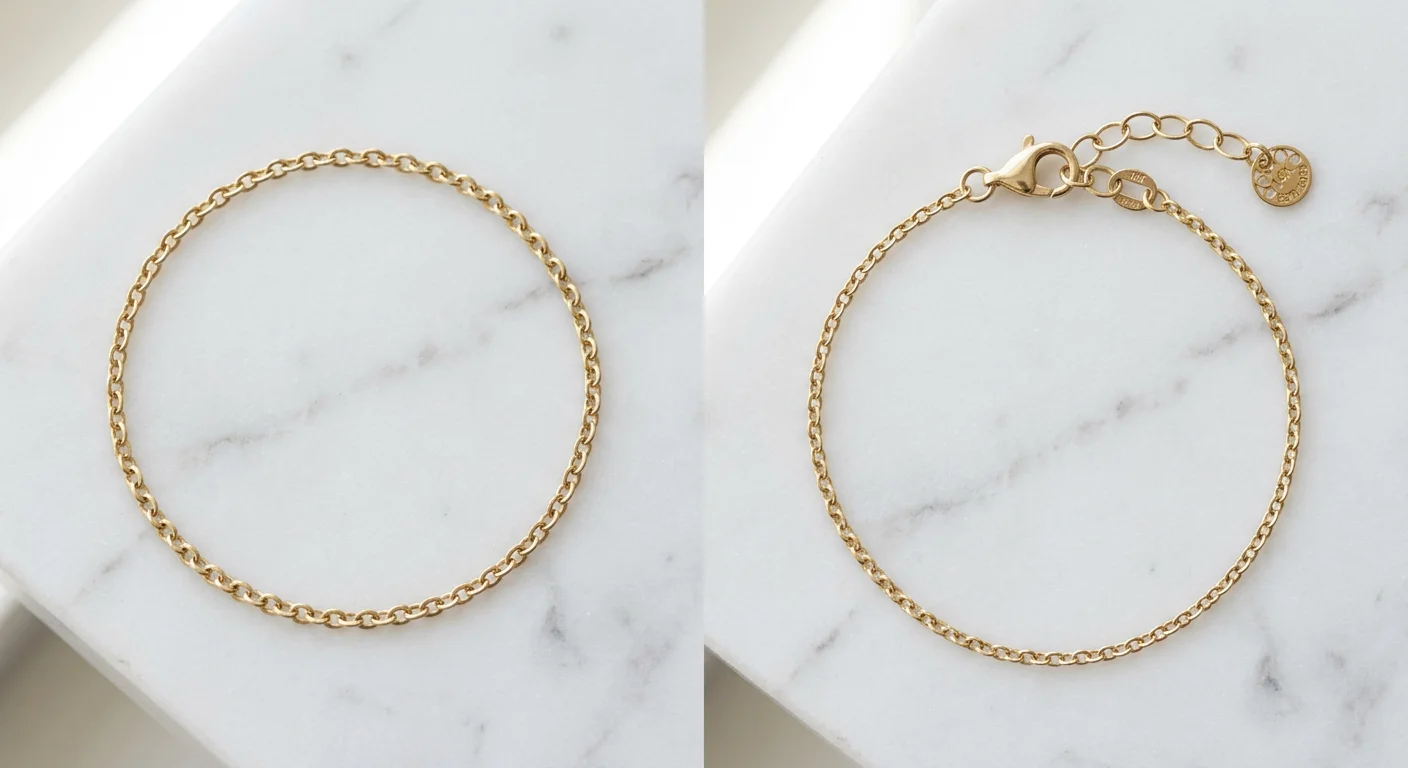
The concept is straightforward. Permanent jewelry is a clasp-free chain — custom-sized to your wrist, ankle, or neck. A jeweler welds it shut on your body using a brief electrical pulse. This is called a micro-weld or pulse-arc weld. No buckle. No lobster claw. No clasp of any kind. Just a seamless metal loop that sits flush against your skin.
The word “permanent” doesn’t mean forever. It means continuous wear. The chain stays on through sleep, showers, workouts, and everything in between. Need it off? A quick snip at the Weld point does the job. That covers MRI appointments, job requirements, or just a change of mind. Many pieces can even be rewelded afterward.
Most permanent jewelry uses 14K gold chains or other lightweight metals. These materials are chosen for skin compatibility and long-term durability. Common formats include:
- Bracelets
- Anklets
- Necklaces
Each piece gets fitted, closed, and finished with a smooth, inspected seam before you leave the chair.
For business owners, the jewelry welder is more than a technical device. It affects service speed, weld consistency, customer comfort, and how confidently a studio can handle daily appointments. A reliable permanent jewelry welder helps operators finish each piece quickly, keep the weld point clean, and reduce the chance of weak closures or repeat repairs.
This is why many jewelry studios treat the welder as the core investment behind the service. Chains, charms, and displays attract the customer — but the welding machine determines how professional the final experience feels.
What Is a Permanent Jewelry Welder?
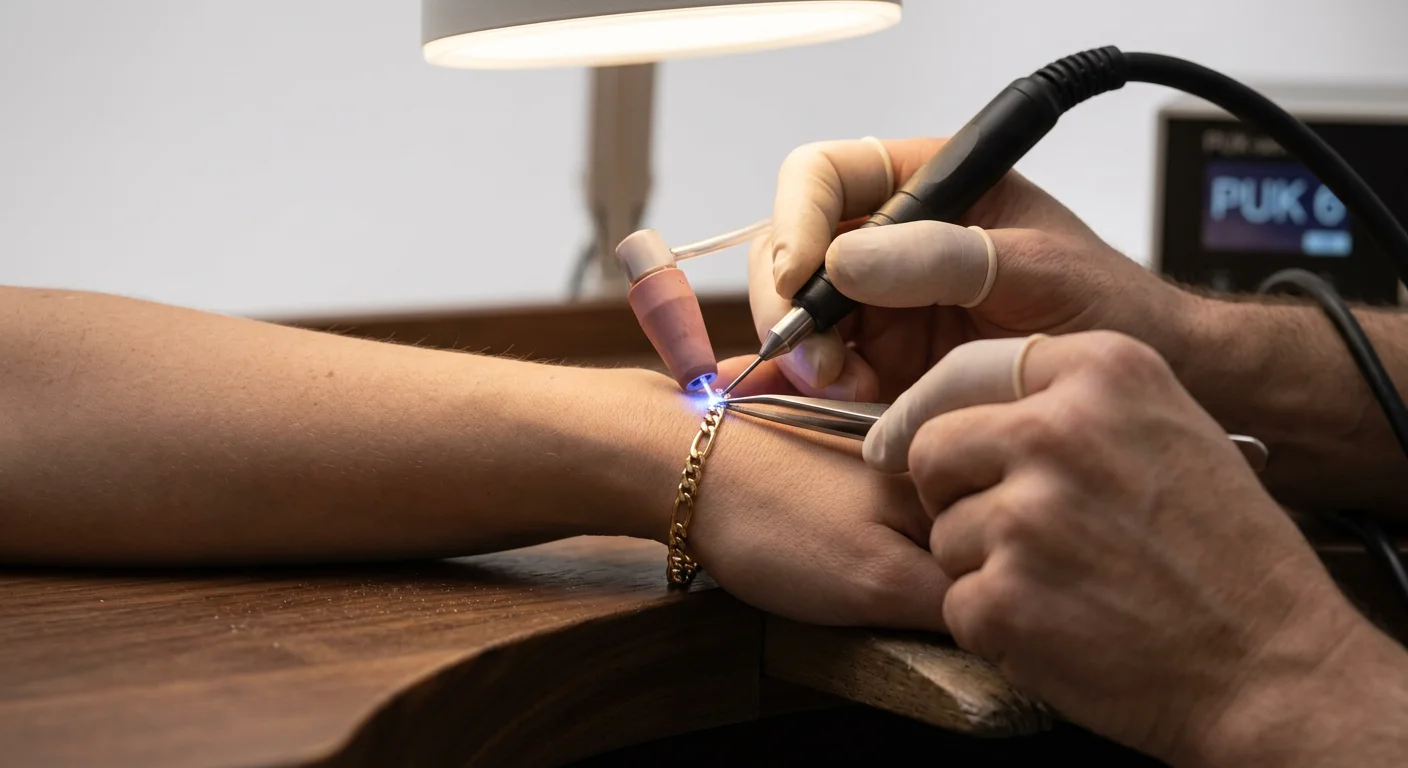
The tool behind the trend is smaller than most people imagine. A permanent jewelry welder is a compact pulse arc micro-welder. It fuses fine chain links on your body, closing the loop without a clasp. The whole process takes a fraction of a second.
Here’s what sets it apart from traditional jewelry tools: it’s built for near-skin work. The arc targets one precise point. The heat stays minimal. Each weld takes under 10–20 seconds per piece. Most clients feel nothing at all.
The welder handles the materials permanent jewelry is made from — 14k gold-filled chain, sterling silver, and solid gold. It performs well on conductive metals, outperforming Laser welders on silver and copper. Those metals reflect heat, which causes problems for laser tools. Pulse arc handles them cleanly.
The person operating it matters just as much as the Machine. A permanent jewelry artist measures your wrist and cuts the chain to your exact fit. They set the energy level for your specific metal, then trigger one or a few pulses at the seam. After that, they check the closure, confirm the chain moves without catching, and walk you through care and removal before you go.
The welder is compact enough for kiosks and pop-up events. New operators can pick up the technique without a steep learning curve — it takes practice, but nothing unmanageable. The weld itself is the easy part. The fit, the eye, the customer read — that’s the real craft.
What Is Traditional Jewelry?
Traditional jewelry is the kind you’ve worn your whole life without ever stopping to name it. The bracelet with the lobster clasp. The necklace your mom had to help you fasten before school. The earrings with the screw back that took two hands and a mirror.
At its core, traditional jewelry is built to come on and off — by you, on your own, no tools needed, no professional required. That’s not a small detail. It’s the core logic the entire category runs on.
The mechanical closure is the defining feature. Pin-and-catch brooches. Hook-and-eye clasps. Cord ties on pendants. These aren’t just technical choices — they’re what make traditional jewelry yours to control. Put it on for dinner. Take it off before bed. Swap it out on a Tuesday because your mood shifted.
Materials shift by era and culture:
- High-karat gold (18–22k) in status pieces from ancient Egypt and Mesopotamia
- High-purity silver in Berber and traditional Chinese jewelry
- Base metals like copper and pewter for everyday medieval European wear
- Gemstones — sometimes covering more than 50% of the visible surface in Mughal and Mesopotamian designs
The one thing that ties all of it together is user autonomy. You don’t need a jeweler to wear traditional jewelry. You never did. Take a Māori hei-tiki on a sliding cord knot. Or a Roman fibula brooch pinned into a cloak. Both follow the same logic: you put it on yourself, and you take it off yourself. The design has always assumed that.
Permanent Jewelry vs Traditional Jewelry: Key Differences
Six differences. That’s what it comes down to. Not aesthetics, not price alone — six structural realities that determine whether permanent jewelry fits your life or fights it.
1. How It Closes (and How It Comes Off)
Permanent jewelry has no clasp. Full stop. A jeweler welds the chain shut on your body using a pulse-arc welder. It fuses a small jump ring into a seamless loop. The whole process takes a few minutes per piece.
Traditional jewelry runs on removable hardware — lobster clasps, spring rings, toggles, magnetic closures. You open it, you close it, you do it yourself, every single time. Removal takes seconds and needs no tools.
Want off a permanent piece? You cut it. Scissors or wire cutters at the weld point. That’s the trade.
2. Service Experience vs. Retail Product
Buying permanent jewelry is nothing like buying traditional jewelry. You book an appointment or walk into a studio. A trained artist measures your wrist on your wrist, cuts the chain to your exact size, and welds it closed. You leave wearing it. No box, no bag — it’s already on you.
Traditional jewelry is a retail product. It ships in standard lengths — 7-inch bracelets, 16-to-20-inch necklaces. You buy it, you put it on yourself. The fit is what it is.
Pricing reflects the difference. Permanent jewelry runs $50 to $300+, covering both material and service. Traditional jewelry spans a far wider range — from fast-fashion pieces under $10 to fine jewelry in the thousands.
The service model also explains why equipment matters. A permanent jewelry appointment depends on speed and trust. The customer is watching the process happen on their wrist, ankle, or neck, so the welder needs to produce a clean spark, a stable weld, and a smooth finish without making the experience feel intimidating. For jewelers adding this service, the right jewelry welder can turn a simple chain sale into a higher-value in-person experience.
3. Continuous Wear vs. Daily Flexibility
Permanent jewelry stays on through everything — showers, workouts, sleep, swimming. No morning decisions. No losing it in a coat pocket. Many wearers choose it for a symbolic reason: a friendship, a milestone, a “never-take-off” intention.
Traditional jewelry is built around the opposite idea — you want control. Wear it for the occasion, swap it for another on Tuesday, stack it a new way in December. That flexibility is the whole point.
The trade-off is straightforward:
– Permanent = maximum continuity, minimum styling flexibility
– Traditional = maximum versatility, zero continuity
4. Materials and Durability
Both types can use quality materials, but each is built for a different purpose.
Permanent jewelry uses 14k solid gold, 14k gold-filled chain, 925 sterling silver, or hypoallergenic Stainless steel. These materials work well against skin over long periods. A high-quality gold permanent chain can last 5 to 20 years under normal wear. No clasp means one less failure point — but the welded jump ring can become a weak spot under a hard snag.
Traditional jewelry covers everything from fine platinum to base-metal costume pieces. Clasps wear out, bend, and pop open at the worst time. Lower-cost plated pieces can tarnish after one wet wear.
Each type breaks differently. Neither is damage-proof — the risks just show up in different places.
5. Fit and Ergonomics
Permanent jewelry gets measured and cut to your exact body — within a few millimeters. That precision means less movement on the skin and a cleaner visual line. The fit is also locked. Your wrist swells or your weight shifts? The chain may need to come off and get redone.
Traditional jewelry almost always includes extender chains — an extra inch or two that lets the same piece work for different wearers and different days.
6. Maintenance and Repair
This is where the gap gets real.
Traditional jewelry is easy to maintain yourself. You can swap a clasp with pliers, soak the piece in cleaning solution, polish it at home, or replace a jump ring on your own. Basic upkeep needs no professional.
Permanent jewelry needs a professional for almost everything beyond a quick daily rinse. Resizing means cutting it off and rewelding. A broken link means a trip back to a jeweler or permanent jewelry artist. Need it off for an MRI? Cut it. Want it back on after? Re-weld it.
The convenience of never taking it off has a clear flip side — you can’t fix it yourself.
Pros and Cons of Permanent Jewelry
Every decision has a real cost. Here’s what you trade choosing permanent jewelry over traditional.
The Upsides
Convenience is the headline. No clasps means no morning routine — no putting it on, taking it off, or digging through your bag to find it. The full installation — chain selection, custom fitting, welding — takes under five minutes at the studio. You walk out wearing it. That’s the whole process.
The symbolism carries real weight too. Permanent jewelry marks things that matter: friendships, weddings, new babies, personal milestones. It sits closer to a tattoo in emotional meaning than to an accessory. Many people choose it because you can’t take it off on a whim. The commitment is the point.
For style, it’s built for a minimalist look. Thin chains. No visible clasp. Flat against the skin. Add a birthstone charm or an initial tag, and it feels personal without getting fussy. For durability, a solid 14k gold chain worn every day can last 5 to 20 years. Plus, there’s no clasp spring to break — something traditional jewelry can’t say.
Airport security? Most wearers pass TSA without removing it.
The Downsides
What makes it appealing is also what makes it tricky. It never comes off — until you cut it.
Need it off for an MRI? Cut it. Pre-surgery? Cut it. New job with a uniform policy? Cut it. The removal itself isn’t hard — scissors or wire cutters do the job. But it’s a friction point traditional jewelry never creates. That’s worth knowing upfront.
Wearing it non-stop speeds up wear. A bracelet that sleeps, swims, and sweats with you every day breaks down faster than one stored overnight. Sterling silver tarnishes faster in constant skin contact. Chlorinated pools are especially rough on plated or lower-quality pieces.
Skin sensitivity is a real concern. Trapped moisture, friction, and swelling can all cause irritation — dermatologists flag these regularly. Nickel allergy is the most common issue. Even small amounts in alloys or under worn plating can trigger itching, redness, and blisters. Body changes like pregnancy can also create fit problems with a fixed-size chain.
The cost deserves a straight answer: $100–$500 for gold, $50–$150 for silver. Custom charms push that higher. That’s not a flaw — it reflects real materials and skilled service. But it’s a bigger upfront spend than picking a bracelet off a shelf.
The short version: Permanent jewelry suits people who want consistency, symbolism, and zero maintenance. It’s a harder fit for people who need flexibility, face medical procedures, have metal sensitivities, or just like swapping their look on a Tuesday. Neither choice is wrong — but one is probably the right call for you.

Pros and Cons of Traditional Jewelry
Traditional jewelry has worked well for thousands of years — and for good reason. You can put it on, take it off, and swap it out on your own terms. That’s not a limitation. It’s the whole point.
What Traditional Jewelry Gets Right
Style flexibility is the obvious win. The average woman owns 20–30 pieces but cycles through a core 5–10 on a regular basis. A simple capsule — three pairs of earrings, three necklaces, three bracelets, three rings — can produce 50+ distinct combinations without buying a single new piece. Swapping takes seconds. Earrings come off in 10–30 seconds. A bracelet clasp opens in five. No appointments, no cutting, no professional needed.
Context control matters more than people admit. Healthcare workers, lab technicians, contact sport athletes, and anyone near industrial machinery often can’t wear fixed metal jewelry. OSHA warns against chains and rings near moving equipment. Many sports leagues require removing all dangling pieces before play. Traditional jewelry handles those realities without drama. You just take it off.
The cost math is clear. Permanent welded chains run $50–$200 per piece at most studios. For that same budget, you could own two to four sterling silver bracelets — each one wearable in a different context, on a different day, with a different outfit. Wood and resin options cost even less.
Repair and resale stay open. A clasp replacement takes 10–30 minutes at most jewelry counters. Ring resizing runs $30–$80 and comes back within a week. You can resell, gift, or pass down traditional pieces — physical transfer and adjustments are still possible. Permanent jewelry gets cut off, not consigned.
Where Traditional Jewelry Falls Short
The flip side is real friction. Wearing 20 pieces means managing 20 pieces. Morning jewelry decisions add up to 1–5 minutes each day — somewhere between 6 and 30 hours a year spent deciding what to put on. That’s not nothing.
Loss is a real cost. Traditional jewelry comes off for showers, sleep, and sport. More handling means more chances to leave a piece somewhere. Informal estimates put 5–15% of everyday-wear pieces going missing over five years. Small studs and thin stackable rings are the most common casualties.
Maintenance is ongoing, not a one-time fix. Daily-wear silver needs cleaning every one to three months. White gold needs re-rhodium plating every one to two years. Wood pieces need to stay dry and may need periodic oiling. None of this is hard — but all of it needs your attention on a schedule.
The experience isn’t built in. A welding session has a beginning, a middle, and a clear moment you walk out wearing something new. Traditional jewelry shopping doesn’t offer that structure. The meaning can be just as real — a gift, an heirloom, a piece chosen with care — but that meaning isn’t baked into the buying process the way a welding appointment is.
The bottom line: Traditional jewelry gives you flexibility, repairability, and control. You pay for those advantages in daily decisions, ongoing maintenance, and the occasional lost earring. The trade-off comes down to how you live day to day.
Who Should Choose Permanent Jewelry vs Traditional Jewelry?
The choice isn’t about budget. Both permanent and traditional jewelry span a wide price range — permanent pieces run $50 to several hundred dollars, while traditional jewelry starts under $20 and climbs into the tens of thousands. Price overlap is real. What splits these two categories is how you live and what you want jewelry to do for you.
Choose Permanent Jewelry If You Fit This Profile
You wear the same piece every day without thinking about it. Not because you forgot — because that’s your preference. You’re not rotating looks. You’re not coordinating with outfits. You want one bracelet, worn without a break, that means something and stays put.
Permanent jewelry works best for:
- Minimalists who want a “set-and-forget” everyday piece they never remove — not for sleep, not for the shower, not for the gym
- Sentimental buyers marking a relationship, a milestone, or a memory — matching welded bracelets between best friends, a chain from a wedding week, a clasp-free anklet from a trip that mattered. Something more lasting than a drawer
- Active, busy people who lose removable jewelry, hate dealing with clasps, and want zero friction in their morning routine
- Experience seekers drawn to the welding session itself — custom-fitted, closed on your wrist in under five minutes, already yours before you leave the chair
Here’s a quick gut-check. You’ve worn the same bracelet every single day for the past month. You never thought about swapping it. You’re already living like a permanent jewelry person.
Choose Traditional Jewelry If You Fit This Profile
You like the ritual. Picking earrings in the morning. Layering three necklaces for a Saturday. Wearing a statement cuff once and putting it away until it’s right again. That’s not indecision — that’s the whole point of building a collection.
Traditional jewelry fits better for:
- People who change pieces three or more times a week to match outfits, occasions, or moods
- Anyone whose job, sport, or medical situation requires regular metal removal — frequent MRIs, lab work, contact sports, or safety-regulated workplaces
- Those building a collection or investment — pieces you can clean, upgrade, resell, or pass down
- People with skin sensitivities that need rotation, airing out, or specific metal swaps day to day
A Four-Step Decision Framework
Still unsure? Work through these in order:
- Track your current pattern for one week. Same piece every day? Go permanent. Switching three or more times? Stay traditional.
- List your constraints. Job rules, medical procedures, or sports that require removing metal? Those tip the scale toward traditional.
- Name your motivation. Sentiment and symbolism pull toward permanent. Fashion variety and collecting pull toward traditional.
- Sit with the cut-off reality. Permanent jewelry comes off with scissors — not a crisis, but a real step. That feels like a friction you’d resent? Traditional jewelry is the honest answer.
Neither is the better choice. One just fits your life more than the other.
Common Misconceptions and Safety Concerns
Let’s clear up the myths that stop people from making a confident choice.
Myth #1: “Permanent” means you’re stuck with it forever.
Not true. Permanent jewelry means continuous wear — not a lifelong commitment. A pair of scissors removes it in seconds. Many studios will reweld the same chain right after. The word “permanent” describes how it sits on your body day-to-day. It says nothing about what happens if you change your mind.
Myth #2: It can’t go through airport security.
Most wearers pass TSA without taking off their chain. The metal is too small to set off scanners. It’s not an issue in practice.
Myth #3: Any metal is fine for long-term skin contact.
This one matters. Nickel is the most common jewelry allergen. It shows up in low-quality alloys and plated pieces. Itching, redness, and blisters can develop from trapped moisture and constant friction against the skin. Stick with 14k solid gold, 14k gold-filled, or 925 sterling silver. These metals hold up well against daily skin contact and are far less likely to cause a reaction.
One real concern worth planning for: MRI appointments. You’ll need to cut the chain before going into the machine. It’s a small inconvenience — but it’s real. Know this ahead of time so you’re not caught off guard.
Pricing and Value Comparison
Price confuses people — not because the numbers are hard, but because these two categories aren’t selling the same thing.
Permanent jewelry sells an experience. Traditional jewelry sells an object. That difference changes how you judge what you’re paying.
What You’re Paying For
A permanent bracelet at most studios runs $50–$120. The chain itself — bought wholesale — costs the studio $12–$35 in material. Add a $10–$30 welding fee on top. The rest covers custom fitting, the welding session, and often a free reweld policy if the chain breaks or needs resizing. You’re not paying for metal weight. You’re paying to walk out already wearing it.
Traditional jewelry works on a different price model. A 14k gold bracelet retailing at $250–$500 may carry $90–$120 in real gold content — that’s material value you can recover. Brands mark up raw materials 2×–4×. That markup goes into a physical object you can resell, gift, or pass down.
The Value Depends on Your Priority
| Permanent Jewelry | Traditional Jewelry | |
|---|---|---|
| Typical retail price | $50–$200 | $20–$5,000+ |
| Material cost share | Low (often 20–40% of price) | Higher (20–50%+ for gold/silver) |
| Service component | Yes — fitting + welding | No |
| Repair cost | $0–$10 reweld | $10–$80+ at jeweler |
| Resale value | Low | Moderate to high |
| Per-wear cost | Low (worn daily) | Varies by frequency |
Wear a $80 permanent bracelet every day and the per-wear cost drops fast. Two years of daily wear puts you under $0.11 per day. That math is hard to beat.
Want something you can sell, upgrade, or leave to someone? Traditional gold or silver keeps that door open. Permanent chain jewelry does not.
Neither is a bad deal. They’re just different deals. Know which one you’re buying before you sit down in that welding chair — or hand over your card at the counter.
How to Make the Right Choice
The right answer is sitting in your routine — you just have to look at it straight.
Count how many times you take off jewelry in a typical week. More than three or four times? Traditional jewelry fits your life. Wear the same piece every day without a second thought? Permanent jewelry matches how you live.
Most people fall somewhere in the middle. A single permanent bracelet works well — thin, solid metal, worn for a reason that means something to you. Add a small traditional collection for everything else. That’s not settling. That’s just smart.
The jewelry doesn’t have to say something. It just has to be yours.
FAQ
Q: Does the welding process hurt? A: Almost never. The pulse-arc welder fires a tiny spark — it lasts just a millisecond, and heat only reaches a weld point under 2mm wide. Most clients feel nothing at all. Some notice a small bit of warmth. That’s it.
Q: Can permanent jewelry be removed?
A: Yes. One snip with jewelry cutters at the weld point, and it’s off in seconds. The weld isn’t stronger than the chain around it — it’s just a small, clean join. Many studios will reweld the same piece right after if you want it back on.
Q: Will it set off airport security?
A: Not often. The chain is too light to trigger TSA scanners. Most wearers walk straight through with no issue.
Q: What about MRI appointments?
A: Cut it before you go in. It’s a real step — not dramatic, but plan for it. Bring small cutters or call your studio ahead of time.
Q: Which metals are safest for long-term wear?
A: 14k solid gold, 14k gold-filled, and 925 sterling silver. These three cut down allergy risk and hold up well against constant skin contact. Stay away from anything nickel-heavy or lightly plated — those wear down fast and can irritate skin over time.
Q: Can the chain be rewelded after removal?
A: Yes. A jeweler adds a new jump ring and welds it closed again — same process, same result.
Q: What kind of welder is used for permanent jewelry?
A: Most permanent jewelry studios use a compact jewelry welder designed for micro-welding fine chains and jump rings. The goal is not heavy metal fabrication — it is a small, controlled weld point that closes the chain securely while keeping heat focused and minimal. For studios, a good welder should be easy to set, stable on fine metals, and comfortable to use in front of customers.
Conclusion: How to Make the Right Choice
Neither jewelry style wins outright — they just win in different ways.
Permanent jewelry suits the person who’s done with lost clasps, tangled chains, and the daily routine of putting jewelry on and taking it off. It’s a commitment piece, yes. But it’s low-maintenance and built for real life. Traditional jewelry gives you flexibility, variety, and the freedom to match your mood, your outfit, or your moment.
The smartest approach? Know yourself first.
You live in your accessories and want something that becomes part of you — welded jewelry might be what you’ve been looking for. You love switching things up? Traditional fine jewelry stays irreplaceable for that.
Still on the fence? Explore MaxWave‘s permanent jewelry collection and see what a clasp-free bracelet feels like in person. Try it. That’s often the best way to decide.
The right jewelry doesn’t just accessorize your life — it reflects how you live it.
Still on the fence? Explore MaxWave’s permanent jewelry collection and see what a clasp-free bracelet feels like in person.