
Cheetah print wallpaper has a certain electric quality — wild yet refined, bold yet timeless. It’s a look that works in a moody, hotel-worthy master bedroom or a bright living room that stops guests in their tracks. The right animal print changes how a space feels from the ground up.
And for anyone planning a truly custom feature wall, the options now go beyond rolls of wallpaper. Peel-and-stick panels still make sense for renters and quick refreshes, but permanent spaces can also use direct-to-wall printing technology to create seamless cheetah patterns, oversized animal-print murals, or fully custom accent walls printed directly onto the surface.
So many patterns, colorways, and installation options exist, though. Knowing where to start is half the battle.
That’s why we pulled together 20 of our favorite cheetah print ideas. They span bedrooms, living rooms, and custom accent walls — including a few cases where wallpaper works best, and a few where a wall printer can deliver a cleaner, more permanent finish. Skip the overwhelm — go straight to the part where your walls look that good.
Why Cheetah Print Wallpaper Is Dominating Interior Design Right Now
Animal prints never left — they just waited for their moment. And in 2025, that moment is here.
The numbers back it up. Animal print arrivals are up 104% year-on-year for Spring/Summer 2025, according to EDITED market data. Leopard print search interest has surged 170% year-on-year. The broader category is booming. People want bold, expressive interiors — spaces that feel like a personality, not a showroom.
Within that revival, cheetah print has carved out its own covetable lane.
Here’s what sets it apart from the rest of the animal-print pack. Cheetah spots are small, clean ovals. They’re more graphic and less heavy than leopard’s dense rosette clusters. That visual restraint is what makes cheetah work so well across a full wall. It stays a statement, not chaos — never tipping into too much.
Think of it this way:
– Leopard is the mainstream classic
– Cow print is the current novelty darling
– Cheetah is the refined middle ground — bold enough to be interesting, livable enough to stay
That positioning matters. Animal prints are moving fast — out of high fashion and celebrity interiors, straight into everyday home design. Cheetah print wallpaper isn’t a trend you’ll regret in two years. It’s the choice that makes your space feel curated rather than costumed.
Bedroom Idea #1–#2: Neutral Cheetah Wallpaper Accent Wall Behind The Headboard
The headboard wall does more work than any other surface in your bedroom. You see it every morning and every night. It sets the mood for the whole room — quietly, without you even noticing.
A neutral cheetah print wallpaper on that single wall fits right in. It adds character without taking over the space.
The key word here is neutral. Not high-contrast black-on-white animal print. Think soft beige, warm stone gray, earthy taupe — colorways where the spots read as texture first and pattern second. Brands like Hovia and Happywall do this well. They use warm stone undertones with a ΔL contrast of 10–20 between spot and base. The pattern stays low-key. You have to get close before it even registers as cheetah.
Idea #1 pairs this with a Queen bed. Cover 78–90 inches wide — about 1.3–1.5× your bed width. Leave 6–12 inches of painted wall on each side. That gap creates a natural vertical frame. The pattern looks deliberate, not accidental.
Idea #2 scales up for a King. Three panels of 72 cm peel-and-stick cheetah wallpaper (like the customizable Etsy option) land you at 216 cm — centered, balanced, done.
For both ideas, stop the wallpaper 6–12 inches below the ceiling. That strip of solid wall breaks the pattern before it reaches the crown molding. The whole look softens. You get something closer to a boutique hotel than a safari lodge.
The finishing formula:
– Linen bedding in oatmeal or warm ivory — natural texture against a smooth paper face
– Light oak or medium walnut bed frame — pulls the spot color down into the furniture
– 2700–3000K bedside lamps with linen shades — keeps the warm tones cohesive from floor to ceiling
Bedroom Idea #3–#4: Moody Dark Animal Print Wallpaper For A Hotel-Style Master Bedroom
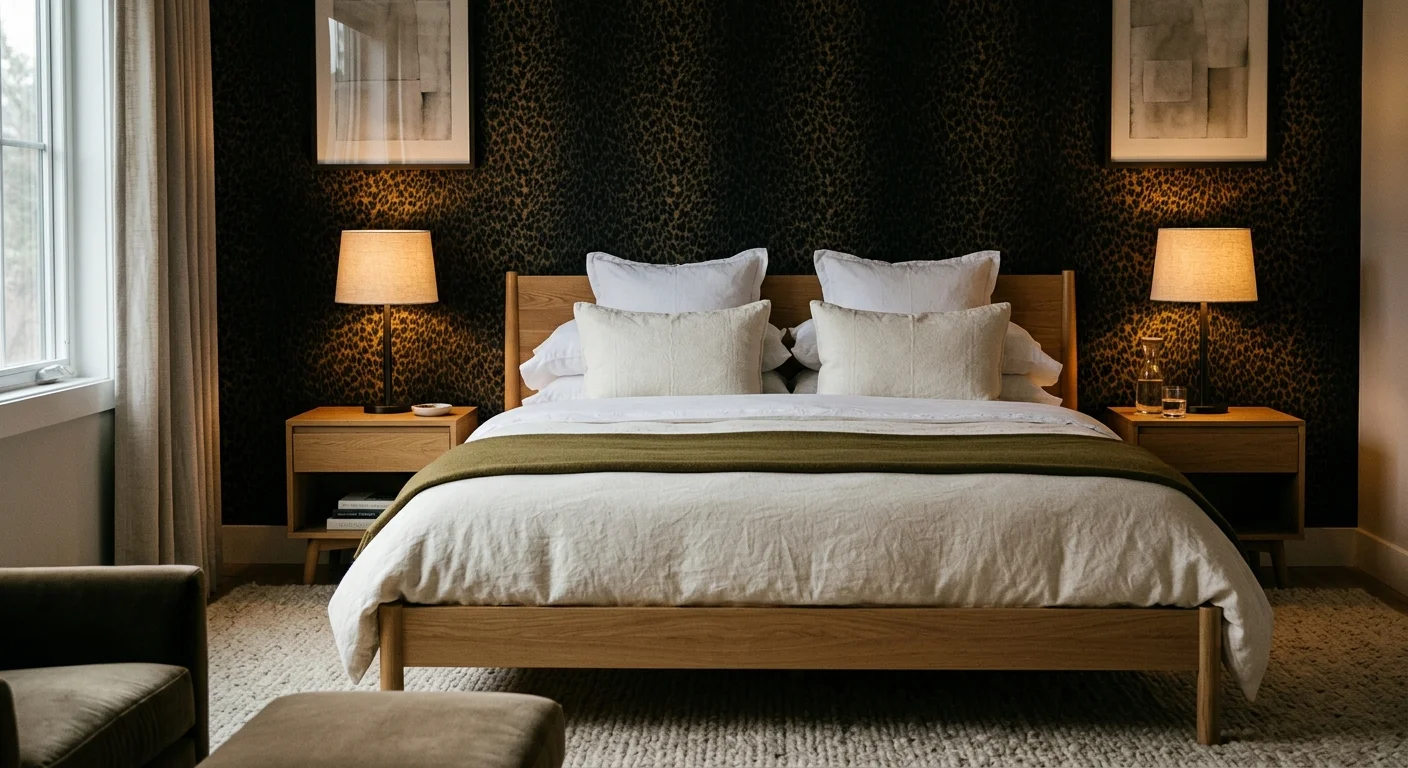
Dark walls demand confidence. A black or deep-brown animal print wallpaper on your headboard wall? That’s confidence with a capital C.
This version of cheetah print feels like checking into somewhere expensive. The spots aren’t texture anymore — they’re the whole point. Against a near-black base, every mark looks intentional. The room gets quieter, heavier, more considered.
Idea #3 works in a 14–16 m² room with a Queen bed. Cover the single headboard wall — about 8–9 m² — and leave the remaining three walls in deep charcoal or warm dark taupe. Full-room coverage in this colorway can compress a smaller space. One wall keeps it sharp and purposeful.
Idea #4 scales to a King in a 16–18 m² room, same principle. The headboard wall does all the work so nothing else has to.
Making Dark Wallpaper Work In Real Life (Not Just In Photos)
Deep-colored walls absorb light. Plan to add 30–50% more artificial brightness than you’d use in a standard bedroom. That means:
-
Ambient layer: LED ceiling fixtures at 8–12 W/m², giving you 150–250 lux base illumination
-
Bedside lamps: Two fixtures, 400–800 lm each, 2700–3000K, with frosted or fabric shades — never bare bulbs
-
Accent lighting: Low-wattage wall-grazing fixtures (3–5 W/m²) to bring out the cheetah pattern’s depth and outline
Position bedside sconces with centers at 140–160 cm from the floor, placed 25–45 cm out from the bed edge. That placement highlights the wallpaper without shining light straight into your eyes.
One more rule: keep individual fixture shade widths under 40–45 cm. Oversized lampshades flood the room with flat, even brightness. You’ll lose the moody effect entirely.
The Hotel Finish Formula
Bedding: Go 70–90% white or warm ivory, with 10–30% dark or metallic accent pieces layered in front. White against a near-black cheetah wall creates the exact contrast that makes five-star rooms feel effortless. Build the pillow stack in graduating heights — 4–6 total — with deep-toned front pillows in black-gold or dark bronze to echo the spot color.
Metals: Brushed gold, champagne, or antique bronze at 10–15% of your visible surface area. Think a pair of black-and-gold bedside lamps, a slim 60×80 cm metal-framed artwork above the bed, and one 50×150 cm mirror with a narrow dark frame. Together, these create multiple reflection points. They pull light back into the room without flattening the atmosphere.
Mirror placement: Position a full-length mirror 45–90° from the wallpaper wall — not straight across from it. That angle reflects the cheetah pattern a second time. You get double the visual impact without the room feeling like a funhouse.
One Buying Note Worth Knowing
Go matte over satin, every time, for this look. Matte surfaces scatter light and reflect under 10% back as glare, so the moody quality stays consistent across all your light sources. Satin can work — but your walls need to be near-perfect and your lighting needs to be tight. Any seam imperfection under strong side-lighting shows up fast on a dark, semi-gloss surface.
Also: check for a lightfastness rating of ≥ Grade 5 on the product spec sheet. Deep pigments on black-base wallpapers fade faster under UV exposure. On a large, high-contrast pattern like this, that color shift becomes visible within a few years — and it won’t be subtle.
Bedroom Idea #5–#6: Blush & Pastel Leopard Print Wallpaper For Feminine Or Teen Bedrooms
Pastel cheetah wallpaper for bedroom hits a very specific sweet spot. It’s playful without being childish. Pretty without being precious. It’s the kind of wall that grows with a teenager instead of aging out in two years.
The color psychology behind this choice is worth knowing. Blush and soft pink tones connect to warmth, comfort, and safety. Those are real benefits in a space where a teenager spends most of her emotional life. Lavender tones down agitation in sensitive kids. Mint green, close to Pantone 14-6316, has been shown to lower anxiety and support focus in study areas. These aren’t just pretty colors. They’re doing real work in the room.
Idea #5 is built around a single accent wall in blush or lavender cheetah print. Keep the other three walls in creamy white or warm oatmeal — that’s your 60% neutral anchor. The pattern covers close to 30% of total wall area. For a standard 9–12 m² teen bedroom, that works out to around 8–10 m² of wallpaper. Enough to feel planned. Not so much that the room starts to feel loud.
Idea #6 uses the same structure but moves the wallpaper to a non-headboard wall — the one opposite the bed, or a shorter side wall in a narrow room. Sleep researchers and designers agree on this: the area behind the bed should stay low in visual complexity. That supports better rest. Put the cheetah print on the wall you look at, not the one you sleep against.
The Finishing Formula For This Look
Pull the whole room together using the 60-30-10 color rule:
-
60% neutral base: Cream, oatmeal, or soft warm gray across the remaining walls, ceiling, and any large area rug
-
30% pastel layer: The cheetah wallpaper itself, plus sheer curtains in a matching blush or ivory, and light bedding in lavender or sage
-
10% personality pops: Macaroon-toned throw pillows (3–5 pieces at 40×45 cm), a small lemon yellow throw blanket at the foot of the bed, a few A4 or 30×40 cm art prints in white frames
White furniture is non-negotiable here. A matte white or cream bed frame with under-bed storage drawers keeps the floor plan feeling open and light. A white desk and bookshelf in the study corner build on that clean, organized feeling. That combination makes a small bedroom feel bigger than it is.
Add one or two rattan elements — a bedside table, a woven pendant shade with 2700–3000K warm bulbs — and the whole room shifts from decorated to curated. That natural texture breaks up all the softness. Just enough to keep the room from sliding into full themed territory.
Bedroom Idea #7–#8: Peel-And-Stick Cheetah Wallpaper For Renters (No Damage, Full Impact)
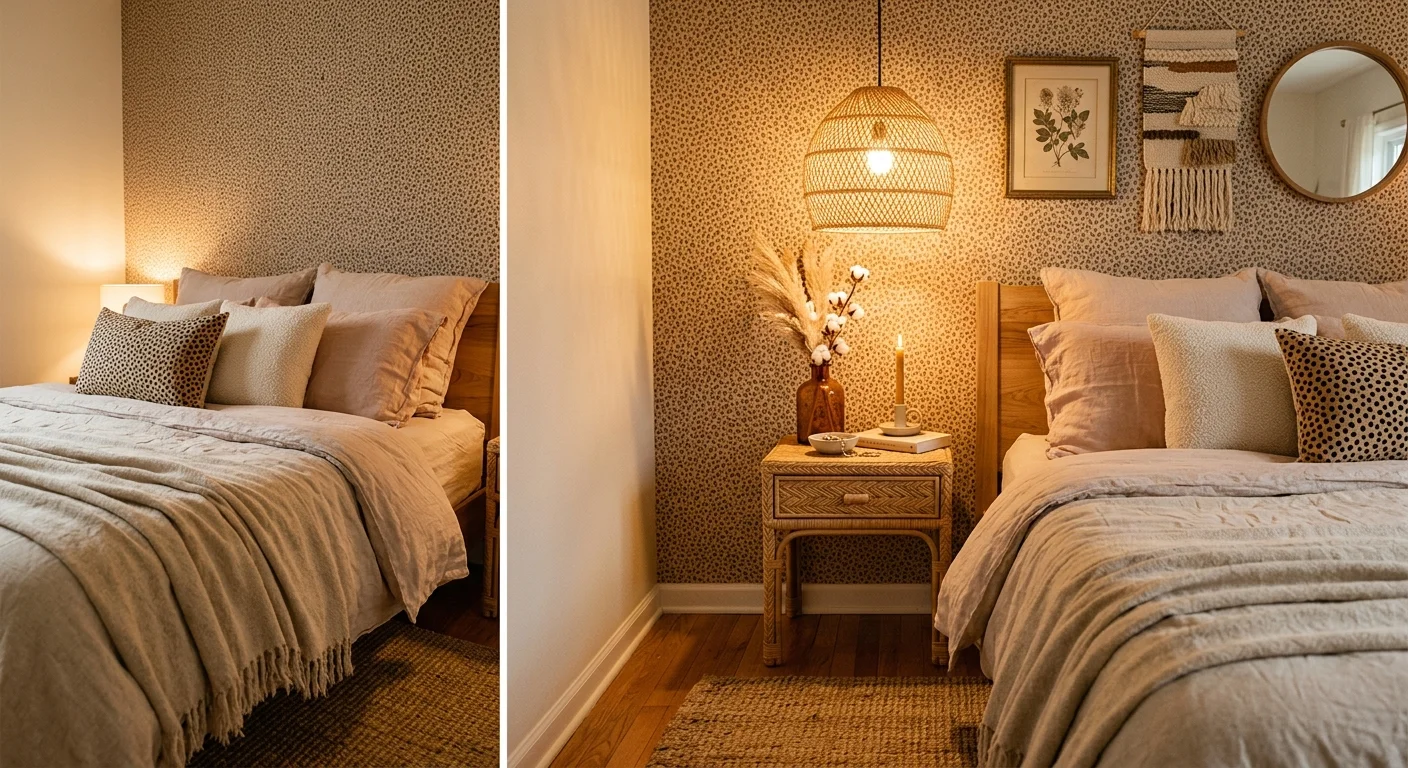
Renting doesn’t mean settling for blank white walls — it just means being smarter about how you make them yours.
Peel-and-stick cheetah wallpaper is what most renters don’t know they need. No paste. No professional installer. No panicked patch job before move-out. You get the full visual punch of a wild animal print bedroom wall — without touching a single lease clause.
Here’s what to expect: quality removable cheetah wallpaper holds up for 3–5 years under normal bedroom conditions. That lines up with a typical rental cycle. Brands like California Wallpaper offer the same cheetah pattern in both peel-and-stick and traditional vinyl. No design compromises needed. Most mid-range rolls cost US$30–60. Designer animal prints go up to US$80–120 per roll, covering about 2.5–3 m² each.
Idea #7 uses a large-repeat pattern. Look for designs where the spot repeat runs 50–70 cm from top to bottom. Apply it floor-to-ceiling on the headboard wall. That full-height coverage is what gives the room its impact. Half-wall treatments break the visual flow. Commit to the whole surface — it makes a real difference.
Idea #8 takes the same peel-and-stick panel to a different wall — the one straight across from your bed. It becomes a cheetah print accent wall you face every morning. Simple placement, strong effect.
One important distinction: peel-and-stick wallpaper is still the smarter choice for renters. It gives you impact without permanence. But if you’re decorating an owned home, a studio, or a commercial interior where the wall is meant to stay bold for years, direct-to-wall printing becomes worth considering. A wall printer can place a custom cheetah pattern directly onto the wall surface, with no roll edges, no panel seams, and no adhesive layer sitting between the design and the wall.
The Three Rules That Protect Your Deposit
Prep the wall first.
Fill any nail holes with lightweight spackle. Sand it smooth. Wipe the surface with a barely-damp cloth before you start. On eggshell or satin-finish paint, the adhesive grips well and releases clean later — no damage, no residue.
Test before you commit.
Put one small strip in a hidden corner. Wait 24 hours. Then peel it back at a 30–45° angle. Paint peeling off with it? Re-prime that wall or pick a different spot. Better to find out now than on move-out day.
Remove at a slow, steady pace.
On move-out day, work at room temperature. Pull at that same low angle — slow and steady. Any leftover adhesive residue cleans off with warm soapy water.
Living Room Idea #9–#11: Bold Cheetah Print Accent Wall Behind The Sofa
The sofa wall is the living room’s loudest opinion. Get it right, and everything else follows its lead.
A bold cheetah print accent wall behind the sofa is one of the highest-impact moves in a living space. It’s also one of the most forgiving. The furniture does half the visual work for you. The sofa anchors the pattern. The pattern elevates the sofa. They push each other up — it’s a true two-way relationship.
Getting The Proportions Right First
Before you pick a colorway or order a roll, measure. The wallpaper width should run 20–30% wider than your sofa on each side. That extra breathing room separates a deliberate, designed wall from one that looks like an afterthought. For a more precise guide, use the golden ratio — 1.618:1. It’s a solid framework for balancing the visual weight between your wall and your furniture.
Room size changes the rules:
-
Smaller living rooms: Keep the cheetah print to the sofa wall alone. The three remaining walls stay light, low-contrast, and quiet. One strong face is enough.
-
Larger living rooms: You have room to go fuller and wider with the pattern. Still, preserve clear left and right margins. The wall should read as a considered background — not a wraparound.
Three Color Schemes That Work
Camel + black cheetah print + brown leather sofa + brass hardware. This is the warm, lived-in, maximalist version. The black spots sit well against warm leather and brass. High contrast, but everything belongs to the same warm palette.
Black and white animal print + gray sofa + chrome accents. The clean, modern read. The monochrome pattern does all the visual work. Gray and chrome keep the saturation low so the room never tips into chaos.
Green cheetah print + dark wood + gold details. The most dramatic of the three. Your other three walls need to stay neutral — soft white or warm beige — to hold the room steady around that one statement surface.
The Practical Rules That Keep It From Feeling Like Too Much
Use the 60-30-10 rule for this layout. Your three neutral walls and main furniture pieces carry 60%. The cheetah accent wall commands 30%. Your metals, throw pillows, or art bring the final 10%. That last 10% matters — don’t layer in more animal print through cushions or rugs. The accent wall is already doing its job.
A few numbers worth keeping in mind:
-
45 cm minimum between sofa and coffee table — pattern-heavy rooms need clear, open movement paths
-
Stick to one metal finish throughout: brass or chrome, not both
-
Choose solid, low-texture upholstery for your sofa so it grounds the wall rather than competing with it
Got a small room? Go for a lower-density cheetah pattern with larger individual spots. Bigger, more spread-out marks feel less overwhelming than tight, busy clusters — even though that seems backwards. In a larger room, you can run the full pattern repeat at scale without the space feeling consumed.
Living Room Idea #12–#14: Monochrome & Abstract Cheetah Patterns For Modern Interiors
Monochrome cheetah print wallpaper does something color versions can’t. It removes the question of “does this match?” and replaces it with something better: pure graphic confidence.
Modern and Scandinavian-leaning interiors have been moving in this direction for a while. Strip away the camel and gold, and what remains is the pattern itself — the spots, the rhythm, the repetition. Against a white or pale gray living room, that’s more than enough.
Realistic vs. Abstract: Which Pattern Belongs In Your Space
The distinction matters more than most people realize.
Realistic cheetah spots are small, dense, and irregular — 1–3 cm in diameter, with 200–400 spots per square meter. That density reads as texture from across the room. It works well in maximalist, bohemian, or eclectic spaces where layering is the whole point. In a cleaner, more minimal room, it can tip into visual noise.
Abstract or oversized spots are a different animal (pun intended). Individual marks scale up to 5–15 cm — two to five times the natural size — with clean geometric edges and far more breathing room between them. Density drops to 40–150 spots per square meter. The result feels deliberate, almost architectural. That’s the version that belongs in a modern interior.
Idea #12 uses a black-and-white abstract cheetah pattern — oversized, widely spaced spots — on the TV wall. Keep the remaining three walls crisp white. Spots cover about 20–35% of the wall’s visual surface. That ratio gives you a clear focal point without the room feeling consumed by pattern.
Idea #13 takes the same monochrome approach but scales down to a tiny cheetah print — think FancyWalls’ Tiny Monochrome series, available in standard 50–52 cm wide rolls with both peel-and-stick vinyl and non-pasted paper options. Small-scale spots on a white base read more as texture than pattern at a distance. That makes them a solid fit for rooms that already have strong architectural features competing for attention.
Idea #14 goes fully custom. This is where cheetah print wallpaper starts to overlap with direct-to-wall printing. Custom wallpaper panels can work beautifully for a sofa wall running 3.5–4 m wide, especially when you want one large image with fewer seams and less pattern-matching stress.
But for a permanent feature wall, a wall printer can take the same idea further. Instead of ordering rolls, trimming edges, and aligning repeat patterns by hand, direct-to-wall UV printing places the cheetah design straight onto the wall surface. That means no panel joins, no lifted corners, and no repeat break across the middle of the pattern. For boutiques, cafés, salons, hotel rooms, studios, and owned homes, this creates a cleaner custom finish — especially with oversized abstract cheetah spots or one-off animal-print murals.
Use wallpaper when you want flexibility. Use a wall printer when you want the pattern to feel built into the room.
Lighting a Black-and-White Cheetah Wall
High-contrast patterns are unforgiving of bad light. A few rules worth following:
-
Color temperature: Use 3000–3500K for pure black-and-white abstract patterns. That neutral white light preserves the crisp edge definition. Drop to 2700–3000K if your cheetah print has warm gray or brown undertones alongside lighter wood furnishings.
-
Wall placement: Position the patterned wall as a side-lit surface — not facing a large window head-on. Strong direct daylight on a 70%+ contrast pattern feels aggressive rather than striking.
-
Track or wash lighting: Space fixtures 60–100 cm apart above the feature wall, angled at 30–45°. Target a wall surface illuminance of 150–250 lux — enough to read the pattern without the contrast turning harsh.
Keep your sofa in pure gray, warm ivory, or pale linen. Bring in light oak or white ash for furniture pieces. The pattern does the talking — everything else just needs to listen.
This same logic also works outside the home. In a boutique, beauty salon, photo studio, or small hospitality space, a wall printer can scale the cheetah pattern to the exact wall dimensions instead of forcing the design into standard wallpaper roll widths. The result feels less like a product applied to the wall — and more like a branded interior moment.
Living Room Idea #15–#16: Earth-Tone Cheetah Wallpaper Paired With Leather Sofas And Brass Accents
Brown leather, warm brass, and a cheetah-print wall covered in camel and espresso spots — this combination has been refining itself for decades. It doesn’t need to announce itself. You walk into the room and it just feels right.
The wallpaper does most of the heavy lifting here. Look for an earth-tone cheetah print with this color split:
– 40–50% warm mid-brown spots
– 30–40% sand or camel base
– 10–20% dark espresso outlines
Keep individual spots between 3–5 cm diameter. At a typical seating distance of 2–3 meters, that scale reads as rich texture — not a busy pattern.
Idea #15: Mid-Century Modern Read
Pair a cognac leather sofa — clean lines, tapered wood or metal legs — with a single cheetah feature wall. Keep the other three walls in warm sand or soft white (LRV above 60).
Add a jute or sisal rug at 200×300 cm in light camel. This lifts the darker elements off the floor and keeps things breathing.
For brass, stay restrained:
– 2–3 brushed brass lamps — floor lamps at 140–170 cm, table lamps at 50–70 cm
– 5–8 small brass objects — a tray, a candle holder, a slim frame
That puts brass at about 10–15% of your visible objects. That’s the sweet spot.
Idea #16: Boho Chic Layering
Same wallpaper, totally different energy. Swap the cognac sofa for a darker, distressed leather with a softer silhouette. Then pile on the layers:
-
5–9 throw pillows in terracotta, caramel, olive, and cream
-
40–50% solid earth tones
-
20–30% light neutrals
-
10–20% subtle small-scale pattern
-
-
1–2 chunky wool or bouclé throws
-
2–3 medium plants — a rubber plant or an olive tree work well
That last point matters. Brown and green is a pairing designers reach for again and again in leather-anchored rooms. It’s one of the most naturally harmonious color combinations you can use. The plants lock it in.
One finishing note for both ideas: choose at least one round coffee or side table in wood or stone. It softens the angular weight of the leather sofa. It also breaks up the strong vertical repeat of the wallpaper. The whole room relaxes.
Conclusion
Cheetah print wallpaper isn’t a trend you’ll regret. It’s a choice to live with purpose and a touch of wildness.
Love the quiet elegance of a neutral cheetah accent wall behind your headboard? Or maybe the bold drama of black and gold in a maximalist living room? Either way, the right pattern turns a space into something that feels like yours.
The best part? No designer needed. No big renovation budget either. One statement wall can do more for a room than months of furniture shopping ever will. And if you want that same animal-print energy without seams, rolls, or repeat-pattern limits, a wall printer opens up a more custom way to bring the idea to life.
So take the leap. Browse the ideas that made you stop scrolling. Screenshot the ones that felt like home. Let that be your starting point. Your walls are ready for something worth looking at.
Want to turn custom wall ideas like these into real printed surfaces? Explore WallPrintBox direct-to-wall printing solutions and see how a wall printer can create seamless, made-to-measure feature walls for homes, studios, cafés, salons, and commercial interiors.