
If you search for a diode laser today, you will likely find them described as compact, semiconductor-based devices that generate coherent light. They are widely known for powering fiber-optic communications, medical applications like permanent hair removal, and 5W–40W desktop engravers for materials like wood, leather, and dark acrylic.
However, what many people don’t know is the true power of laser diodes in heavy industry.
While hobbyist engravers and medical tools are highly visible, that definition barely scratches the surface. When stacked into arrays or used as the core pump source for fiber lasers, these semiconductor devices scale from milliwatts to tens of kilowatts. They are the driving force behind modern manufacturing—powering handheld metal welding, precision jewelry welding, and automated new energy battery manufacturing lines.
You might be evaluating a semiconductor laser for precision metal processing, or trying to understand why wavelength and beam quality matter more than raw wattage. Either way, the decisions you make at the component level ripple through every layer of your system’s performance. This guide gives you the full picture.
What is a Laser Diode? The Core Definition & Market Positioning
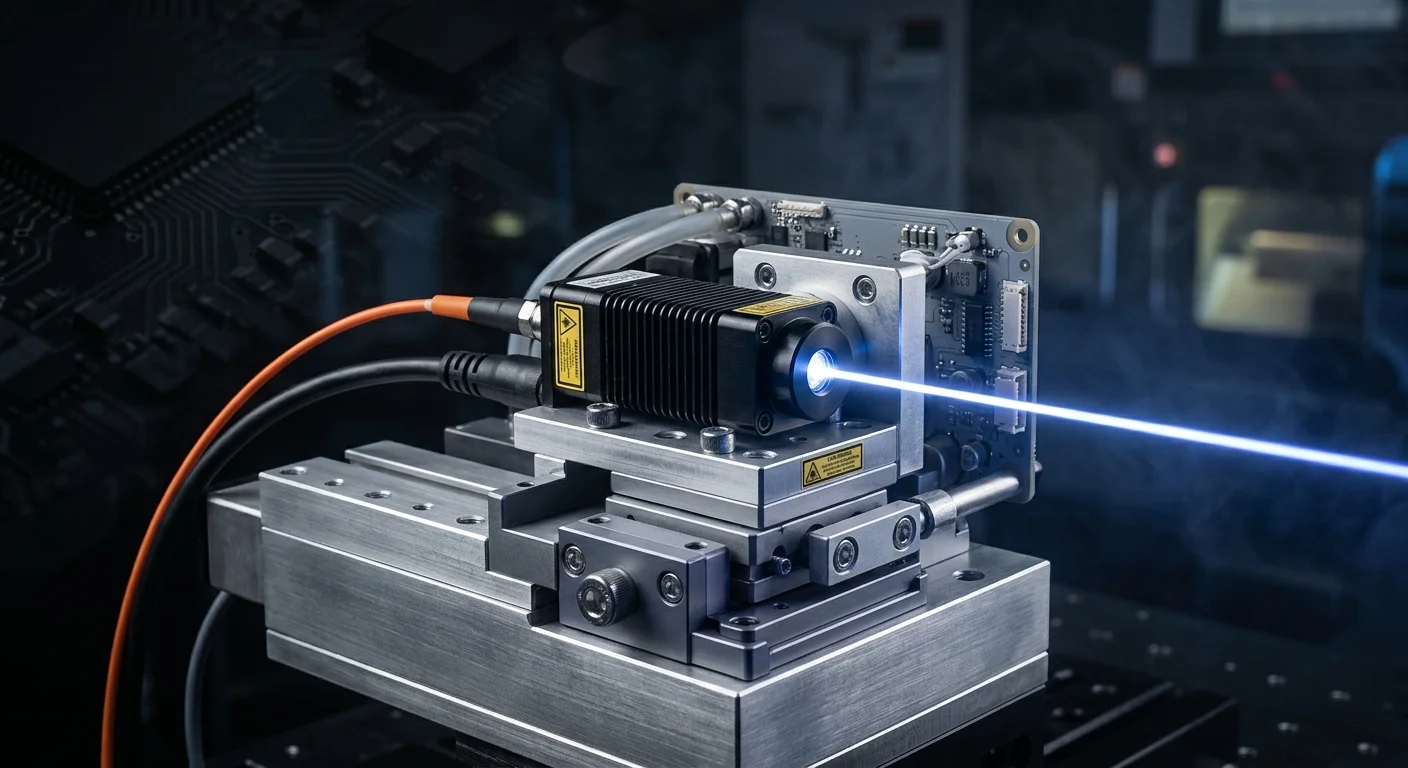
At its core, a laser diode is a semiconductor device built around a p-n junction. It converts electrical current into coherent light through stimulated emission. No gas tubes. No flash lamps. No moving parts. Just a forward-biased junction in a direct bandgap material — GaAs or GaN — and photons get to work.
That simplicity hides a lot, though. The output from that junction ranges from microwatts to tens of kilowatts. Architecture, thermal management, and driver design all shape that range. A barcode scanner and a 10 kW metal-cutting head run on the same foundational physics. The engineering choices between those two endpoints are where things get interesting.
Why the Market Moved Here
The numbers make the case fast.
| Dimension | Diode Laser | Fiber Laser | CO₂ Laser |
| Wall-plug Efficiency | 50–70% | 30–50% | 10–20% |
| Footprint | Compact | Medium | Large (bulky gas tube) |
| Maintenance Cost | Low (no consumables) | Medium | High (gas refill, mirrors) |
A wall-plug efficiency of 50–70% is not a marketing claim. It is the highest conversion rate across all commercial laser types. For industrial operations running continuous shifts, that running cost gap adds up fast.
From Milliwatts to Metal Processing
Early diode lasers were modest devices — milliwatt-range, built for optical communications and indicators. Today, diode laser modules deliver 450W CW through a 200µm fiber. Single-emitter progress now pushes into configurations that scale to kilowatt-class direct diode systems. These systems handle serious metal processing.
The double-heterostructure made this possible. It confines carriers and photons at the same time. That confinement drives the power density industrial applications need.
Wavelength range follows the material choice:
-
660–900 nm for GaAs-based devices
-
1300–1550 nm for InP-based designs, used across fiber-optic communications
That range controls absorption behavior in the target material. So wavelength selection is a system-level decision — not something you figure out at the end.
How Diode Lasers Work: The Physics Behind Coherent Light Generation
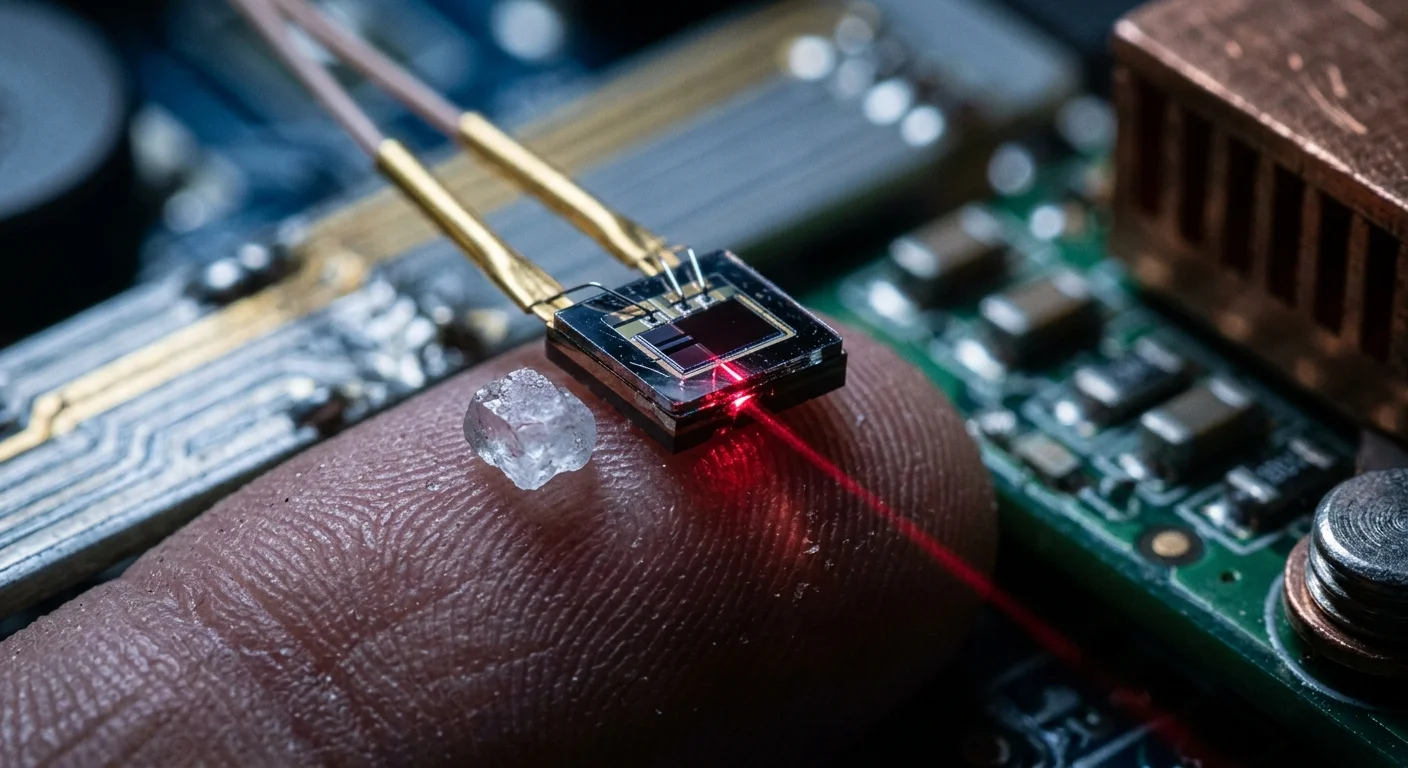
Strip away the housing, the driver board, the fiber coupling. What remains is a slice of semiconductor about the size of a grain of salt. That tiny chip runs one of the most elegant processes in applied physics.
Here’s what happens inside.
Current In, Photons Out: The Recombination Mechanism
Forward bias current flows through the p-n junction. Electrons flood in from the N-side. Holes arrive from the P-side. They meet in the active region, recombine — and release energy.
That energy becomes light. But how that light gets released is everything.
Two processes govern it:
-
Spontaneous emission — An electron drops to a lower energy state and fires off a photon in a random direction, with random phase. This starts oscillation. But it becomes a source of loss once real lasing begins.
-
Stimulated emission — An incoming photon nudges a waiting electron-hole pair into recombining. The result: a second photon that is an exact copy of the first. Same frequency. Same phase. Same direction. Same polarization.
That second process is where coherence comes from. One photon triggers another. That one triggers two more. The cascade builds. A narrow, phase-locked beam emerges from what was, moments earlier, simple electrical current.
Why the Semiconductor Material Matters
The bandgap energy of the material sets the photon energy at recombination. Photon energy sets the wavelength. So the choice of semiconductor — GaAs, GaN, InP — is not just a materials call. It is a wavelength call. That choice has direct consequences for how your target material absorbs the beam.
There is no separating the two.
The Double-Heterostructure: Confinement as a Force Multiplier
Raw p-n junctions leak. Carriers spread out. Photons scatter. Early diode lasers hit this exact wall — the junction couldn’t hold enough carrier density to drive useful gain.
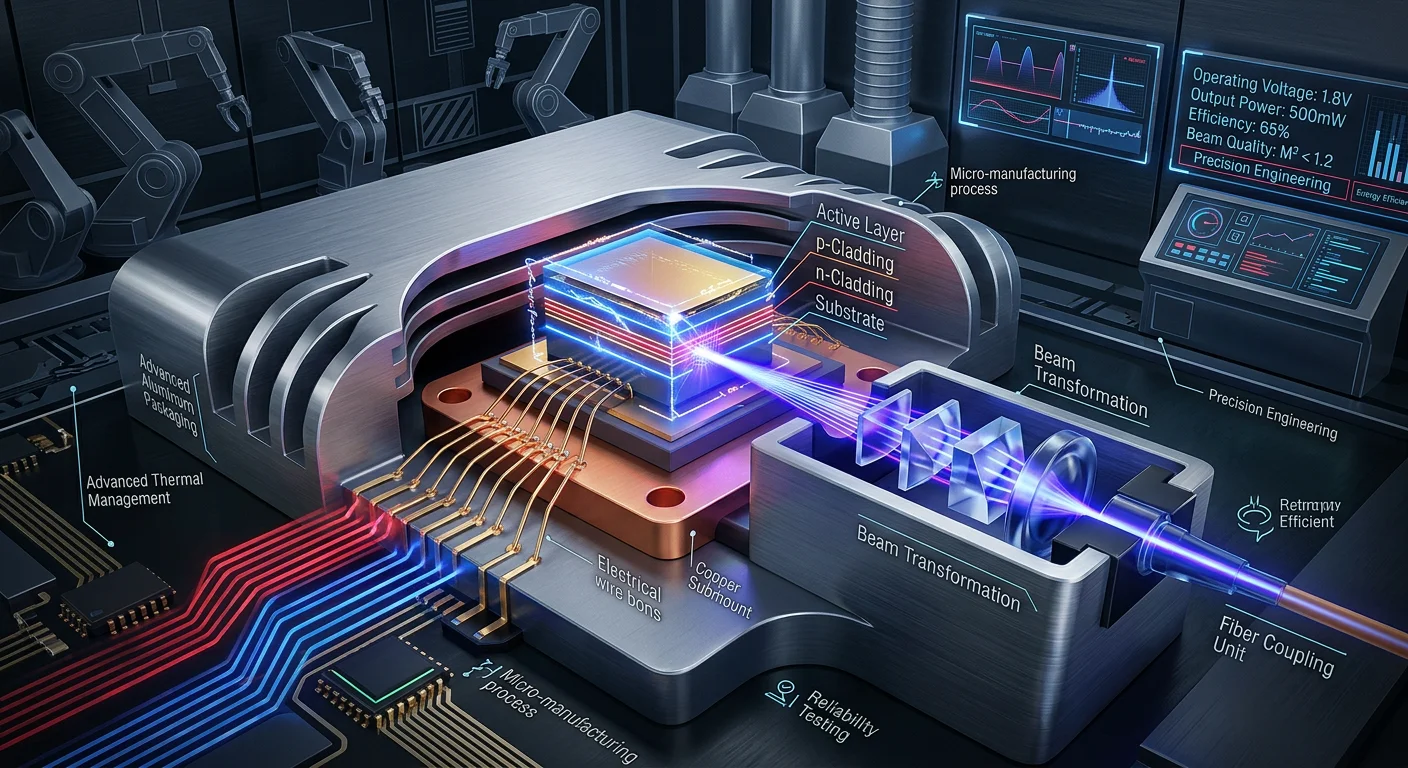
The double-heterostructure fixed that. A thin, low-bandgap active layer sits between higher-bandgap cladding layers on both sides. Two things happen at once:
-
Carriers get trapped in the active layer. They have to recombine there instead of drifting away.
-
Photons stay guided along the same path. The refractive index difference between layers acts as an optical waveguide.
The gain region and the optical mode overlap fully. That’s not an accident — it’s the design intent.
The Optical Cavity: Turning Gain Into a Beam
Stimulated emission gives you amplification. The Fabry-Pérot resonator gives you feedback.
The laser chip’s end facets are cleaved — cut with crystallographic precision to create parallel, mirror-smooth surfaces. Photons traveling along the waveguide hit those facets, reflect back, and pass through the gain medium again. Each round trip adds more stimulated emission events.
But amplification has to beat loss. Two loss mechanisms fight against it non-stop:
-
Surface state absorption at the cleaved facets converts optical energy into heat through phonon interactions. This drains cavity efficiency on a continuous basis.
-
Incomplete reflection means photons escape from both ends. One facet is designed to let the beam exit. The other reflects as much light as possible back into the cavity.
Once gain exceeds total loss, lasing threshold is crossed. Below that point: no usable optical output. Above it: power scales in a straight line with drive current.
Current Controls Everything
Voltage is incidental here. Current is the control variable.
The carrier injection rate into the active region tracks with current. More current means more recombination events, more stimulated emission, more output power. A well-designed laser diode driver holds that current steady — adjusting voltage to maintain the target level regardless of temperature drift or load variation.
That current-to-power relationship is called slope efficiency. It’s one of the first numbers engineers check on a new device. It tells you how much optical power you gain per additional milliamp above threshold. The relationship is consistent, predictable, and easy to measure.
That’s the physics. Everything else — packaging, cooling, beam shaping, fiber coupling — exists to preserve and exploit it.
Core Advantages of Diode Laser Technology in Manufacturing
Efficiency That Rewrites the Operating Budget
Electro-optical conversion efficiency exceeds 30%, and in optimized setups, it pushes well past 50%. Traditional laser systems lose far more energy to heat. That lost energy shows up on your utility bill and cooling costs.
-
Lower energy draw per watt of output means lower operating costs.
-
Industrial-grade diodes carry MTBF (Mean Time Between Failures) ratings exceeding 100,000 hours.
Most procurement teams don’t fully appreciate what that lifespan means. It cuts out the scheduled maintenance windows that CO₂ and lamp-pumped systems require. You spend less time planning downtime and more time running production.
Power Density and Footprint
All that power comes in a compact, lightweight package. No gas tubes. No bulk optics that need precision alignment. You can fit these systems into robotic arms, multi-axis gantries, or portable handheld processing tools.
Top Industrial Applications: Transforming Modern Fabrication
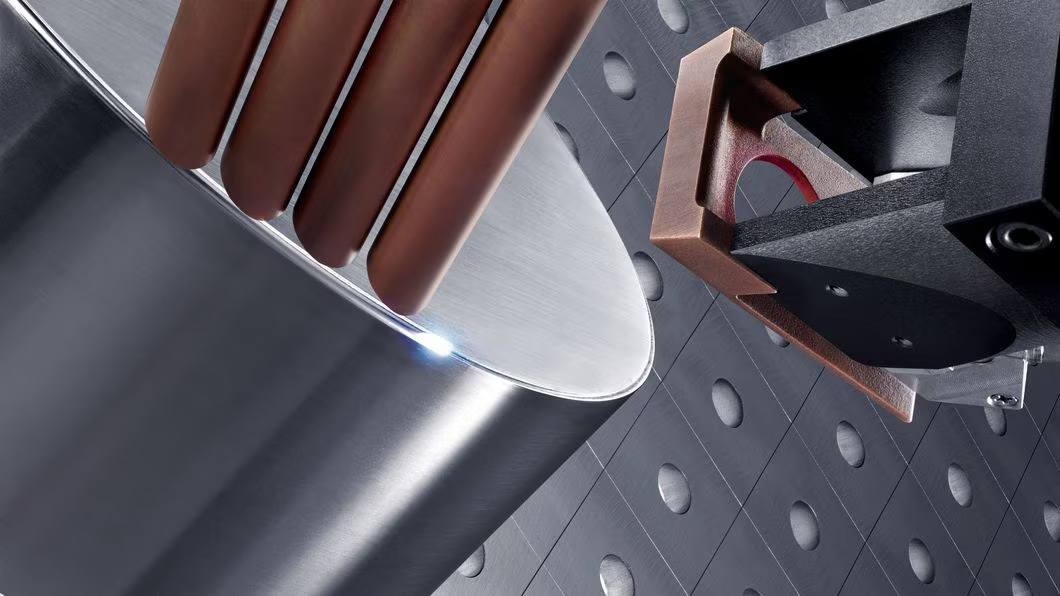
Industrial laser diodes aren’t just riding a trend; they are driving one. Here is where the high-power applications are changing the factory floor.
Welding: Speed, Precision, and a Lower Skills Barrier
Handheld laser welding has changed one of manufacturing’s oldest assumptions: that fast welding requires a certified expert. Powered by high-efficiency diode pump sources, handheld fiber laser welders run 3–10x faster than traditional TIG welding. The heat-affected zone (HAZ) stays under 1mm, and deformation is minimal. Sheet metal fabricators are replacing TIG setups and retraining existing floor staff in days, not months.
Precision Jewelry Micro-Welding opens another dimension. Jewelry and instrument manufacturers work with gold, silver, and platinum—materials that are highly reflective and heat-sensitive. Using targeted wavelengths, diode-pumped systems now achieve flawless, non-destructive spot welds. Yield rates run 98–99%, establishing a new precision benchmark for the jewelry industry.
Battery Manufacturing: Where Tolerances Matter Most
The EV and renewables surge is pushing massive demand for automated laser welding in the new energy sector. Battery manufacturing shows exactly why diode laser stability is non-negotiable. Tab welding requires melt depth control held to ±0.05mm tolerance. Explosion-proof valve sealing and busbar joints run on the same tight parameters. In automated lines, beam power fluctuation must stay below 1%. Diode arrays provide the exact, stable energy required to prevent field failures in battery packs.
Surface Processing: Laser Cleaning and Marking
Laser rust and paint removal runs 10x faster than chemical stripping—with zero consumables, no solvents, and no disposal costs. Similarly, precision marking provides permanent traceability marks (batch codes, QR patterns) at 0.1mm resolution, applied without contact and without degradation over the part’s full service life.
The Factory Floor in 2026
Smart manufacturing investment is picking up speed across all these areas. 80% of industry leaders are committing 20% or more of their budgets to automation, AI, and IoT integration. AI-driven process optimization cuts rejection rates by 40%. IoT-connected laser systems feed into the 25% downtime reduction smart factories are already reporting.
Chipmaking is pulling in $500B+ in new investment, with a 3x capacity expansion projected by 2032. Demand for precision laser fabrication is structural — not cyclical. Diode laser systems sit at the center of that build-out, and that position isn’t going anywhere.
How to Choose the Right Laser Equipment for Your Production Line
Bad equipment choices show up six months later in scrap rates. Getting this right starts with your materials, not a catalog.
1. Match Wavelength and Power to Your Process (Welding, Cutting, or Engraving): Material absorption drives every decision. Carbon steel absorbs 35% of energy at 1.06µm, making fiber or diode-pumped systems ideal for welding. For laser engraving and marking, wavelength dictates the contrast, depth, and clarity you can achieve. A 1064nm wavelength excels at high-contrast permanent marks on bare metals, while other specifications are needed to avoid burning heat-sensitive plastics. You need a setup configured specifically for your material’s absorption profile.
2. Volume Determines Automation Level:
-
<500 parts/month: Handheld welding setups or manual workstation laser engravers for small batch processing.
-
500–5,000 parts/month: Semi-automated systems, matched precisely to your required welding thickness or engraving speed (mm/s).
-
>5,000 parts/month: Full automation lines (essential for EV battery manufacturing or high-speed “flying” laser marking on continuous conveyor belts).
3. Evaluate Vendors With a Weighted Scorecard: Request actual test cuts, welds, or engraving samples on your exact production materials. Check for automation compatibility, technical support responsiveness, and the Total Cost of Ownership (TCO) over a five-year period.
Conclusion

Laser diodes aren’t just components. They are the competitive edge built into every precision-driven manufacturing operation today.
From the basic physics of stimulated emission to real throughput gains in handheld welding, jewelry repair, and new energy automated lines, the technology is proven. What separates leaders from laggards right now isn’t access to information; it’s the willingness to act on it.
Ready to evaluate a laser welding system for your application? Need help matching laser wavelength and power specs to your production requirements? MaxWave’s engineering team has done exactly this across dozens of industries. We know what works for your specific materials.
Don’t guess. Get it right the first time.