
Every gram of 14K gold costs more today than it did six months ago. Your prices haven’t moved? Your bench profits already have — and not in your favor.
This isn’t a market trend you can wait out.
14k gold melt value kept climbing through 2025. It shows no signs of slowing in 2026. Jewelers who treat gold as a fixed line item are losing margin on every single piece. It adds up fast.
This guide is about precision, not panic. You’ll get the exact formulas, purchasing strategies, and client communication tools you need. Use them to set prices with confidence — no matter where precious metal pricing in 2026 goes next.
What Is 14K Gold Price Per Gram Right Now — and Why It Keeps Climbing in 2026
The number landed in mid-April 2026: $85.49–$89.90 per gram for 14K gold in USD. In Europe, Italian jewelers saw their material cost rise from €78.86 to €81.69 per gram in one week. That’s a 3.58% jump in seven days.
That’s not volatility. That’s a new floor being built under your feet.
Here’s the math that drives it. One gram of 14K gold contains 0.5833 grams of pure gold. Pure gold trades at $122.55 per gram (24K spot rate, mid-April 2026). That 58.3% purity ratio feeds straight into your 14k melt value — every single day, no exceptions.
The karat gold price difference makes this concrete:
|
Karat |
Price Per Gram (USD) |
|---|---|
|
24K |
$122.55 |
|
18K |
$91.45 |
|
14K |
$70.00 |
|
10K |
$47.64 |
Currency adds another layer. USD/EUR sits at 0.8477. European bench jewelers face a double squeeze — precious metal pricing in 2026 shifts with gold spot moves and with every tick of the exchange rate. Both hit at once.
The market isn’t waiting for you to update your price sheet.

How Rising 14K Gold Price Per Gram Erodes Your Bench Profit Margin
Gold now accounts for 60% of total material costs in a finished jewelry piece. That one number tells the whole story—especially when you track the 14K gold price per gram.
Gold doesn’t nudge your margin — it bulldozes it. Here’s what the numbers show:
-
Gold spot moves from $2,300 → $3,500/oz — a 52% baseline jump already baked into your current material costs
-
A 14K ring with a melt value of $300 last year now runs $450
-
Your bench fee — say, $50–$150 per piece — hasn’t changed
-
That fixed fee once covered 20% of total cost. Now it covers 8%
That gap is your vanishing margin.
Raising retail prices helps — but not enough. A 10% price increase offsets some gold cost. It also cuts out about 10% of your customers. One major competitor raised prices 30% at once. The market pushed back hard and fast.
By end-2026, forecasts put pure gold above $193/gram — meaning 14K lands near $112/gram. That’s a 22–38% year-over-year loss for any bench still running fixed-margin pricing. The erosion is steady and it compounds fast.
The math is simple. It’s just unforgiving.
The Bench Jeweler’s 14K Gold Pricing Formula: Calculate Your True Cost Per Piece
Most bench jewelers undercharge for materials — not because they’re bad at math, but because they’re working with incomplete math.
Here’s the complete formula. Commit it to memory:
Weight (grams) × 0.583 × spot gold price per gram = 14K melt cost
That 0.583 is your purity multiplier. It’s the decimal form of 14/24 — the exact ratio of pure gold in every gram of 14K alloy. Spot gold trades in pure form. Your bench works in 14K. That multiplier connects the two.
Run the numbers on your current work:
|
Piece |
Weight |
Gold Melt Cost (spot $100.85/g) |
|---|---|---|
|
Ring |
8g |
$470.64 |
|
Necklace |
10g |
$588.30 |
|
Bracelet |
20g |
$1,176.60 |
These aren’t retail prices. They’re your floor — the absolute minimum your materials cost before a single minute of labor hits the clock.
Your full cost-per-piece formula looks like this:
(Metal + stones + findings + packaging) × 4 + pro-rated labor + 10% overhead
Take a simple example: $6 in materials × 4 = $24, plus $10 in bench labor = $34, plus 10% overhead = $37.40 base price. That 4× multiplier covers wholesale margin, retail buffer, and market shifts in one step.
One key adjustment: purchased your 14K sheet or wire at a fixed pennyweight cost? Use that actual purchase price — not live spot. Your real material cost is what you paid. Not what gold traded at the day you sat down to work.
Build a Dynamic Pricing System That Auto-Adjusts as Gold Spot Price Shifts
Static pricing is a liability you can no longer afford.
Gold spot updates every second across LBMA, COMEX, and OTC markets. Your quote sheet from three weeks ago is already wrong. The gap between that number and today’s real 14K gold price per gram eats straight into your margin.
The fix isn’t complicated. It’s a system.
Set Your Trigger Threshold First
Don’t reprice on every tick. That’s noise. Build a threshold instead — a specific percentage shift that signals a real pricing event.
A ±1% hourly move is the standard volatility trigger institutional dealers use. For a bench jeweler, here’s what that looks like in practice:
-
Spot moves less than 1%? Hold your current quote.
-
Spot moves 1–2%? Flag it. Recalculate before your next client estimate.
-
Spot moves beyond 2%? Reprice now. No exceptions.
Build the Adjustment Formula Into Your Workflow
Here’s the working formula:
Adjusted Material Cost = Spot × 0.583 × (1 + Fabrication Margin%) × Currency Factor
Add a 3–8% fabrication premium over spot. This covers logistics, small-order surcharges, and supplier markup. Sourcing in EUR? Layer the current USD/EUR conversion on top. Both variables move — so price for both.
Pull your live spot from a free XAU/USD feed. Check it before every new estimate. That one habit closes most of the margin leak.
The jewelers who stabilize their jewelry cost of goods sold in 2026 won’t be the ones with the best craft. They’ll be the ones who stopped treating gold as a fixed number.
Smart Batch Purchasing Strategy: Time Your 14K Gold Buys to Lower Per-Gram Acquisition Cost
Timing is a skill. Most bench jewelers treat gold buying like groceries — buy when you need it, pay whatever the market says. That worked when gold was $44/gram. At today’s prices, it quietly eats your profit.
The math behind batch buying is simple. Buy in volume during a dip — even just 2–3% below recent highs — and you lock in a lower cost across everything you produce in the next few weeks. While others keep buying at rising prices, your margins stay protected.
Here’s how to make it work in practice:
-
Set a buy trigger. Pick a price that signals a real dip — around 3–5% below your 30-day average. When gold hits it, buy. No hesitation, no second-guessing.
-
Know your float capacity. Batch buying only works if your cash flow can support 4–6 weeks of materials. Don’t guess — calculate your safe range before you need it.
-
Verify what you’re buying. Always check for the 585 hallmark (58.5% purity). No stamp, no deal. If your supplier isn’t clear, that’s already a red flag.
-
Document your acquisition cost. Record your exact per-gram purchase price every time. That number — not live spot — is what actually determines your profit.
The goal isn’t to beat the gold market. No one does that consistently. The real goal is simple: stop buying at the worst possible time.
Build a system. Follow it. Stay in control.
Alloy Strategy: 10K vs 14K vs 18K — Protecting Your Jewelry Bench Profit Margin

The karat you recommend isn’t just a technical decision. It’s a margin decision.
Most bench jewelers default to 14K for everything. That worked when gold was $44/gram. At today’s prices, that habit quietly cuts into your profit—sometimes more than you realize.
The logic is simple. Different karats serve different customers. Match the right alloy to the right buyer, and you protect your margin without even touching your retail price.
Match the Karat to the Customer — Not the Other Way Around
10K (41.7% pure, hallmark 417) This is your workhorse. Lower gold content means lower material cost—and higher margin at the same selling price. Offer this to customers who actually use their hands: mechanics, construction workers, active lifestyles. It’s tougher, more durable, and easier to justify. You’ll also see fewer repairs, fewer remakes, and fewer headaches. Less time fixing problems = more time making money.
14K (58.3% pure, hallmark 585) This is still your volume driver. It covers the widest customer base, has the strongest resale market, and sits right in the “safe choice” zone for most buyers. Engagement rings, wedding bands, daily wear—14K is what most people expect. It’s not exciting—but it’s reliable. And that’s why it sells.
18K (75% pure, hallmark 750) This is where your margin expands. The price jump from 14K to 18K typically runs 44–56%. On real pieces, that adds up fast:
-
A single 8mm Cuban chain at 22 inches
-
14K price: $13,452
-
18K price: $19,325
-
Difference: nearly $6,000 on one piece
That’s not a small upgrade—it’s a major revenue shift.
And for the right customer, it makes sense. Better color, higher gold content, stronger resale value. You’re not upselling—you’re aligning with what they already want. The richer color, the skin-sensitivity advantage, and the stronger resale value give luxury and investment-minded buyers solid reasons to go with 18K. You’re not upselling — you’re matching them to what they actually want.
One point worth making to every client, no matter the karat: all three options track global gold prices and carry real metal value. That conversation puts your work in a different category from plated or fashion pieces. It also gives customers confidence that what they’re buying is worth protecting — and worth coming back to you for.
How to Talk to Clients About Gold Price Increases Without Losing the Sale
Raising your prices is never the hard part. The hard part is saying it out loud to someone who’s been trusting you with their custom work for three years.
Here’s what most bench jewelers avoid saying: clients don’t leave because you raised your prices. They leave because the news felt like a surprise. Or worse, like you were hiding something. Get the communication right, and most of them stay.
Start the conversation 60–90 days before the new rate takes effect. That lead time matters. It gives clients time to process, budget, and come back with questions instead of complaints. A quick email to your full list works fine for the first heads-up. But your long-standing clients — and anyone you already know will push back — deserve a direct, personal conversation. Phone call, coffee, whatever fits the relationship. Don’t let those conversations happen by accident.
Keep the structure tight:
-
Lead with appreciation. Name the relationship before you name the number.
-
State the new price and the effective date up front. No softening, no buried language. “The new rate is $X starting [date].”
-
Explain the reason in one or two sentences. “14K gold melt value has climbed over 50% in the past 18 months. That shift runs straight through to material costs on every piece.”
-
Reinforce your value with something specific. A piece you made together. A remake you handled without complaint. Something concrete from your history together.
When They Push Back
Some clients will push back. Be ready for it — not with defense, just with calm preparation.
|
What They Say |
What You Say |
|---|---|
|
“That’s a big jump. We’ve been coming to you for years.” |
“I know, and that relationship means a great deal to me. This reflects where material costs and my service level sit right now. Let’s walk through what’s changed.” |
|
“We might need to look around.” |
“That makes sense. Do what’s right for your business. I’m here if you want to talk through what fits.” |
Add one more move to every price conversation: frame the increase as a market condition, not a personal choice. Smart gold pricing for jewelers starts with this mindset. The impact of gold spot prices on jewelry costs isn’t your call — it’s the LBMA’s. Separating those two things takes the tension down fast. Ask clients what price pressure they’re seeing in their own work or purchases. That one question shifts the conversation from confrontation to shared reality.
Don’t hide the increase inside a longer invoice. Don’t apologize in ways that invite negotiation. State it, explain it, stand behind it. Clients worth keeping will respect the honesty. The ones who won’t were already looking for a reason to leave.
Pricing Transparency Documentation: The Itemized Invoice That Justifies Your Rates
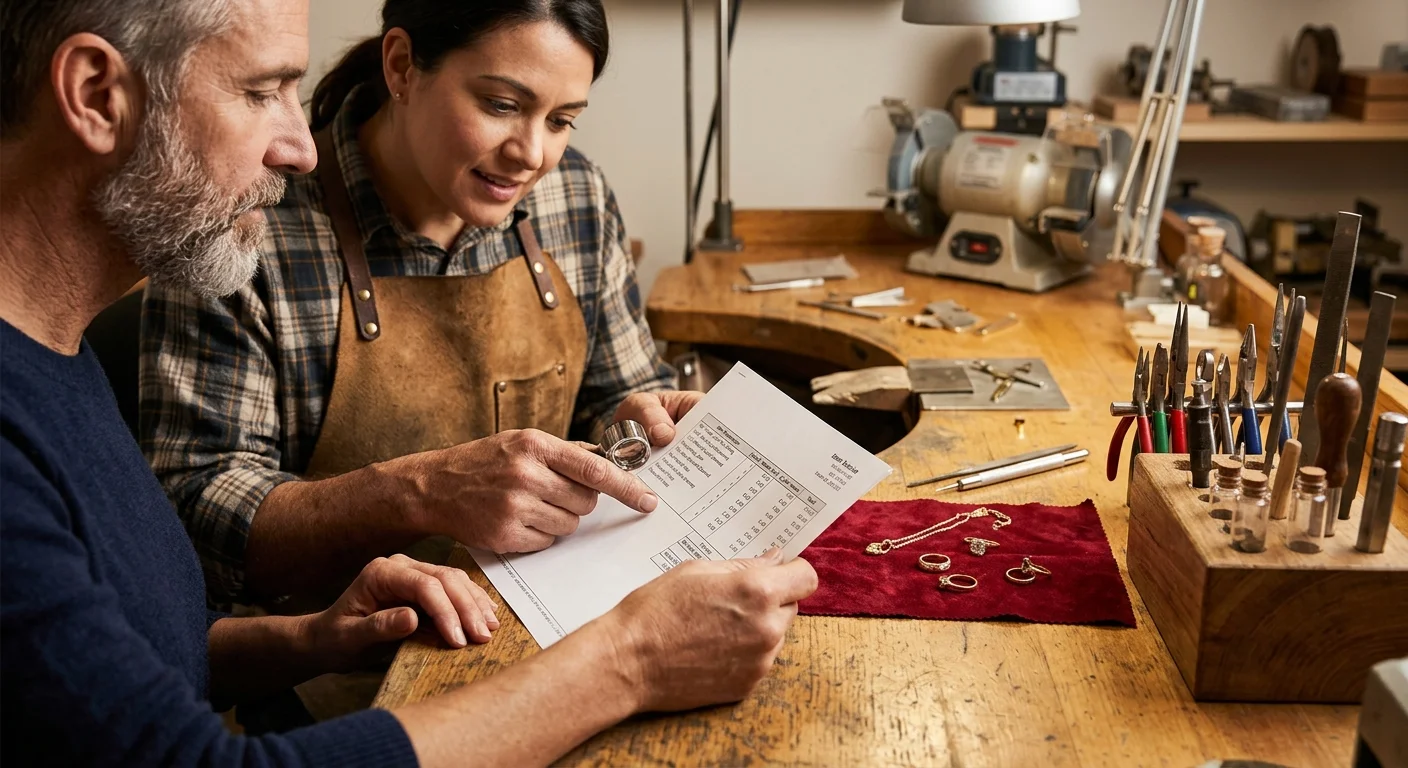
An itemized invoice does more than record what happened. It makes your pricing hard to argue with.
A single number at the bottom of a page puts clients in negotiation mode. But a full breakdown changes everything. Show them 8 grams of 14K gold at $89.87/gram, 2.5 hours of bench labor at your hourly rate, stone setting, findings, finishing — and they’re reading a story. That story makes sense to them.
Build every invoice with these core lines:
-
Metal cost: weight × 0.583 × spot price per gram on purchase date
-
Labor: actual hours × your bench rate
-
Findings and consumables: solder, polishing compound, prongs
-
Stone setting or special work: listed as its own line, not bundled with anything else
-
Subtotal → applicable tax → grand total
That gold line item is your armor. It shows where the 14K gold price per gram increase landed — on the invoice, not on your credibility. Clients who see your costs don’t walk. They send people your way.
2026 Gold Price Forecast and What It Means for Your Long-Term Bench Business Strategy
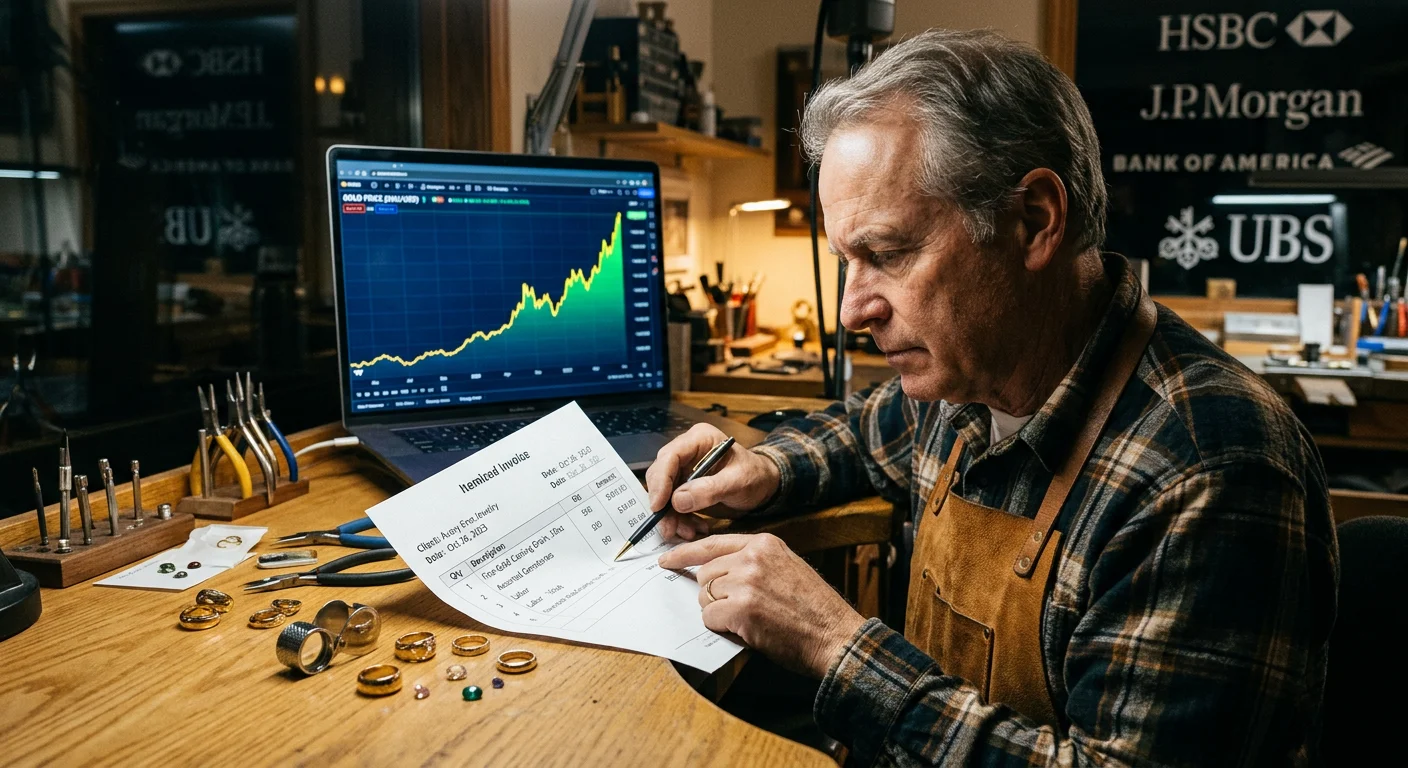
The banks aren’t whispering anymore. Goldman Sachs calls $5,400 by year-end. JPMorgan says $6,300. Deutsche Bank and Societe Generale both land at $6,000. These aren’t fringe predictions. This is the institutional consensus. Gold already hit an all-time high of $5,600 on January 29, 2026. The ceiling keeps moving—and so does the 14K gold price per gram.
Three forces are driving this. None of them are going away:
-
Central banks are buying 60 tonnes per month. China alone ran 15 consecutive months of purchases through January 2026.
-
ETF inflows pulled in 500 tonnes from Western markets since the start of 2025.
-
Fed rate cuts add an estimated $120/oz in support for every 0.5% easing cycle.
For your bench, that math points to one thing: 14K gold approaching $112/gram before 2026 closes.
Build your long-term strategy around three price triggers:
-
Buy dips below $4,200 — that’s the bull/bear line. Serious pullbacks have found support there before, and the pattern holds.
-
Lock material costs fast on any rally pause — don’t wait for confirmation.
-
Hold your pricing discipline through volatility — 43% of the last 30 trading days closed green. The trend isn’t reversing.
The jewelers still standing at the end of this cycle won’t be the ones who called gold’s price spot-on. They’ll be the ones who stopped pretending the old numbers still work.
FAQ: 14K Gold Price Per Gram — Jeweler’s Quick Reference
Straight answers. No filler.
What is 14K gold worth per gram right now?
Current spot runs $89.87–$95.55/gram USD. That’s your melt floor — not your sell price.
How do I calculate it myself?
One formula. Same every time:
Weight (g) × 0.583 × 24K spot price per gram = 14K melt value
At $95.53/g spot, a 10g chain holds $955.30 in raw metal. That number shifts every day.
What will a buyer pay me?
Expect 60–95% of spot — it depends on the buyer, volume, and form. Take a real example: $81.50/g buyback against $89.65/g spot. That gap covers their overhead. Know the difference before you walk in.
Quick unit reference (current range):
|
Unit |
USD Value |
|---|---|
|
Gram |
$89.87–$95.55 |
|
Troy oz |
$2,659–$2,973 |
|
Kilogram |
$85,493–$95,594 |
Why does spot show 24K prices?
Spot quotes pure gold only. Take that number and multiply by 0.583 to get your 14K value.
Conclusion
The gold market isn’t slowing down—and in 2026, it’s moving fast.
Your 14K cost isn’t fixed. It changes daily. Profitable jewelers aren’t guessing—they’re using smarter systems to stay ahead.
Now check your numbers. Recalculate your last few orders with today’s gold price.
If your margins dropped, it’s time to adjust.
Not sure how to optimize your pricing or workflow? Talk to us.
We’ll help you improve efficiency, reduce waste, and stay profitable with the right tools.
Gold will keep rising.
Make sure your strategy does too.