
The world of interior finishing is undergoing a profound digital transformation. For decades, designers wanting high-end custom art on their walls had only two real choices: hiring an expensive artist for weeks of hand-painting or using patterned wallpaper that inevitably showed seams and lacked originality. However, with the rise of Vertical Printing technology, this traditional landscape is being completely reshaped. This is more than just a new tool; it is a “digital bridge” that brings infinite creativity directly from the computer screen to physical spaces.
The Future of Walls: What is a Vertical Printer?
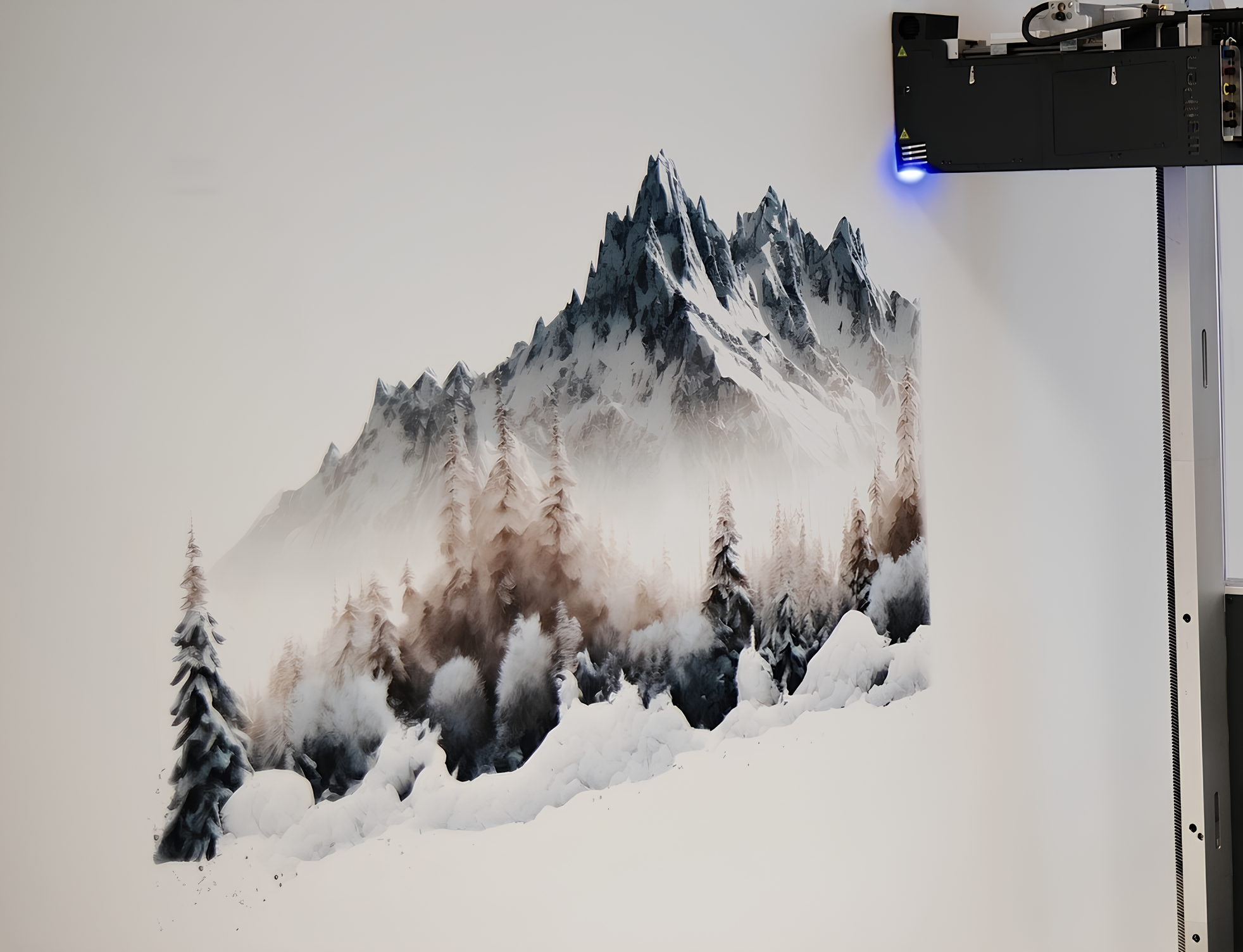
Technically speaking, a vertical wall printer is an intelligent robot capable of high-resolution inkjet printing directly onto vertical surfaces. Its core competitive edge lies in its high-precision ultrasonic sensor system. During the printing process, these sensors scan the wall in real-time, directing the printhead to automatically adjust its distance. This ensures a flawless image even on surfaces that aren’t perfectly flat, avoiding the distortion or blurring common with traditional methods.
Furthermore, the application of UV-curing technology allows for a “ready-to-use” experience. A built-in UV lamp follows the printhead, instantly curing (drying) the ink the moment it hits the wall. This not only results in vibrant, scratch-resistant colors but also solves the biggest pain point in interior renovation: odors and environmental safety. Because the ink dries instantly and remains stable, the space can be occupied immediately—even in sensitive environments like hospitals or children’s bedrooms.
Why It’s Replacing Traditional Decor Methods
Compared to manual painting or wallpapering, vertical print offers a “generational leap” in both efficiency and precision:
- Lightning-Fast Delivery: A complex, detail-rich mural that would take a painter days can now be finished in just a few hours. For commercial projects like restaurants or offices, this means significantly reduced downtime.
- Pixel-Perfect Accuracy: Whether it’s a high-resolution photograph or a subtle gradient, vertical printing achieves a 1:1 replica. You no longer have to worry about the artist’s “off-days”; what you see on the screen is exactly what you get on the wall.
- Total Material Compatibility: Its versatility is unmatched. Beyond standard latex-painted walls, it can bond seamlessly with glass, tile, wood, concrete, and even polished metal.
What Does One Cost?
The 2026 market breaks down into three clear price tiers:
| Tier | Price Range | Example Brand |
| Budget entry | $8,300–$15,000 | MaxWave MW-GP200X, Dxonjet VPJet4.0 |
| Mid-market | $25,000–$35,000 | TWP T Series |
| Premium | $45,000–$60,000+ | wallPen E2 |
From Homes to Offices: Top Spaces for Wall Printing
The applications for vertical printing are limited only by your imagination, but three sectors are leading the charge:
-
Commercial Brand Impact: Restaurants, hotels, and corporate offices are using custom wall art to boost their brand identity. A custom-printed lobby creates an instant “wow factor” that traditional paint simply cannot match.
-
Modern Residential Trends: Homeowners are choosing personalized feature walls over generic wallpaper. From vacation landscapes to abstract art that matches their furniture palette, the level of customization is unprecedented.
-
Public & Educational Spaces: Schools and hospitals use vertical printing for durable, easy-to-clean educational murals and wayfinding signs that are both functional and beautiful.
The Business Value: Why It’s a Profitable Move
For decoration companies, introducing vertical print is not just an aesthetic upgrade—it’s a business model evolution. In an era where labor costs are skyrocketing, the “One Man, One Machine” model drastically slashes overhead. Moreover, this high-tech approach serves as a powerful marketing hook. Offering “same-day design and delivery” for custom interiors allows a business to stand out instantly in a crowded market.
From an ROI (Return on Investment) standpoint, the cost of ink is remarkably low, while the premium clients are willing to pay for bespoke digital art is high. Many partners who have invested in Maxwave Laser equipment find that with a steady stream of projects, the machine pays for itself within just a few months.

A Buyer’s Guide: What to Know Before You Dive In
While the future of vertical printing is bright, there are a few key points to consider before investing:
Surface Preparation: While sensors handle minor bumps, the best resolution is always achieved on a smooth, primed surface.
The Learning Curve: The operation is highly automated, but a new operator typically needs 2–3 days of training to master image processing software and machine calibration.
Manufacturer Reliability: Long-term success depends on technical support and a steady supply of quality ink. Choosing a manufacturer with deep technical roots, such as Maxwave Laser, ensures you aren’t left stranded during a project.
Conclusion
The future of interior finishing is digital and personalized. Vertical wall printing has simplified complex crafts and made high-end art accessible to everyone, turning every wall into a canvas of endless possibilities. If you are looking to renovate a space or seeking the next big trend in the decor industry, vertical printing is undoubtedly the answer.