
You’ve seen the spec sheets—laser welding aluminum is fast, clean, and precise. But one question actually matters: how thick can you weld? Most answers fall short, because real penetration isn’t fixed—it shifts with power, welding mode, alloy type, and process control. Change one variable, and the result changes.
This guide focuses on real-world performance. You’ll get practical power-to-thickness benchmarks, the key factors that actually drive penetration, and a clear way to judge whether laser welding fits your application.
From aerospace to EV batteries, thickness isn’t just a spec—it determines whether the process works at all. A 1.5kW system and a 6kW system operate in completely different ranges, and alloys like 6061 and 5052 behave differently under the same conditions. Below, you’ll find the benchmarks and process limits that define those boundaries—so you can make the call before your weld does.
Laser Welding Aluminum: Power vs Thickness (Real Data)
Here’s the table nobody puts in their brochure. It shows what a laser does under real production pressure — not on a laboratory coupon, but on the actual material sitting in your fixture.
The numbers below come from fiber laser systems running under real shop conditions. Two columns matter most: Stable Production Thickness and Single-Pass Max. That gap between them is where most projects fall apart.
| Laser Power | Single-Pass Max Thickness | Stable Production Thickness | Absolute Max |
| 400–1000W | 2–4 mm | 1–3 mm | 3–5 mm |
| 1500W | 3–6 mm | 3–4 mm | 4–6 mm |
| 2000W | 4–6 mm | 3–5 mm | 5–6 mm |
| 3000W | 6–8 mm | 4–6 mm | 6–8 mm |
| 3–6 kW | 8–12 mm | 6–10 mm | 10–12 mm |
| 6 kW+ | 12–25 mm | 8–15 mm | 18–30 mm |
The Gap Between “Rated Max” and Reality
Equipment manufacturers rate single-pass full penetration under optimized, controlled conditions. That’s a fair engineering number. It is not your laser welding aluminum thickness in production.
In practice, the stable repeatable figure runs 20–50% lower than the rated maximum. A 3kW system rated to 8mm single-pass? Your dependable operating range is 4–6mm. Push toward the ceiling and you trade weld consistency for occasional heroics. Most quality-conscious shops won’t make that trade.
There’s another side worth knowing. Lock in your process — tight focus control, clean pierce sequences, nitrogen assist pressure in the 16–18 bar range — and you can gain 20% additional melt depth through stability alone. Not by upgrading your laser. Just by running the one you have with more discipline.
Alloy Makes a Measurable Difference
Two alloys lead aluminum fabrication. They don’t behave the same under the beam.
6061-T6 is harder, conducts heat well, and needs higher energy input to reach the same penetration depth:
– At 3kW: reaches 1.5mm penetration at 22 m/min
– At 6kW: reaches 6mm penetration at 3.5 m/min
5052 runs softer and responds faster to the laser. That sensitivity cuts both ways — it’s also more prone to porosity if your process isn’t clean:
– At 3kW: reaches 2mm penetration at 18 m/min
– At 6kW: reaches 5mm penetration at 4 m/min
Same power level. Very different results. Specifying equipment based on generic “aluminum” capability — without accounting for alloy — builds on an assumption that will cost you.
Power Thresholds by Thickness Range
Here’s how material thickness maps to required laser power:
-
0.5–3mm aluminum: 1000–2000W at 1000–3000 mm/min
-
4–8mm aluminum: 2000–4000W at 500–1500 mm/min
-
9–15mm aluminum: 4000W+ at 200–800 mm/min
Watch what happens to speed as thickness goes up. At 9mm and above, the beam moves slow enough that heat management becomes the main challenge. Shielding gas coverage, focal position stability, surface prep — none of these are secondary concerns anymore. They are the whole game. The laser has enough power. The real question is whether your process control is tight enough to let it perform.
Why is Aluminum Hard to Weld?
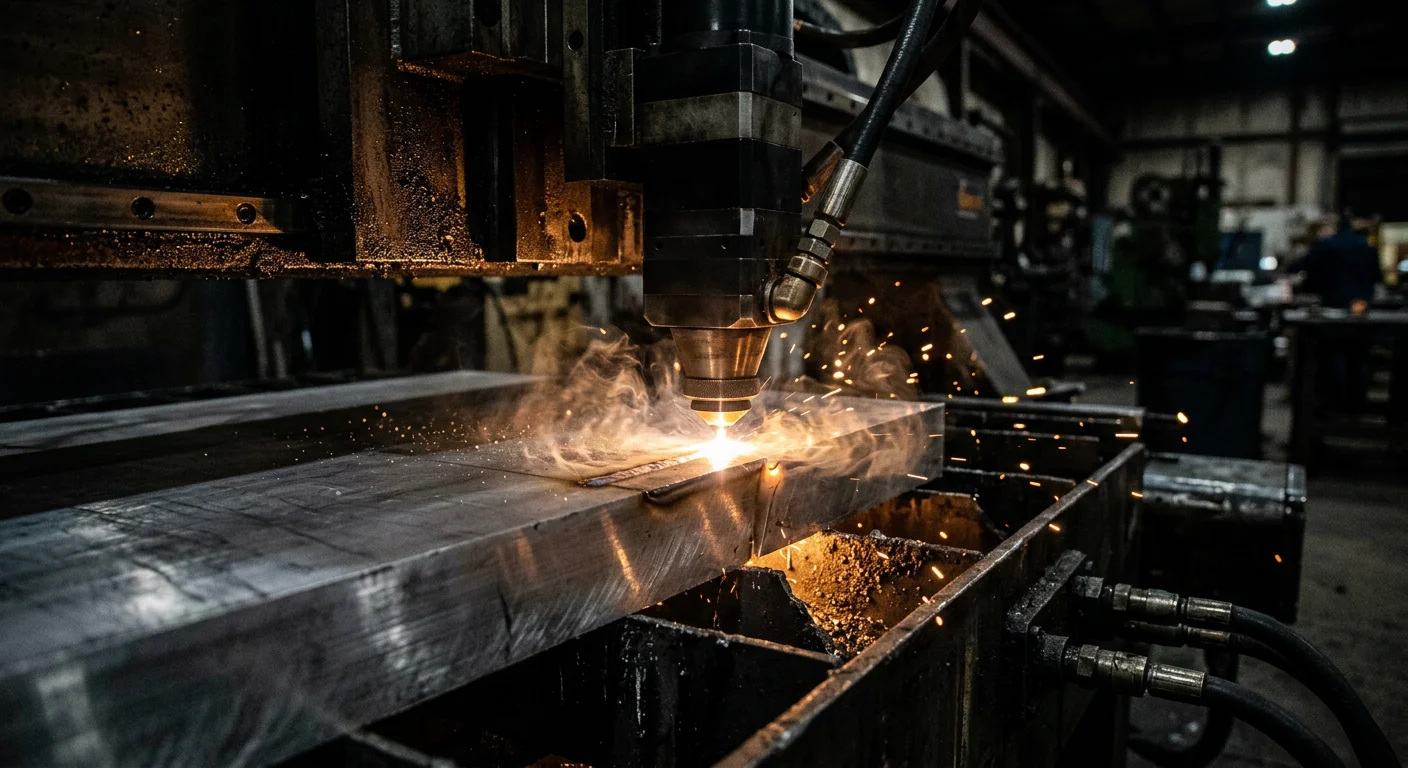
Aluminum looks easy to work with—light, machinable, and widely used. Then you try laser welding aluminum, and it behaves very differently from steel.
The reasons are rooted in physics. They explain why aluminum requires higher power, tighter parameters, and stricter process control.
The Oxide Layer Problem
Every aluminum surface has an oxide layer (Al₂O₃) that melts at 2,072°C, while the base metal melts at 660°C. The surface requires over three times the energy to break down.
The oxide doesn’t float like slag—it sinks into the weld pool, causing inclusions and poor fusion. Without proper cleaning, defects form before welding begins.
Heat Goes Everywhere — Fast
Aluminum conducts heat at 237 W/(m·K), about five times faster than steel. Heat spreads before a stable melt pool forms, requiring a highly concentrated energy source.
But this also creates risks:
-
Fast heat spread causes distortion and burn-through
-
Low melting point (660°C) leaves a narrow process window
-
Small overheating leads to failure
Hydrogen Porosity: The Silent Defect
Liquid aluminum absorbs hydrogen, but solid aluminum does not. As the weld pool solidifies quickly, trapped hydrogen forms porosity.
Sources are common—moisture, contamination, or shielding gas impurities—leading to welds that look clean but fail under load.
Thermal Expansion and Hot Cracking
Aluminum expands about twice as much as steel, creating high shrinkage stress during cooling and increasing the risk of distortion and cracking.
Alloy differences matter:
-
6061 loses strength in the HAZ
-
5052 is more prone to porosity
Aluminum also lacks phase transformation during cooling, so grain structure remains coarse.
What This Means for Laser Welding
These factors don’t prevent welding—but they narrow the process window. Reflectivity, heat flow, porosity, and HAZ sensitivity all demand precise control.
The next sections break down power, speed, focus, and shielding—so you can run the process reliably.
Laser Welding Aluminum: Depth Beyond Power

Laser power gets all the attention. It’s the number on the spec sheet, the figure in the sales call, the headline metric everyone uses to size up a machine. But power alone doesn’t determine laser welding aluminum thickness. Four other variables do the real work. Let any one of them drift out of range, and your penetration depth drops—no matter how much wattage you’re running.
Focal Position
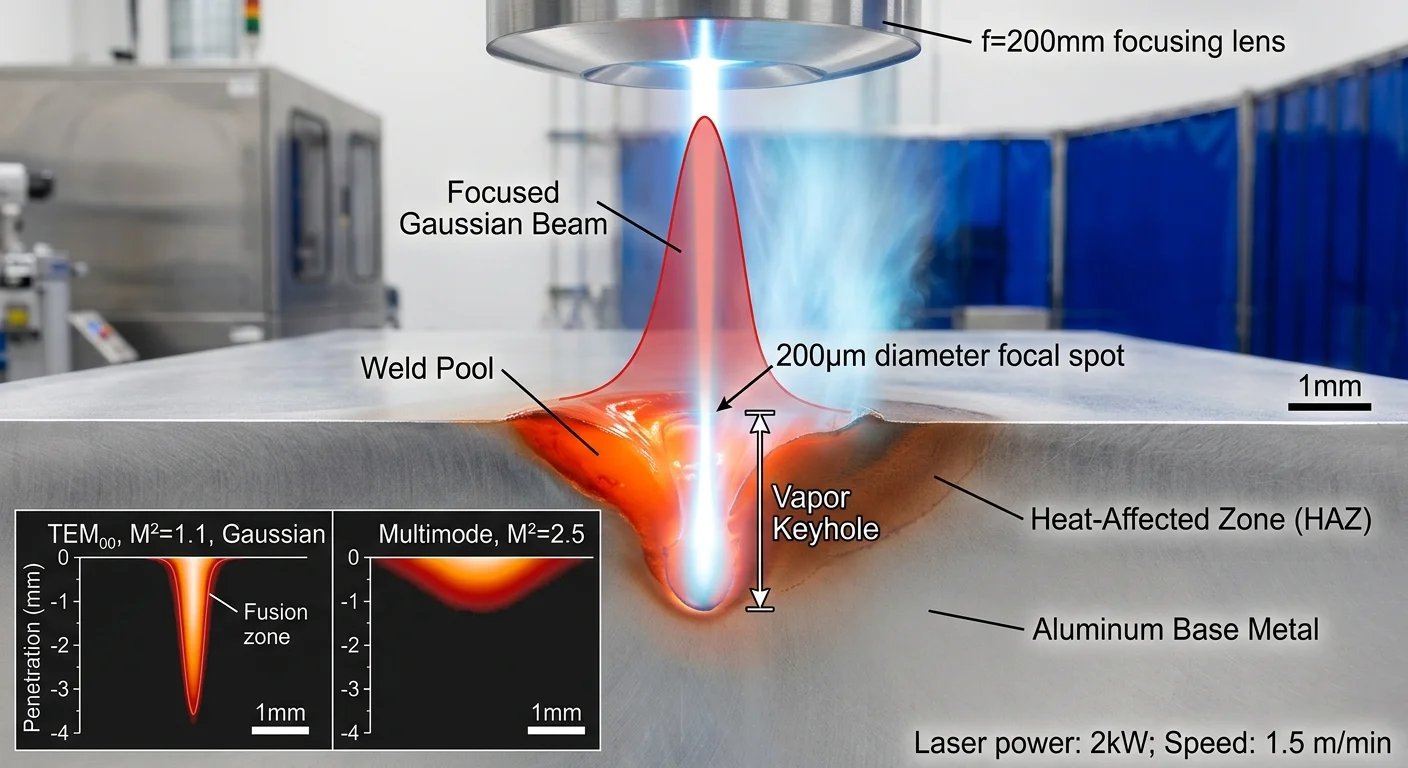
Focal position is the most sensitive variable in the entire process. Move the beam just ±0.5mm away from the optimal position. Penetration depth can fall by 15–20% — with no change to power, speed, or gas coverage.
For keyhole welding on aluminum, the focal point sits 0 to 2mm below the surface. That puts peak intensity inside the material, not on top of it. Conduction mode runs the focus at or just above the surface. This spreads the energy footprint and limits depth on purpose.
Tight focus control isn’t a refinement. It’s a baseline requirement.
Welding Speed
Speed and penetration move in opposite directions. Slow down, and the beam dwells longer — more energy per unit length, deeper melt. Speed up, and energy input drops. Penetration drops with it.
The relationship isn’t linear. That’s where most parameter tables mislead you. At very low speeds, excess heat input creates a turbulent melt pool. Porosity risk rises. The heat-affected zone widens. Depth barely increases. There’s a practical floor.
Practical working ranges:
– Thin sections (1–3mm): 2,000–4,000 mm/min
– Mid-range (4–8mm): 500–1,500 mm/min
– Thick sections (9mm+): 200–600 mm/min
Shielding Gas
Argon is the standard for aluminum laser welding. Helium raises the plasma ionization threshold and improves penetration at high powers — this matters most above 4kW. A mixed Ar/He blend (70/30 or 50/50) is common in thick-section work where plasma suppression is critical.
Flow rate also counts. Too low, and atmospheric contamination enters the weld zone. That feeds the hydrogen porosity mechanism described earlier. Too high, and turbulence destabilizes the melt pool. Keep flow rate between 15–25 L/min, adjusted for your nozzle geometry.
Beam Quality (M² Factor)
A fiber laser with an M² close to 1.0 produces a near-perfect Gaussian beam — tight focus, high intensity, strong keyhole formation. As M² rises, focus quality degrades. Penetration depth falls. For thick aluminum work, beam quality matters just as much as raw power output.
Laser Welding Aluminum Pro Tips for Deeper Penetration
Small process adjustments move the needle more than most engineers expect. Chase these variables before buying a higher-wattage laser welding machine — the gains are real, and they cost nothing extra.
Clean the Surface. Every Time.
Aluminum oxide reforms within hours of mechanical cleaning. Prep in the morning, weld after lunch — you’ve already lost ground. Clean right before fixturing. Use acetone first, then a stainless steel brush kept for aluminum only. Steel particles from shared brushes seed porosity before the beam ever touches the part.
Dial In Your Focus Position
You’ve already seen the numbers — a ±0.5mm focal drift kills 15–20% of your penetration depth. In production, thermal expansion in the workholding fixture can shift that position mid-run. Nobody catches it until the damage is done. Verify focal position at the start of each new batch. On long weld runs, check it again mid-run.
Ramp Your Power at the Pierce Point
Aluminum’s high reflectivity is most dangerous at weld start. The surface is still solid, the keyhole hasn’t formed yet, and the beam faces peak reflection risk. Use a power ramp-up sequence. Start at 40–50% power, then reach full output within the first 2–3mm of travel. This moves the material from conduction mode into keyhole mode cleanly, with no reflective spike.
Push Your Shielding Gas Coverage to the Side
Standard coaxial shielding covers the weld pool from above. Add a lateral trailing shield 15–20mm behind the beam. It keeps the solidifying bead protected longer as it cools. On thick-section aluminum laser welding, this one addition can cut surface porosity by a measurable margin.
Lock Your Travel Speed to ±2%
Speed variation is a hidden penetration killer. A 5% speed fluctuation swings energy input per unit length by 3–4% — enough to push a marginal weld in and out of spec on the same run. Servo-controlled motion systems hold speed tighter than older drive setups. Your equipment likely has real-time speed feedback. Use it. Treat anything outside ±2% as a reject condition.
Conclusion
Laser welding aluminum isn’t a guessing game — it’s an engineering decision. You now have the numbers to back that up: the right laser power, the right parameters, and a solid grasp of where the real limits are.
The bottom line? A well-configured fiber laser system for aluminum can handle far more than most people expect. But power, speed, focus, and shielding gas all need to work together. Miss one variable, and you’re not just losing penetration depth — you’re producing scrap.
Running 1mm sheet metal? Pushing into 10mm structural plate? The answer is the same either way. Match the machine to the material. Not the other way around.
Ready to find out which laser power level fits your aluminum application? Talk to a MaxWave specialist — bring your material specs, and we’ll bring the parameters.
The right weld starts with the right conversation.