
Picking between a MaxWave and a Miller laser welder sounds simple—two brands, one decision. But in reality, it quickly gets confusing as you compare specs, prices, and demos. And the stakes are real: a fiber laser welder isn’t cheap—the wrong choice can cost you thousands and limit your workflow. This guide cuts through the noise with real price comparisons, practical performance insights, and a clear verdict.
The timing matters too. The global laser welding market is already worth about $3 billion and growing fast toward $5 billion, with demand rising across fabrication, manufacturing, and EV industries. In this crowded market, MaxWave and Miller stand out—one focused on strong ROI at a more accessible price, the other on legacy brand value. Here’s what that difference really means for your business.
Maxwave Vs Miller Laser Welder: Quick Comparison Table
Here’s the part you scrolled to first. No judgment.
|
Feature |
Maxwave |
Miller |
|---|---|---|
|
Starting Price |
~$3,350 |
~$6,000+ |
|
Top Wattage |
3000W |
2000W |
|
Welding Speed |
Up to 4× faster than TIG |
Up to 3× faster than TIG |
|
Stainless Steel |
✅ |
✅ |
|
Aluminum |
✅ |
✅ |
|
Portability |
Handheld, compact |
Heavier industrial build |
|
Learning Curve |
Low |
Moderate |
|
ROI Timeline |
6–12 months |
12–24 months |
|
Overall Value Score |
⭐⭐⭐⭐⭐ |
⭐⭐⭐ |
The table covers most of what you need to know. Maxwave starts at half the price of Miller. It also delivers more raw wattage and gets operators up to speed faster. Miller has strong brand recognition and a long industrial history. But you pay a big premium just for that name on the machine.
The sections below explain why these numbers land where they do.
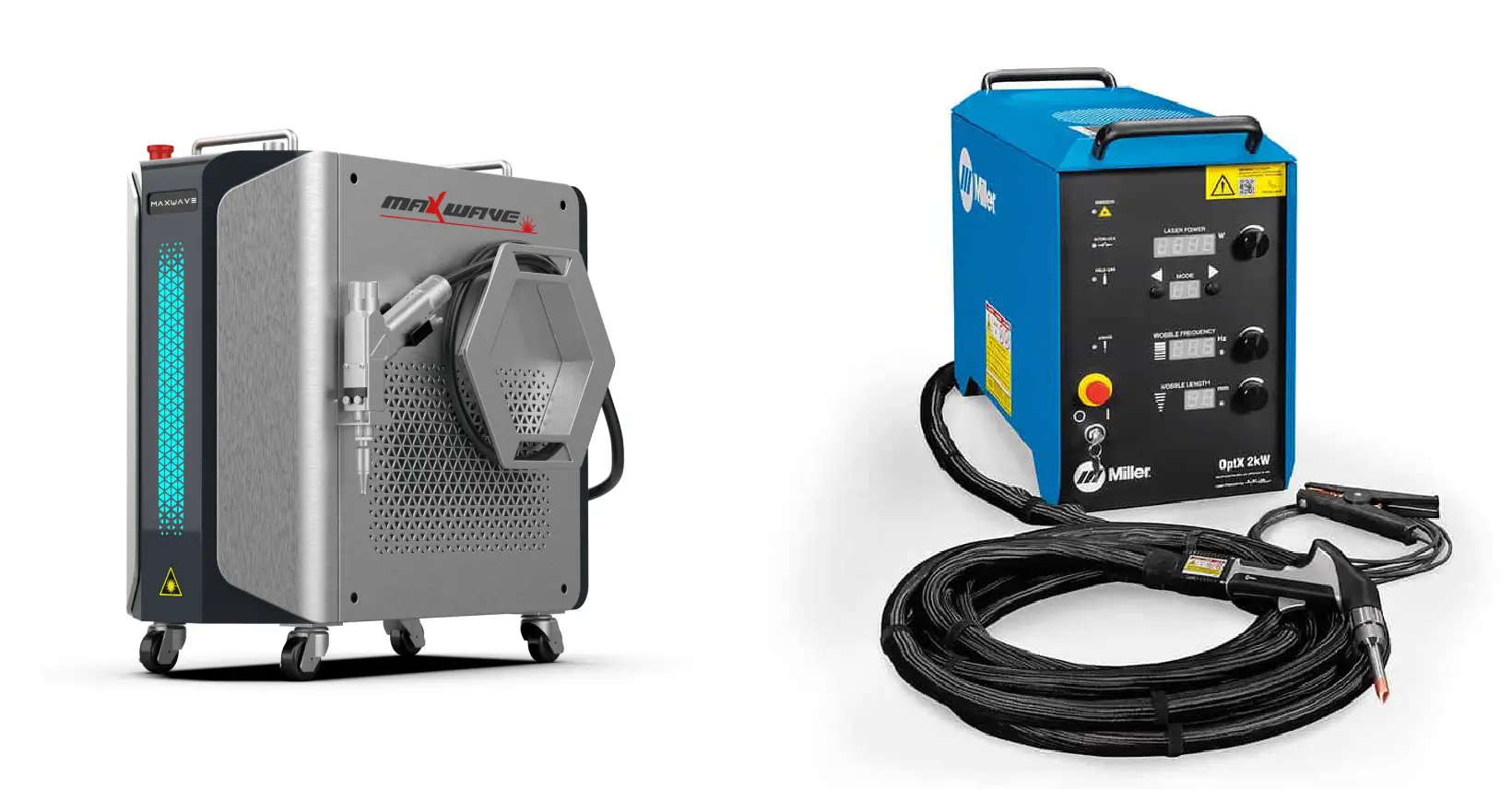
Maxwave Vs Miller Laser Welder: Brand Positioning
Maxwave and Miller are not competing for the same customer. That’s the most important thing to know before comparing anything else.
Miller spent decades building its name in traditional arc welding. It moved into laser technology and brought that industrial-grade reputation along — plus the high pricing that big legacy brands carry. Miller’s laser welders target large-scale manufacturing environments. Procurement budgets are large there. Downtime is costly. Brand recognition matters to purchasing committees.
Maxwave went a different direction. It spotted the gap Miller left open: small fabrication shops, independent welders, and growing businesses who need professional-grade laser performance without the enterprise price tag.
That gap is the whole story.
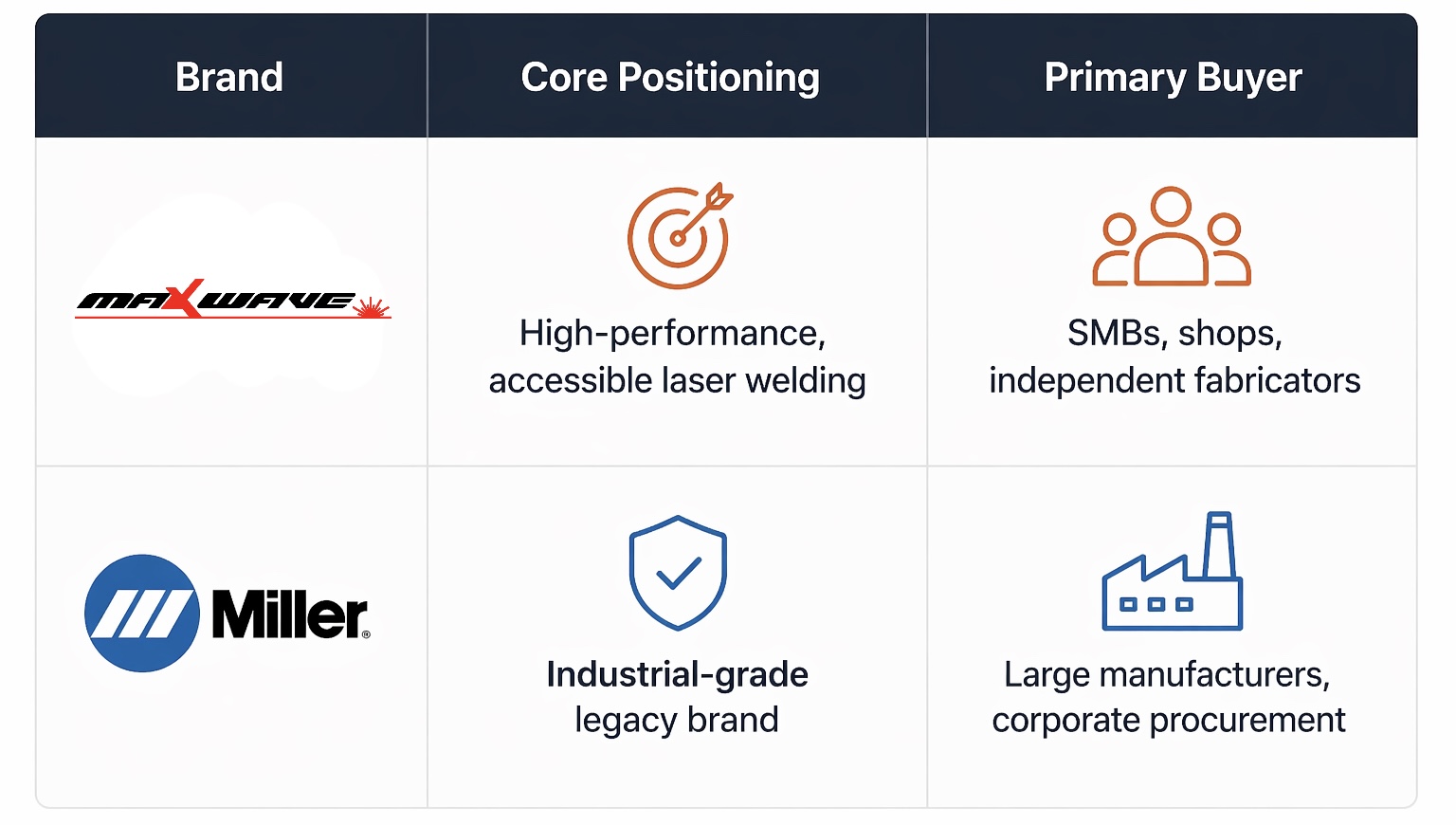
Maxwave isn’t trying to beat Miller at its own game. It serves a customer Miller can’t afford to focus on — and it’s winning that segment by a wide margin.
Price Comparison
Here’s a number worth sitting with: a 2000W Maxwave laser welder runs around $3,000–$6,900. A 2000W Coherent industrial system? Over $200,780. Same wattage. 30× the price difference.
That’s not a rounding error. That’s two completely different types of buyers.
What Maxwave Actually Costs
Maxwave prices its machines by wattage tier. The numbers are clear and easy to follow:
|
Power |
Max Thickness |
Price Range |
|---|---|---|
|
1000W |
3.5mm |
$3,000–$5,700 |
|
1500W |
4.5mm (8mm stainless) |
$4,300–$5,700 |
|
2000W |
5.5mm |
$3,000–$6,900 |
|
3000W |
6mm |
$4,300–$6,900 |
Every tier comes with 3-in-1 functionality — welding, cutting, and cleaning in one machine. That’s a real advantage. A shop that buys separate tools for each job can easily spend $10,000+. Maxwave handles all three in a single purchase.
Where Miller and Others Land
Miller starts at $6,000+. IPG Photonics’ comparable 1500W unit runs ~$6,500. TRUMPF’s industrial system? $350,900. These brands aren’t chasing the same buyer. Their sales process involves committee approvals and six-month vendor evaluations. That’s a different world.
So compare what you actually get. Maxwave’s 1500W air-cooled model welds stainless steel up to 8mm thick. IPG’s equivalent 1500W unit tops out at 3mm stainless. The Maxwave unit also costs $1,200 less.
The Real Cost Math
Hidden costs usually sit in the cooling system. Maxwave uses air-cooled technology across its full range. Miller use water-cooled systems. That means extra infrastructure, regular maintenance, and ongoing operational costs — none of which appear on the original price tag.
Add in Maxwave’s 12–24 month warranty and a 6–12 month ROI timeline. The total cost of ownership starts to look less like a budget pick and more like the smarter financial call.
Maxwave Vs Miller Laser Welder: Welding Performance
Numbers don’t lie — but they need context. So let’s get into the real performance data that separates these two machines on the shop floor, not just on a spec sheet.
Speed: Where Laser Welding Changes the Entire Equation
The biggest performance difference between laser welding and TIG welding isn’t quality. It’s time.
Maxwave’s handheld laser welder runs at up to 4× the speed of TIG. Miller’s industrial laser system hits around 3× faster than TIG. Both beat traditional methods by a wide margin. But that one-tier speed gap between Maxwave and Miller adds up fast across production shifts.
Here’s what that means in practice: a 60-minute TIG session drops to a 15-minute laser job with Maxwave. With Miller, it becomes 20 minutes. Over a full workday, those five-minute differences stack into hours of lost output.
Weld Quality and First-Pass Yield
Speed means nothing if you’re redoing every third weld. This is where laser welding vs TIG welding pulls ahead — not just in pace, but in consistency.
A well-calibrated laser welder targets a weld quality rate above 97%. That means fewer than 3 in 100 welds need rework. Pair that with strong first-pass yield (welds that pass inspection on the first attempt), and you get a real productivity boost. Less rework means:
-
Less grinding
-
Less filler material used
-
Less operator fatigue
Maxwave’s precision beam control keeps voltage and travel speed tight. Even operators newer to fiber laser welding can hit consistent results without heavy setup. Miller’s system needs more calibration experience to reach the same benchmarks. That’s a big part of why it carries a steeper learning curve.
Duty Cycle and Real-World Throughput
A laser welder‘s duty cycle tells you how long it runs at full power before cooling down. On industrial laser welding jobs that run back-to-back, this matters a lot.
Maxwave’s air-cooled design keeps duty cycle output stable. You don’t need external water-cooling infrastructure to maintain performance. Water-cooled systems — like those from Miller — do deliver high sustained output. But they also bring infrastructure demands: setup time, maintenance windows, and extra operational overhead.
For a portable laser welding machine used across multiple workstations or job sites, air-cooled stability isn’t a tradeoff. It’s a clear advantage.
Material Performance: Stainless Steel and Beyond
Stainless steel laser welding is where Maxwave’s wattage edge shows up clearly. The 3000W Maxwave unit handles stainless up to 6mm and aluminum with clean, low-spatter results. The 1500W air-cooled model reaches 8mm on stainless — that’s a spec that beats Miller’s comparable unit by a solid margin.
Miller handles stainless and aluminum well too. But the material thickness ceiling sits lower at the same wattage tier. The price premium doesn’t bring a matching jump in penetration depth.
The performance gap between these two machines isn’t huge. But it tilts toward Maxwave at every turn — at half the price.
Maxwave Vs Miller Laser Welder: Ease of Use
Most laser welders look intimidating the first time you stand in front of one. Lots of buttons. Settings you’ve never heard of. A manual that reads like a graduate thesis. Here’s the thing though: a machine’s learning curve is one of the most underrated purchase factors — and it hits hardest for shops trying to get new operators productive fast.
Maxwave and Miller take very different approaches to this problem.
Maxwave: Built So You Don’t Need a PhD to Start Welding
Maxwave’s interface is built around one core idea: remove as many decisions as possible from the operator.
Here’s the basic workflow:
-
Select your material thickness
-
Let the system auto-adjust voltage, wire feed speed, and beam parameters
-
Make any fine-tuning from a single interface — no walking back to a separate power source
-
Push start — Smooth-Start technology kicks in right away, cutting spatter from the first pass
The display is a bright color LCD. Everything reads sharp under shop lighting. Operators who’ve never touched a fiber laser welder before can run clean welds within hours, not days.
That matters more than people admit. The skilled welder shortage is real. A machine that lets a newer operator produce consistent, high first-pass yield welds — without weeks of calibration training — saves you real money, week after week. It’s the kind of cost savings that doesn’t show up on a spec sheet but shows up on your bottom line.
Miller: More Capability, More Setup
Miller’s system is capable. But it expects more from the person running it. To get the most out of Miller’s industrial laser welding system, your operator needs a solid grasp of laser parameters — beam focus, pulse duration, travel speed interaction. The controls are less forgiving at the setup stage.
For large manufacturing environments with dedicated, experienced welding teams, that’s manageable. For a growing shop onboarding someone new every few months? That learning curve carries a real dollar cost.
Maxwave wins ease of use. It’s not even close.
Maxwave Vs Miller Laser Welder: Maintenance & Running Cost
Buying the machine is the easy part. The invoice number is clean, final, and simple to compare. What happens after that is a different story — maintenance costs pile up slowly, and that’s where the real financial pressure builds.
Here’s a number worth stopping on: maintenance costs represent 15–40% of total production costs in industrial environments. That’s not a rounding error. That’s a second machine payment hitting your books every single year — just buried in a different line item.
And the penalty for ignoring it? Steep. Run-to-failure maintenance costs up to 10× more than regular scheduled maintenance. Deferred maintenance is even more deceptive — every $1 you skip today turns into $4 in capital renewal costs later. The gap grows until it becomes impossible to ignore.
Where Maxwave Pulls Ahead
Maxwave’s air-cooled design isn’t just a spec sheet detail. It’s a direct financial advantage you feel every month.
Water-cooled systems — standard on most industrial-tier machines — come with a long list of ongoing requirements:
-
Regular coolant replacement
-
Pump and filter maintenance
-
Dedicated infrastructure upkeep
-
Extra utility overhead
Maxwave cuts all of that out. No coolant loop. No filter schedule. No separate cooling unit sitting on your floor. For a portable laser welding machine moving across multiple workstations, that simplicity translates into real, measurable savings — month after month.
Predictive maintenance strategies save 8–12% over preventive approaches and up to 40% over reactive maintenance. Maxwave’s simpler mechanical build makes that kind of maintenance discipline much easier to stick to. Fewer components mean fewer failure points. Inspections take less time. Parts costs drop too — and on more complex systems, parts alone eat up 40–60% of total maintenance spend.
Miller’s industrial build is solid. But solid and low-maintenance are two different things.
Maxwave Vs Miller Laser Welder: Real Use Cases
Specs on paper are one thing. Plug the machine in and start burning metal — that’s where brands earn their price tag or don’t.
Here’s what real production looks like after a handheld laser welder replaces the old way.
The Small Fabrication Shop
Two TIG welders and one experienced operator — that’s a common setup for a growing stainless steel fabrication shop. TIG is reliable. But it’s slow. It demands skill. And every complex joint is a gamble on consistency.
Switch to a Maxwave fiber laser welder at the 1500W or 2000W tier and the math changes fast. Laser welding speed runs 4× faster than TIG on clean stainless joints. A weld that took 20 minutes now takes 5. That’s not marketing language — that’s recovered shop time you can bill.
A newer operator with a few hours on Maxwave’s auto-parameter interface can match the output quality of a seasoned TIG welder. That matters a lot. Skilled welders are hard to find and even harder to keep.
The Custom Metal Workshop
Doing stainless steel laser welding on decorative pieces, furniture frames, or custom enclosures? Surface finish matters just as much as strength.
Maxwave’s precision beam control keeps heat-affected zones small. Less distortion. Less post-weld grinding. Your first-pass yield stays high — so less rework eats into your margins.
Miller can hit similar quality benchmarks. But you need a more experienced hand to get there with any regularity. Plus, you’re paying a $3,000–$6,000 premium on entry price before you’ve welded a single joint.
The bottom line: your work involves mixed materials, varying thicknesses, and a team that isn’t all veteran welders. Maxwave fits that real shop environment better — at a price that delivers ROI within 6–12 months.
Maxwave Vs Miller Laser Welder: ROI Analysis
Let’s talk about the number that closes the deal.
ROI = (Net Profit from Equipment ÷ Cost of Equipment) × 100. That formula looks clean on paper. Reality is messier — but the math still works in Maxwave’s favor. So let’s run the numbers straight.
Take a real-world scenario. A shop puts $3,350 into a Maxwave 1500W unit. Add $500 for setup. Total out-of-pocket: ~$3,850. The 4× speed advantage over TIG means more billable hours recovered each day. At a $18/hr burdened labor rate, saving 2 hours per day across 21 working days a month adds up to ~$9,072 in annual labor savings.
Payback period: under 6 months.
Miller’s entry starts at $6,000+. Same formula — bigger denominator. That alone pushes payback into the 12–24 month window, even with similar efficiency gains.
The ROI gap is not subtle:
|
Buyer Type |
Maxwave Payback |
Miller Payback |
|---|---|---|
|
Small shop / independent |
6–12 months |
18–24 months |
|
High-volume factory |
12–18 months |
24–36 months |
One more variable most buyers overlook: labor burden. Wages are one part of what an employee costs. Add healthcare, unemployment insurance, and payroll taxes on top. The true cost per hour runs 30–40% above base wage. A machine that cuts labor hours saves more than salary. It trims the whole burden. Maxwave’s lower entry price makes that savings effect hit faster and harder.
The numbers are clear. For independent fabricators and growing shops, Maxwave’s laser welder ROI timeline is tough to beat.
Conclusion
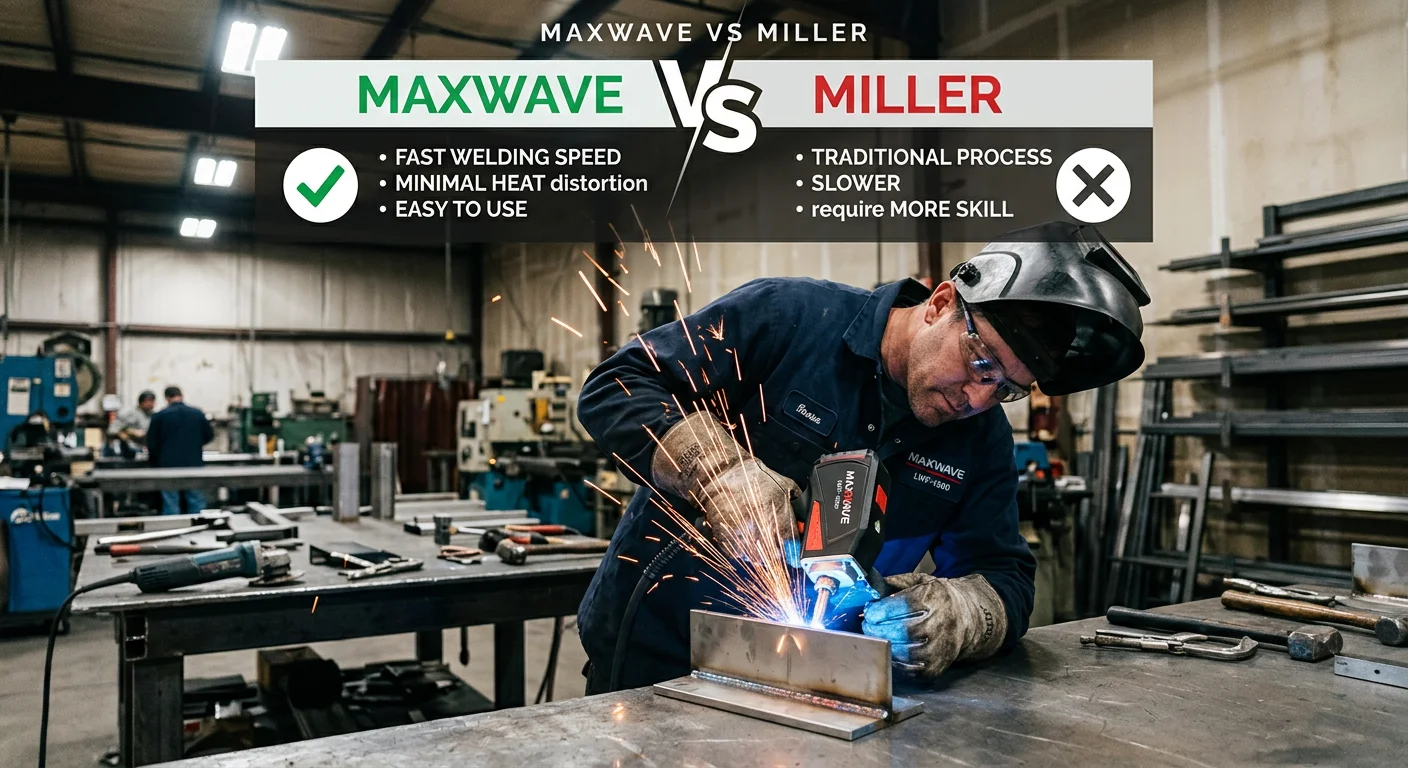
Here’s the truth most comparison articles skip: both machines weld metal. Only one makes financial sense.
Look at the price points, real-world performance, and long-term ROI. The pattern is clear. Maxwave delivers industrial-grade fiber laser welding at a price that won’t break the bank. Miller charges a premium that sounds impressive on paper — but that premium doesn’t show up in your finished welds.
You’re a professional fabricator, a small shop owner, or a serious buyer. You need a handheld laser welder that handles stainless steel, aluminum, and everything in between. You don’t need to drain your budget to get there. Maxwave is the more rational choice — full stop.
So here’s your next move: stop researching, start welding.
The best welder isn’t the most famous one. It’s the one that keeps your shop profitable three years from now.