
Picking the wrong laser welder is expensive. You lose money, time, and momentum — and the frustration adds up fast.
Maxwave and xTool MetalFab are both strong options in the laser welding machine market. But they’re built for different users. That difference matters more than most buyers think.
This breakdown gives you a clear, honest look at how both machines handle real metals — stainless steel, aluminum, and copper. You’ll see which one is actually worth the price for your workflow.
MaxWave vs xTool Laser Welder: Quick Comparison
|
Feature |
MaxWave Laser Welder |
xTool Laser Welder (MetalFab) |
|---|---|---|
|
Brand Positioning |
Industrial-grade welding |
Consumer / entry-level |
|
Price Range |
~$2,950 – $6,900 |
~$4,700 – $15,500 |
|
Power Range |
800W – 2000W |
800W – 1200W |
|
Welding Capability |
Up to ~8mm (industrial) |
~0.2–5mm (light-duty) |
|
Material Type |
Steel, aluminum, industrial metals |
Thin metals + light materials |
|
Ease of Use |
Easy with basic training |
Very easy (beginner-friendly) |
|
Production Use |
Continuous industrial work |
Light / intermittent use |
|
Output Performance |
High power, deep penetration |
Lower power, lighter output |
|
Best For |
Workshops, fabricators, SMEs |
DIY, creators, small businesses |
Quick takeaway:
If you need real metal welding and production capability, choose MaxWave.
If you want easy entry and light-duty work, xTool is a good starting point.
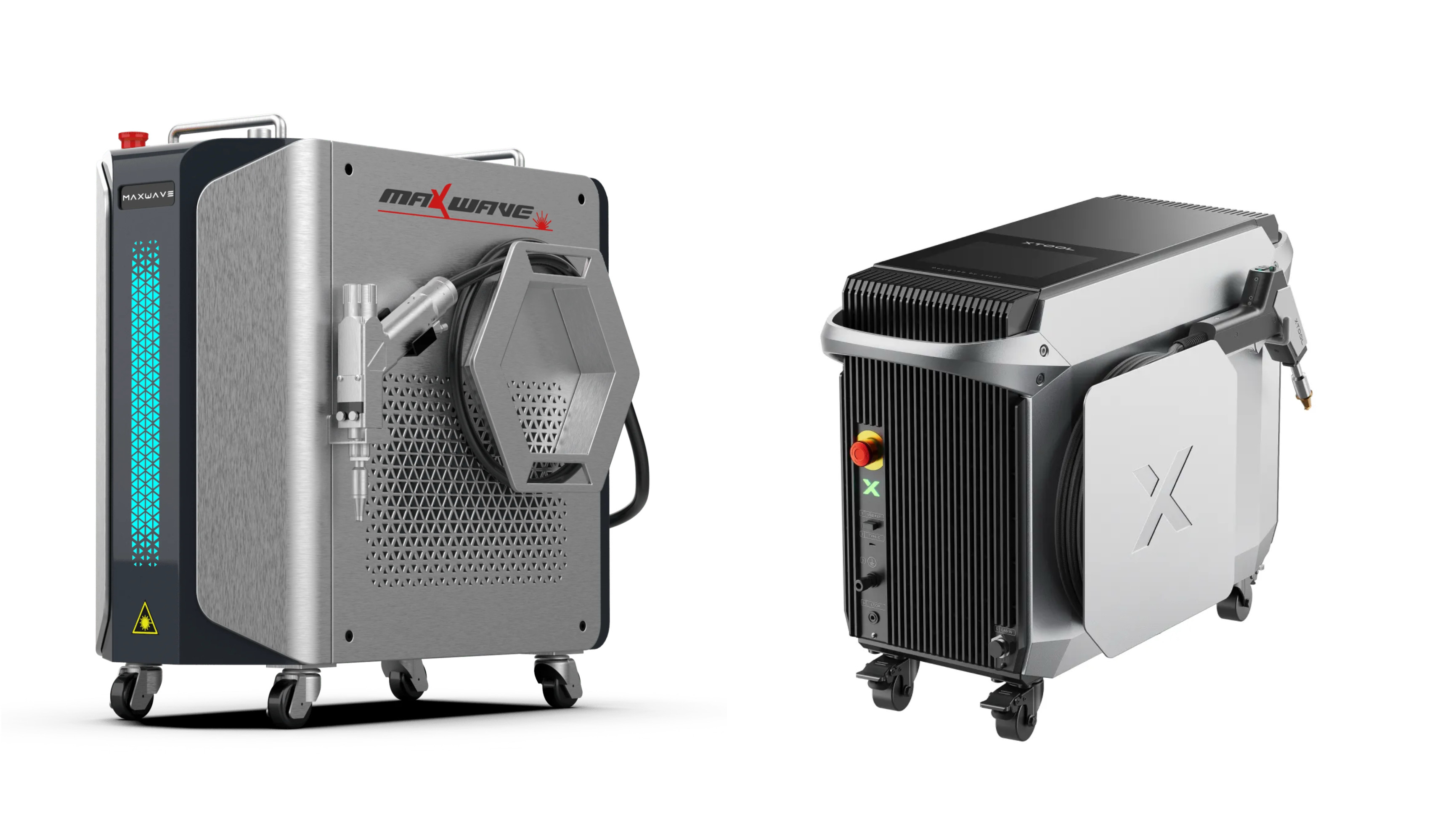
Maxwave Laser Welder: Brand Overview & Product Range
Maxwave has been building industrial laser equipment since 2009. That’s well before handheld fiber welding turned into a crowded market.
The company (Wuhan Maxwave Laser Technology Co., Ltd.) ships to 32 countries. Their product line covers the full range of laser manufacturing: markers, cutters, cleaners, and welders. That breadth is worth noting. The engineering behind their welding systems isn’t an add-on — it draws from deep, cross-product laser experience built across every product category they make.
What Maxwave Makes
Their welder lineup is built for users who need real industrial output, not hobbyist-grade performance:
-
Power range: 800W, 1000W, 1500W, and 2000W configurations
-
Welding thickness: 0.5mm up to 8mm
-
Fiber cable length: 10–15m for flexible, mobile operation
-
Wavelength: 1064nm fiber laser
-
Pulse frequency: 1–5000Hz
-
Cooling method: Air cooling
-
Operating temperature range: 10–40°C
Every product is customizable. This is something small manufacturers and professional fabricators often miss when comparing specs on paper. Customization can make a real difference in how the machine fits your production setup.
Material Compatibility & Weld Quality
Maxwave welds stainless steel, carbon steel, and aluminum alloys with clean results. You get no scarring, no discoloration, and minimal distortion. The flexible optical fiber lets you weld in any position — fillet, arc, overlay, and irregular-shape joints included.
The laser source is rated for 100,000 hours. That lifespan changes how you calculate ROI on industrial equipment. It’s a long service window that reduces replacement costs over time.
Their market position is clear: high-power output for thick materials, built for small-to-medium enterprises, professional fabricators, and precision industrial work.
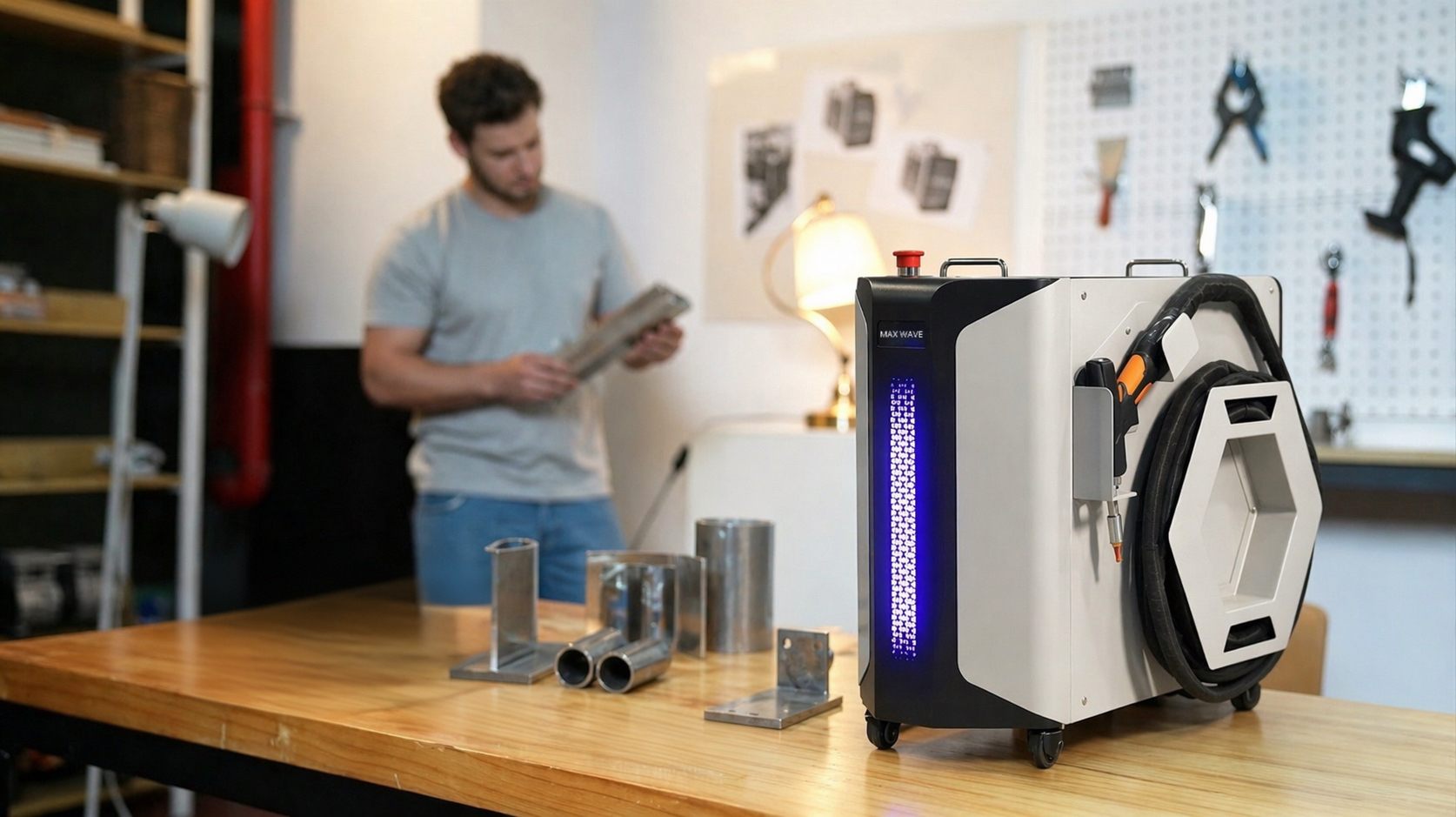
xTool Laser Welder: Brand Overview and Product Positioning
xTool is a fast-rising laser equipment brand backed by Makeblock. It originally entered the market with desktop laser engravers, focusing on accessibility and ease of use rather than heavy industrial applications.
Unlike traditional industrial laser manufacturers, xTool didn’t start in large-scale manufacturing. Instead, it grew out of the maker and small business ecosystem. That foundation shapes its product philosophy—user-friendly design, compact form factors, and accessibility for non-experts.
What xTool Produces
xTool does not offer a full industrial laser welding lineup like traditional manufacturers. Its core product range includes:
-
Desktop laser engravers (such as the F1 and D1 series)
-
Compact laser cutting machines
-
Portable laser solutions
In terms of laser welding: xTool’s focus is more on light-duty or entry-level applications, rather than high-power industrial welding systems.
Product Characteristics and Typical Specs
Compared to industrial laser welders, xTool products emphasize lower power output and compact design, typically far below 800W industrial systems, making them easier to handle and more accessible. They are built for desktop or portable use, with a strong focus on beginner-friendly operation and minimal setup, often featuring integrated, plug-and-play systems. Because of these characteristics, xTool machines are especially well-suited for DIY users, small studios, maker spaces, and customization businesses that prioritize flexibility and ease of use over heavy industrial output.
Their market position is clear: a consumer-level, maker-focused laser equipment brand, designed for ease of use, strong design, and a low barrier to entry, but with limited capability for industrial-scale output.

Head-to-Head Specs Comparison: Power, Weld Depth & Material Compatibility
Power output is where these two laser welding machines split — and the gap tells you a lot about who each machine is built for.
Maxwave runs from 800W up to 2000W. The xTool MetalFab tops out at 1200W. That 800W difference isn’t marketing noise. It’s the gap between punching through 6mm stainless steel in a single pass and stopping at 5mm.
Power Output & Weld Depth
Here’s what the numbers mean at the material level:
Maxwave 1500W (the most popular configuration):
– Stainless steel: up to 5mm single pass
– Carbon steel: 4–5mm
– Aluminum: 3mm reliable; 4mm with parameter adjustment
– Copper/alloys: 0.5–2mm (high reflectivity limits penetration)
– Titanium: 3mm reliable; 4mm possible
xTool MetalFab 1200W:
– Stainless steel: up to 5mm
– Carbon steel: up to 5mm
– Aluminum and other metals: supported, with some exclusions on high-reflectivity engraving
At the 1500W tier, welding speed on stainless steel runs at 18mm/s at 1mm thickness. It drops to 6mm/s at 3mm. Carbon steel follows a close pattern. Aluminum runs a bit slower — 15mm/s at 1mm, topping out around 10mm/s at 2mm.
Step up to Maxwave’s 2000W, and stainless penetration reaches 6mm. Power consumption climbs to 10kW. Current draw hits 45A. Machine weight jumps from 105kg to 130kg. More power means more infrastructure to support it.
Material Compatibility at a Glance
|
Material |
Maxwave 1500W Max Depth |
xTool MetalFab 1200W Max Depth |
|---|---|---|
|
Stainless Steel |
5mm |
5mm |
|
Carbon Steel |
4–5mm |
5mm |
|
Aluminum |
3mm (4mm possible) |
Supported |
|
Galvanized Steel |
3–5mm |
Supported |
|
Copper/Alloys |
0.5–2mm |
Excluded (engraving) |
|
Titanium |
3–4mm |
Not specified |
|
Mold Steel |
0.5–3mm |
Not specified |
What the Laser Source Tier Means for Real Performance
Both machines use fiber laser sources. Source quality still affects real-world output, even when wattage looks the same on paper.
Maxwave uses Raycus or MAX — both Tier 2 sources. Most shops consider Tier 2 the best value for general sheet metal and stainless work. Tier 1 sources like IPG Photonics carry a much higher price tag. They tend to show up in precision aluminum, copper, and high-volume industrial production settings.
For small manufacturers and fabrication shops, Tier 2 delivers the output consistency you need. You skip the cost premium you don’t need.
One more variable worth tracking: the wobble/scan welding parameters. At scan widths above 3mm, Maxwave’s max frequency drops to 350Hz. That matters for gap-bridging and weld bead width control on irregular joints. You’ll run into this on real fabrication work — not just clean test pieces.
Bottom line on specs: your work stays under 5mm on stainless or carbon steel? Both machines can handle it. Push into thicker aluminum, copper, or mold steel — or need a 2000W ceiling — and Maxwave is the clear choice between the two.
Welding Performance Comparison: Speed, Quality & Weld Consistency
When it comes to welding performance, the difference between MaxWave and xTool isn’t whether they can weld—it’s the level of output: industrial-grade performance vs. light-duty application.
Welding Speed
MaxWave laser welder uses high-power fiber laser systems (800W–2000W), enabling faster welding speeds and strong continuous operation, especially for medium to thick metal fabrication. Compared to traditional methods, laser welding can deliver 4–10× higher efficiency, while maintaining stable output for production environments.
By contrast, while xTool also offers a handheld laser solution, its lower power and system design make it better suited for light-duty or intermittent work. In terms of sustained welding speed and overall throughput, it is more limited.
Weld Quality & Bead Consistency
MaxWave is built for industrial applications, with key advantages including:
-
Stronger penetration (higher energy density)
-
Narrower, cleaner weld seams with a smaller heat-affected zone
-
Suitable for structural and high-strength applications
xTool, on the other hand, is better suited for:
-
Thin materials
-
Applications where appearance matters more than structural strength
In simple terms:
MaxWave = structural-grade weld quality
xTool = light-duty weld quality
The Consistency Gap
Batch consistency comes down to one question: who’s running the machine?
MaxWave systems are typically used in standardized production workflows, where once parameters are set, they deliver highly stable and repeatable weld quality, with minimal operator influence.
xTool is designed for flexible use, making it well-suited for small-batch and non-standard work, but it relies more on operator technique, so consistency depends on user experience.
Both are handheld laser welders—but MaxWave is built for production, while xTool is built for entry-level use.
Ease of Use & Learning Curve: Which Is More Beginner-Friendly?
The gap between these two machines isn’t just technical — it’s experiential.
xTool built the MetalFab around a simple assumption: most buyers aren’t professional welders. The 8-inch touchscreen, drag-and-drop interface, and browser-based setup all reflect that thinking. No software installation. No parameter hunting. Your first project takes under 15 minutes. 92% of beginners are operational on Day 1.
Maxwave takes a different approach. It assumes you already know what you’re doing. Power, speed, focus distance, pulse frequency — you adjust all of it by hand. That’s 3–5x more parameters than xTool asks you to touch. 40% of new Maxwave users report feeling overwhelmed during the first setup.
Setup Time & Daily Maintenance
|
Metric |
xTool MetalFab |
Maxwave |
|---|---|---|
|
First Project Time |
5–15 min |
5–30 min |
|
Ease Rating |
9.4/10 |
8.5/10 |
|
Hours to Proficiency |
2–5 hrs |
5–10 hrs |
|
Beginner Success Rate |
92% |
85%+ |
xTool’s main advantage lies in its simplified workflow and visual interface, allowing most issues to be resolved quickly through on-screen adjustments. MaxWave, while offering more adjustable parameters, features a mature and well-optimized system that delivers strong stability in daily use. As users become more experienced, its flexibility becomes an advantage rather than a burden.
Bottom line: If you want the fastest, easiest way to get started, xTool gets you up and running right away. But if you want something just as approachable with more power and room to grow, MaxWave starts simple—and scales with you.
Safety Features & Workplace Requirements
Laser welding comes with real hazards — intense light, metal fumes, heat, and reflective spatter. The way each machine handles those risks determines whether your shop stays compliant and your operators stay safe.
Built-In Protections
Maxwave comes with standard industrial safeguards: enclosure interlocks, emergency stop controls, and laser-off-on-open mechanisms. It expects an experienced operator who already knows PPE requirements before using the machine.
xTool MetalFab adds more active safety features. You get enclosed operation modes, automatic shutoffs, and guided alerts through XCS software. These cut down the chance of operator error. That’s a real advantage for shops where your team members are not trained welders.
Workplace Baseline Requirements
Neither machine removes your PPE obligations. No matter which unit you run:
-
Laser-rated safety goggles (OD rating matched to 1064nm wavelength) — not optional
-
Flame-resistant gloves — over 70% of hand injuries happen without them
-
Adequate ventilation for metal fume extraction
-
Clear, unobstructed workspace meeting OSHA 1910.22 standards
Bottom line: XTool is better suited for users who want a straightforward, plug-and-play experience with minimal decision-making, while MaxWave combines industrial-grade performance with strong usability—allowing beginners to get started quickly and gain greater control as their skills develop.
Price & ROI Analysis: Which Delivers Better Value for Your Budget?
When comparing MaxWave and xTool, the key difference isn’t just price—it’s how each machine generates return on investment.
Upfront Cost vs. Total Annual Cost
|
Metric |
MaxWave Laser Welder |
xTool Laser Welder (MetalFab) |
|---|---|---|
|
Price Range |
$2,950 – $6,900 |
$4,700 – $15,500 |
|
Daily Output |
30 – 80 jobs |
10 – 25 jobs |
|
Profit per Job |
$20 – $50 |
$20 – $50 |
|
Daily Profit |
$600 – $3,000 |
$200 – $1,000 |
|
Monthly Profit |
$15,000 – $75,000 |
$5,000 – $25,000 |
|
Payback Time |
0.5 – 3 months |
2 – 8 months |
Payback isn’t driven by price—it’s driven by output.
Both Are 3-in-1 — But Built Differently
Both MaxWave and xTool offer welding, cleaning, and cutting capabilities.
The difference is in how they deliver it:
-
xTool → Integrated all-in-one system, focused on simplicity and ease of use
-
MaxWave → Modular industrial setup, focused on performance and scalability
In simple terms: xTool combines tools. MaxWave amplifies output.
ROI Logic: Two Completely Different Paths
xTool: Function-Driven ROI
xTool is designed to help you get started quickly and handle multiple tasks with one machine.
Best for:
-
DIY users and small studios
-
Customization businesses
-
Low to medium workload
ROI comes from: flexibility and multi-function capability
MaxWave: Efficiency-Driven ROI
MaxWave is built for users who need higher output and consistent performance.
Best for:
-
Fabrication workshops
-
Repair services
-
Production-focused businesses
ROI comes from: speed, throughput, and job capacity
The Real Difference (Most Buyers Miss This)
Both machines can do multiple jobs—but:
-
xTool helps you do more types of work
-
MaxWave helps you do more work in less time
Final Verdict
If your goal is simplicity and versatility, xTool delivers strong value by making it easy to get started and handle a variety of tasks. However, if you’re focused on higher productivity and faster payback, MaxWave is the better choice, offering stronger performance and greater long-term ROI as your workload grows.
One-Line Takeaway: Both are 3-in-1. One saves space. The other scales your business.
Who Should Choose Maxwave? (Use Cases & Ideal Buyer Profile)
Maxwave rewards expertise. You already know laser parameters — power density, focal offset, pulse frequency. This welder works at your level.
Maxwave fits you if:
-
You weld thick metal on a regular basis. Stainless or carbon steel past 4mm, aluminum sections, mold steel — Maxwave’s 1500W–2000W range covers what xTool cannot handle.
-
You run a professional fabrication or manufacturing shop. Small-to-medium enterprises with trained operators get the most out of Maxwave’s manual control range.
-
You need more than just welding. MaxWave also supports welding, cutting and cleaning (depending on configuration), with a focus on industrial performance rather than simplified all-in-one integration.
-
Volume is moderate but precision is non-negotiable. Structural parts, industrial components, any weld where joint integrity matters more than setup speed — this is where Maxwave earns its place.
-
Budget is tight and ROI needs to land fast. At under 50 parts/month, Maxwave laser welder‘s lower cost base pays back in 6–12 months.
Skip Maxwave if your team has no welding background, your work stays under 2mm, or you need five tools in one footprint.
Who Should Choose xTool MetalFab? (Use Cases & Ideal Buyer Profile)
The MetalFab is built for people who want results, not a certification program.
New to laser welding? The auto-parameter system picks the right power, speed, and wire settings for your material and thickness. No calibration needed. You just work.
xTool MetalFab fits you if:
-
You’re cutting and welding thin sheet metal. The 800W handles stainless and aluminum up to 3–4mm. The 1200W pushes single-pass cuts to 10mm carbon steel.
-
You need more than a welder. Cut, weld and clean — three functions, one 38.2kg unit. Small shop floors don’t have room for four separate machines.
-
Your team has no formal welding background. You get 100+ material presets and AI path optimization. That removes the guesswork that trips up beginners.
-
Your work covers fabrication, signage, automotive panels, or custom metalwork — not structural beams or shipbuilding plate.
Where xTool hits its ceiling: Routine cuts past 4mm will strain the system. Heavy industry work above 6mm is outside this machine’s range. Pushing it there leads to real quality problems.
Conclusion

Choosing between Maxwave and xTool MetalFab isn’t hard. You just need to know what matters for your work.
Running a professional shop? Fabricating stainless steel every day? Need a fiber laser welding machine that pays for itself in weeks? Maxwave is built for that. You’re a hobbyist or new to laser welding? xTool’s easier learning curve makes it a solid starting point.
But keep this in mind: the wrong machine doesn’t just cost money. It costs time, rework, and lost momentum. Getting this decision right the first time is far better than fixing a costly mistake later.
Want to see Maxwave in action for your specific application? [Explore the Maxwave laser welder lineup →] Find the configuration that fits your material, your workflow, and your bottom line.
The right tool makes every weld count. Make sure you start with one.