
Electron beam machining isn’t something you choose casually—it’s the solution when precision reaches its limits.
EBM uses a high-speed stream of electrons to remove material through intense, localized heat. The process runs in a vacuum, ensuring unmatched accuracy and consistency.
If you’re working with aerospace components, medical devices, or micro-scale parts, this is one of the most precise machining methods available.
What Is Electron Beam Machining (EBM)?
Electron Beam Machining (EBM) is a non-contact, thermal machining process.
A focused beam of high-velocity electrons hits the material surface, instantly converting kinetic energy into heat. The material doesn’t cut or deform—it vaporizes.
Key characteristics:
- Ultra-high precision (micro-level)
- No tool wear (non-contact)
- Works on hard and heat-resistant materials
- Requires a vacuum environment
How Electron Beam Machining Works: The Core Principle
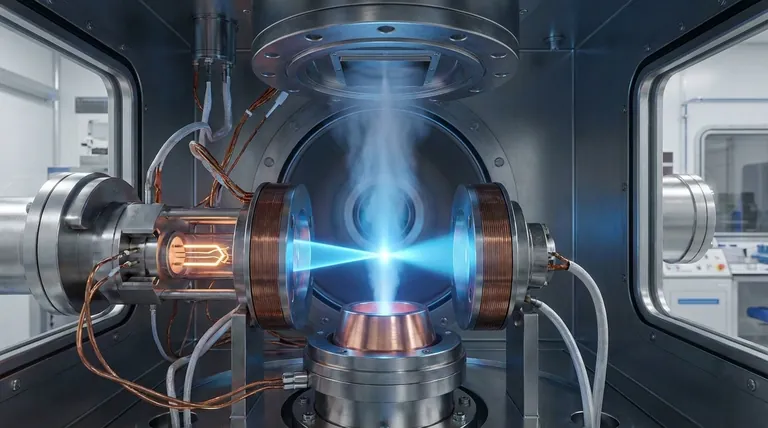
Physics does the cutting here — no blades, no abrasives, no contact at all. This is the core of the electron beam machining process.
A focused electron beam hits a workpiece surface. Kinetic energy turns into thermal energy in microseconds. Localized temperatures spike high enough to melt and vaporize almost any material — not chip it, not grind it — vaporize it. That conversion is the entire foundation of EBM.
From Electrons to Heat: The Conversion Chain
It starts inside the electron gun. A tungsten filament (the cathode) heats up and releases electrons through thermionic emission. A biased grid cup guides that electron flow. The anode — positively charged — then drives those electrons toward the workpiece.
What leaves the gun is a beam traveling at 1.6 × 10⁸ m/s. Electromagnetic lenses squeeze that beam down to spot sizes between 0.1 and 10 μm in diameter. The resulting energy density: 10⁶ to 10⁹ W/cm².
At that intensity, material doesn’t heat up slowly. It transitions — from solid to liquid to vapor — in an instant.
Pulse Mode: Where Precision Gets Its Edge
EBM doesn’t always fire in a steady stream. In pulse mode, the beam switches on and off via the bias grid. Pulse durations range from 50 μs to 15 ms.
Short pulses — in the 50–100 μs range — limit how far heat penetrates into the material. That keeps the heat-affected zone small and tight. For micro-drilling or detailed surface features, this level of control is what sets EBM apart from blunter high-energy alternatives.
Longer pulses and higher accelerating voltages push the beam deeper. That makes them useful for high aspect ratio deep-hole drilling, where penetration depth is the main goal.
Continuous wave mode is also an option for applications that need sustained material removal. But pulse mode is where EBM builds its reputation for precision.
Electron Beam Machining Equipment: Key Components Explained
Five components. One vacuum. Zero margin for error. This is the reality of EBM machining.
Break an EBM system down to its core, and you find a precise chain — each part feeds into the next with no room for failure. Miss any link, and the beam scatters. The part gets scrapped. The downtime bill starts climbing.
Here’s what’s inside.
The Electron Gun
Everything starts here. A tungsten cathode heats to 2,500°C and releases electrons through thermionic emission. The bias grid — charged negative relative to the cathode — controls how many electrons leave and when. That’s also what drives pulse-mode switching: the grid cuts the beam on and off with precise timing.
From there, the anode takes over. It carries a positive charge and accelerates the electron stream to voltages between 50 and 200 kV. That pushes electrons to about half the speed of light.
Focusing Lens and Deflector Coil
Raw speed isn’t enough on its own. The electromagnetic focusing lens narrows the beam to between 0.1 and 10 μm in diameter. A tighter focus means higher energy density at the point of impact — and that’s where the real cutting power comes from.
The deflector coil then steers that focused beam across the workpiece surface. It uses controlled magnetic fields to guide direction. No mechanical contact. No tool wear. Just clean, direct control over the cutting path.
Vacuum Chamber and CNC Worktable
The vacuum chamber holds pressure between 10⁻⁵ and 10⁻⁶ mm Hg. Drop that pressure, and electrons hit air molecules before reaching the workpiece. The beam dies before it does any work.
Inside the chamber, a CNC worktable positions the workpiece with accuracy. Once loaded and sealed, the system cuts material up to 5 mm thick.
Why Component Reliability Matters
The tungsten filament runs at extreme heat. Replacement isn’t optional — it’s regular. And every replacement means downtime. Vacuum pump maintenance can eat up 10–15% of annual capital expenditure. A single leak can push rejection rates above 20%.
High-voltage power supplies run at 150 kV. Calibration drift introduces arcing risk. That drags MTBF below 500 hours fast.
The equipment costs serious money. But for high-value components where kerf width, thermal distortion, and hole geometry are non-negotiable — the numbers still add up.
Critical Process Parameters and How They Affect Machining Quality
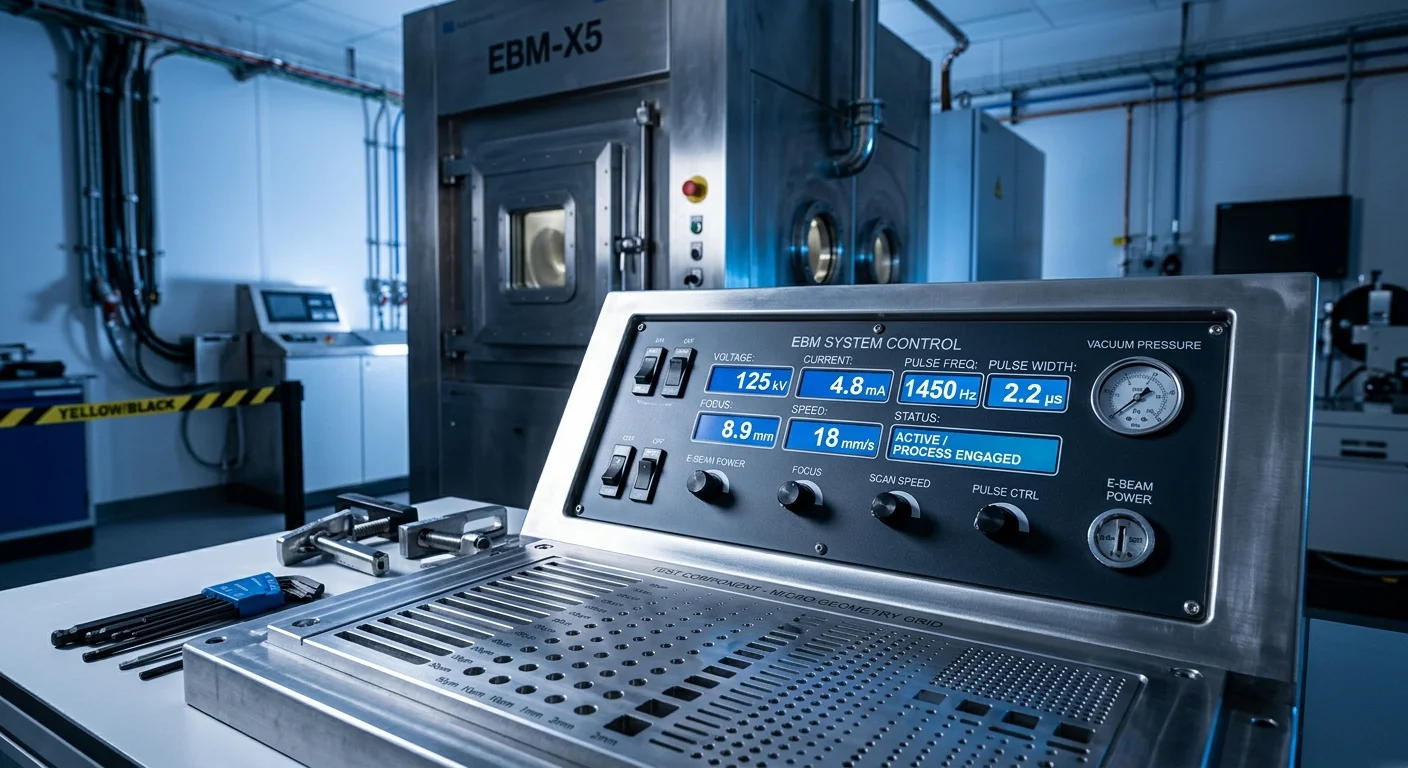
Six numbers control everything. Get them right, and EBM cuts features no other process can touch. Get them wrong — thermal cracking, oversized heat-affected zones, and scrapped parts follow.
Here’s what each parameter does, and what happens when you push it in either direction.
Accelerating Voltage: Depth vs. Precision Trade-off
In Electron Beam Machining, voltage determines how deep the beam can penetrate. At lower voltages, cuts are shallower but more precise, with minimal heat impact. As voltage increases, penetration improves, but the heat-affected zone grows and edge quality may slightly decrease. In simple terms, higher voltage gives you more depth, but slightly less precision.
Beam Current: Power vs. Collateral Damage
Current controls how much energy is delivered. At lower current, machining is more precise with minimal heat impact. As current increases, cutting becomes faster and deeper, but it also introduces more heat, which can create a recast layer on the material surface. Simply put, higher current improves efficiency, but increases thermal effects.
Pulse Duration: The Key Micro-Machining Variable
Pulse duration determines how long the material is exposed to heat. Short pulses limit heat spread and are ideal for fine, detailed features. Longer pulses allow deeper penetration, but also increase the risk of heat damage or even cracking in sensitive materials. In short, short pulses for precision, longer pulses for depth.
Spot Size, Frequency, and Vacuum: The Supporting Three
These factors help fine-tune the process. A smaller spot size delivers higher precision but slower speed. Higher frequency improves processing efficiency but can lead to more heat buildup. The vacuum environment is essential—if the vacuum level is poor, the beam becomes unstable and precision drops significantly. In simple terms, precision depends on balance, but vacuum quality is non-negotiable.
Application-Specific Parameter Windows
These combinations aren’t theoretical. They’re the settings that deliver real results.
| Application | Voltage (kV) | Current (mA) | Pulse (μs) | Spot (mm) | Freq (kHz) | Vacuum (Pa) | Precision (μm) | HAZ (mm) |
|---|---|---|---|---|---|---|---|---|
| Aerospace blade holes (Ø0.1–0.5 mm) | 80–120 | 30–60 | 3–6 | 0.015 | 2–4 | 10⁻⁵ | ±10 | 0.15 |
| Electronics micro-machining (<0.05 mm features) | 40–70 | 10–25 | 1–3 | 0.010 | 5–8 | 10⁻⁶ | ±5 | 0.03 |
Here’s the core logic: reducing spot size by 50% improves precision by 40% but cuts throughput by 25%. Raising beam current by 50% boosts material removal by 60% — yet it also requires vacuum below 10⁻⁵ Pa to hold the HAZ in check. Every adjustment creates a ripple effect across the other parameters. EBM rewards engineers who think in systems, not isolated dials.
Key Parameters, Advantages, and Limitations of EBM
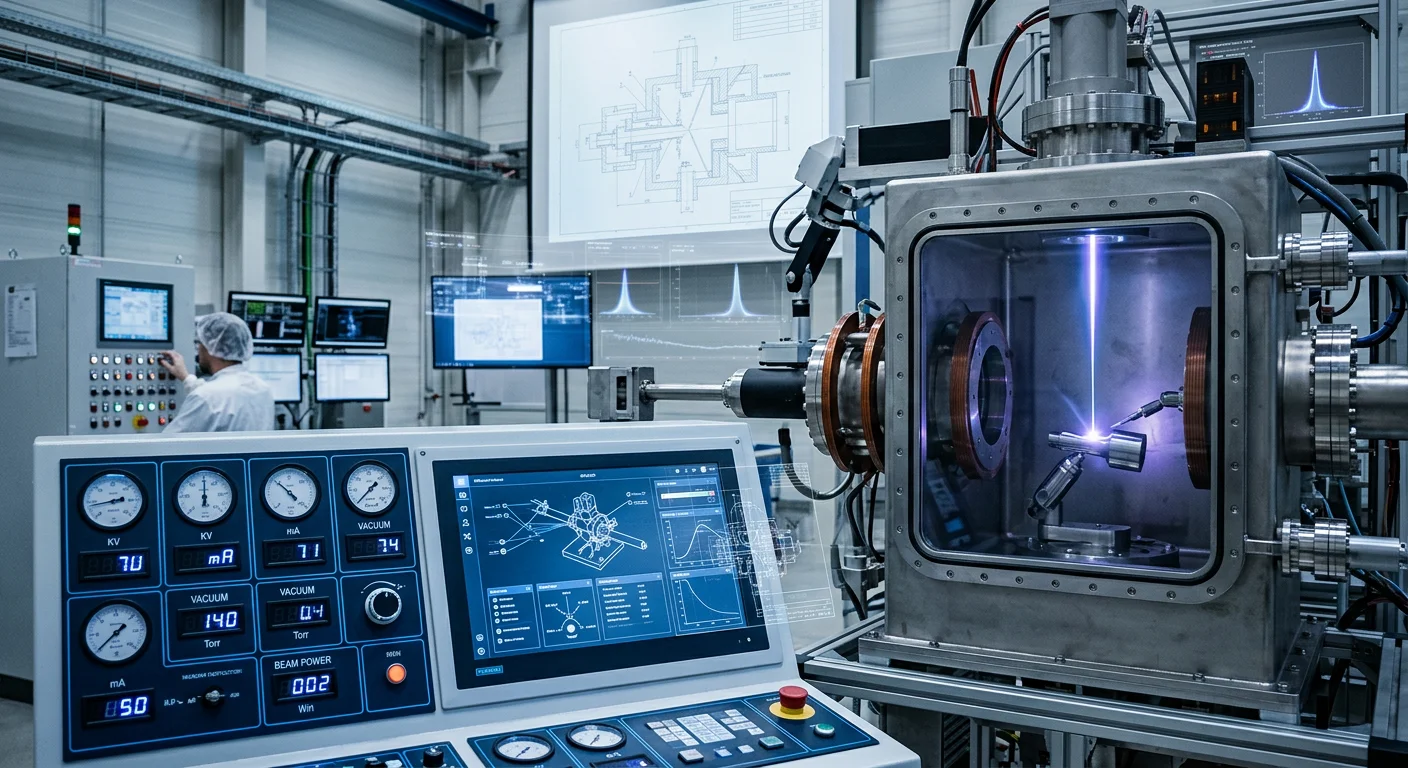
Electron beam machining is not just about how it works—it’s about how you control it and whether it fits your application. Understanding a few key parameters and trade-offs can help you quickly decide if EBM is the right choice.
How Process Parameters Affect Performance
Several key parameters directly influence precision, depth, and overall machining quality.
Accelerating voltage controls how deep the beam penetrates. Lower voltage delivers shallow, high-precision cuts with minimal heat impact, while higher voltage allows deeper machining but increases the heat-affected zone and slightly reduces edge quality. In short, higher voltage improves depth, but reduces precision.
Beam current determines how much energy is delivered. Lower current provides better precision and minimal thermal impact. Higher current increases cutting speed and depth, but also generates more heat, which can affect surface quality. Simply put, more power means higher efficiency—but also more heat.
Pulse duration controls how long the material is exposed to energy. Short pulses limit heat spread and are ideal for fine, detailed features. Longer pulses allow deeper penetration but increase the risk of thermal damage. For most precision applications, shorter pulses are preferred.
Spot size, frequency, and vacuum fine-tune the process. A smaller spot size improves accuracy but reduces speed. Higher frequency increases efficiency but can lead to heat buildup. The vacuum environment is critical—without it, the beam becomes unstable and precision drops significantly. Among all factors, vacuum quality is non-negotiable.
Advantages of Electron Beam Machining
EBM stands out in applications where precision and material challenges go beyond the limits of conventional methods.
First, it offers extremely high precision. The focused beam can achieve micro-level accuracy that few other processes can match, making it ideal for complex and delicate features.
Second, it is a non-contact process. There are no tools involved, which means no tool wear, no mechanical stress, and consistent results over long production runs.
EBM also works well on difficult materials. Hard alloys, brittle materials, and heat-resistant metals can all be processed effectively without the limitations faced by traditional machining.
Another key benefit is the minimal heat-affected zone. Because the energy is highly concentrated, surrounding material remains largely unaffected, resulting in clean edges and minimal post-processing.
Limitations and Trade-offs
Despite its advantages, EBM comes with important limitations that must be considered.
The biggest barrier is cost. EBM systems require significant investment, along with ongoing maintenance and specialized infrastructure such as vacuum systems and shielding.
The vacuum requirement also limits flexibility. Workpiece size is restricted by the chamber, and setup times are longer due to pump-down and preparation processes.
EBM is also not suitable for high-volume production. Compared to other methods, material removal rates are relatively low, making it less efficient for large-scale manufacturing.
In addition, surface finishing may still be required in some cases, and operating the system demands skilled personnel due to safety considerations.
Electron Beam Machining Applications Across Key Industries
Three industries drive most of the demand for EBM. Each one uses it in a distinct way.
Aerospace: Where Tolerances Are Life-Critical
Turbine blades need cooling holes smaller than a human hair. EBM drills them. The focused electron beam cuts gas film holes in high-strength superalloys with micro-level precision. It adds zero mechanical stress to parts that spin at tens of thousands of RPM.
Electron beam welding handles the structural side. It produces deep penetration, narrow heat-affected zones, and minimal distortion. That makes it the go-to choice for turbine engine casings and combustion chambers. Lightweight, fuel-efficient aircraft frames rely on those joint qualities to hold up under extreme conditions.
Medical Devices: Precision at the Molecular Level
Custom bone implants don’t just need to fit — they need to bond with the body. Electron beam surface treatment (EBST) builds micro-structured surfaces on implants. Those surfaces boost osseointegration, improve corrosion resistance, and reduce wear — all at once.
Surgical instruments get the same micro-machining treatment. Some features are too small for standard tooling. E-beam processing also handles sterilization. Tolerances meet strict patient safety standards. EBM covers all of this in one process chain — no extra steps needed.
Microelectronics: Holes Nobody Else Can Make
Circuit boards need precision holes. MEMS sensors need micro-grooves. EBM electron beam drilling delivers both. It hits accuracy levels that photolithography can match, but mechanical drilling cannot get close.
Circuits fail sometimes. Electron Beam Induced Deposition (EBID) deposits conductive material straight onto damaged traces. No replacement board. No production halt. You keep the line running. For prototype LSI components, maskless EBM skips the photomask step. Complex geometries move from design to physical form faster than traditional fab methods can manage.
EBM vs. Laser Beam Machining vs. EDM: Which Should You Choose?
Three processes. All non-conventional. All thermal. The wrong choice costs you precision, time, or money you didn’t plan for.
Here’s how they differ — and a quick decision framework to get you to the right answer.
The Core Trade-offs at a Glance
| Parameter | EBM | LBM | EDM |
|---|---|---|---|
| Energy Source | Focused electron beam | Coherent laser photons | Electrical sparks |
| Environment | Vacuum required | Open atmosphere | Dielectric fluid |
| Spot Size | 0.01 mm | Larger than EBM | Limited by spark gap |
| HAZ | Narrow + recast layer | Narrow + recast layer | Minimal — no recast |
| Material Range | Conductive only | Any (reflectivity limits apply) | Conductive only |
| Speed | Slower (vacuum setup) | Fastest | Slow on thick/hard |
| Equipment Cost | Highest | Moderate | Moderate |
What Separates Them
EBM beam machining‘s edge is the spot size. At 0.01 mm, it drills high aspect ratio holes that laser can’t match. It also avoids the reflectivity problem that causes issues for LBM on certain metals. The trade-off is real, though. You need a vacuum chamber, X-ray shielding, and trained operators. Large workpieces don’t fit. Cycle times run longer.
LBM wins on speed and flexibility. No vacuum means no setup delay. It cuts conductive and non-conductive materials in open air. Sheet metal, plastics, composites — all fair game. Running high volumes across mixed material types? Laser is the practical answer.
EDM is the go-to for hard, thick, conductive parts. It leaves no recast layer. That’s the one thing both EBM and LBM can’t avoid. For tool steels and complex electrode-formed shapes, EDM’s clean HAZ makes the slower cycle time worth it.
Five Questions That Point to the Right Process
- Non-conductive material? → LBM is your only option.
- Vacuum feasible + ultra-fine features (≤0.01 mm)? → EBM.
- Hard/thick conductive parts, no vacuum, no recast tolerance? → EDM.
- Speed is the priority? → LBM — no chamber, no delay.
- High aspect ratio micro-holes in aerospace alloys? → EBM beats everything else here.
The decision isn’t about which process is better. It’s about which constraints your application can — and can’t — live with.
Frequently Asked Questions About Electron Beam Machining
Engineers ask the same questions. Here are straight answers.
Is pulsed or continuous mode better?
Depends on the job. Pulsed mode — controlled by the bias grid switching on and off — is the right call for precision hole drilling. It limits heat buildup and keeps the HAZ tight. Continuous mode works best for deep welds. Use it where penetration past 2 inches matters more than heat control.
How deep can EBM cut?
Welds go beyond 2 inches. For penetration calculations, use: δ = 2.6×10⁻¹⁷ (V²/ρ). At 100 kV in steel (density 7.6 g/cc), that comes out to 0.36 mm. Adjust based on your voltage and material density.
Can small businesses use EBM?
Yes — through outsourcing. Contract EBM services keep costs down for small runs. You skip the infrastructure costs entirely. Try your application through a service provider first. That way, you test the process before buying equipment.
Does EBM work on composites?
It depends. EBM can boost polymer performance through crosslinking. This raises tensile strength and heat resistance. But not every composite is compatible. Check material fit before moving forward.
How strong are electron beam welds?
Very strong. EBM welds hold 95% of base material strength. Depth-to-width ratios exceed 10:1. Distortion stays minimal. That makes EBM a solid choice for heat-sensitive components.
Conclusion
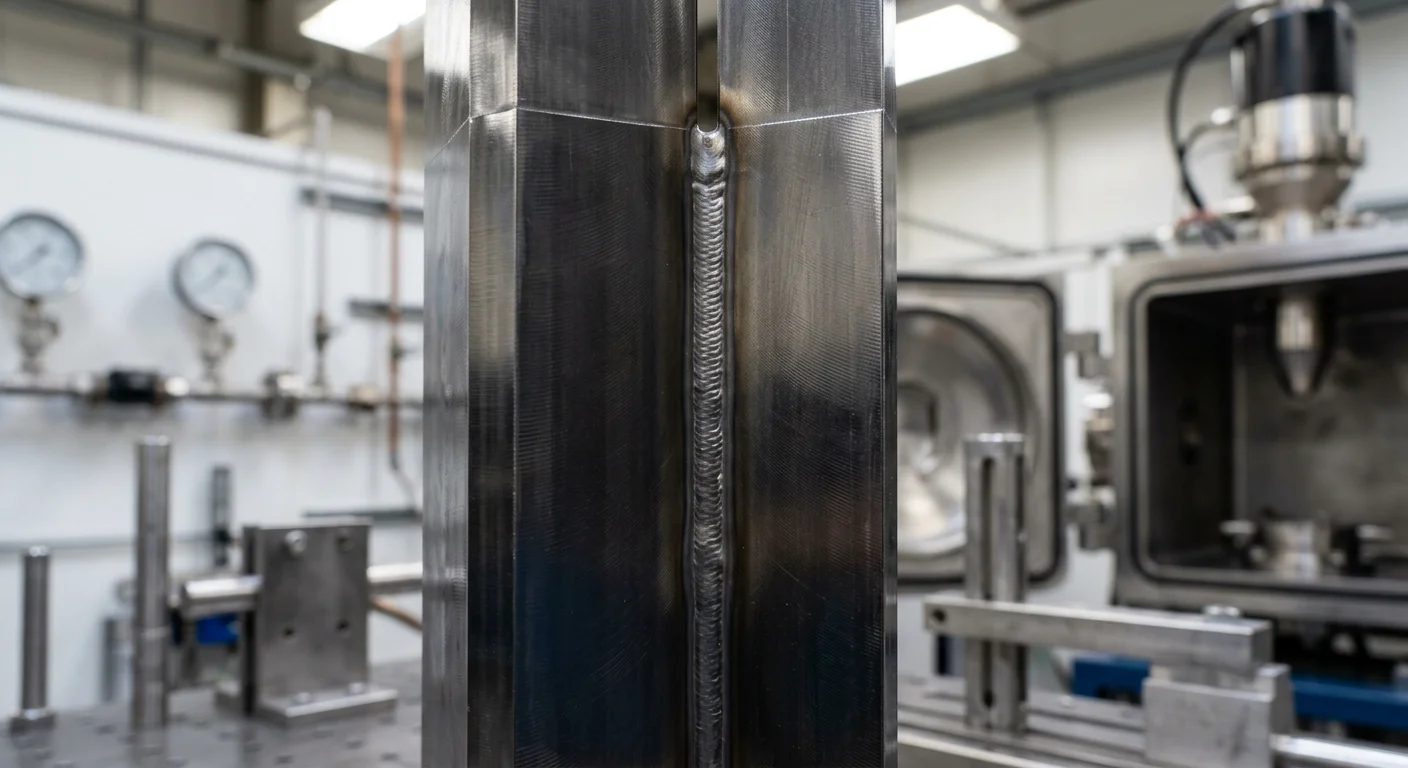
Electron beam machining isn’t a process you choose lightly—it’s the answer when precision truly matters.
You now understand how it works, why a vacuum environment ensures consistency, and where EBM outperforms laser machining and EDM.
So the real question isn’t how it works—
it’s whether it fits your application.
For aerospace components, medical devices, or micro-scale parts, the answer is often yes.
Ready to move forward?
Explore MaxWave’s machining solutions or connect with our team. When precision matters, the right partner makes all the difference.