
Pick the wrong motor for your robot arm, and you’ll feel it fast — sluggish joints, lost steps, overheating drivers, or a parts bill that blows past your budget.
Servo motors, stepper motors, and brushless DC motors are not the same. Each one changes how your arm moves, and how much control logic you’ll be fighting with at 2 a.m.
Every motor type has a sweet spot. Know those sweet spots, and your robot arm performs. Miss them, and it frustrates you at every turn.
Sourcing a robot joint actuator for an industrial build? Or figuring out the right robotic arm actuator selection for your first six-axis project? This guide cuts through the noise and gets you to a clear, confident decision.
What Do Robot Arms Use For Motors?
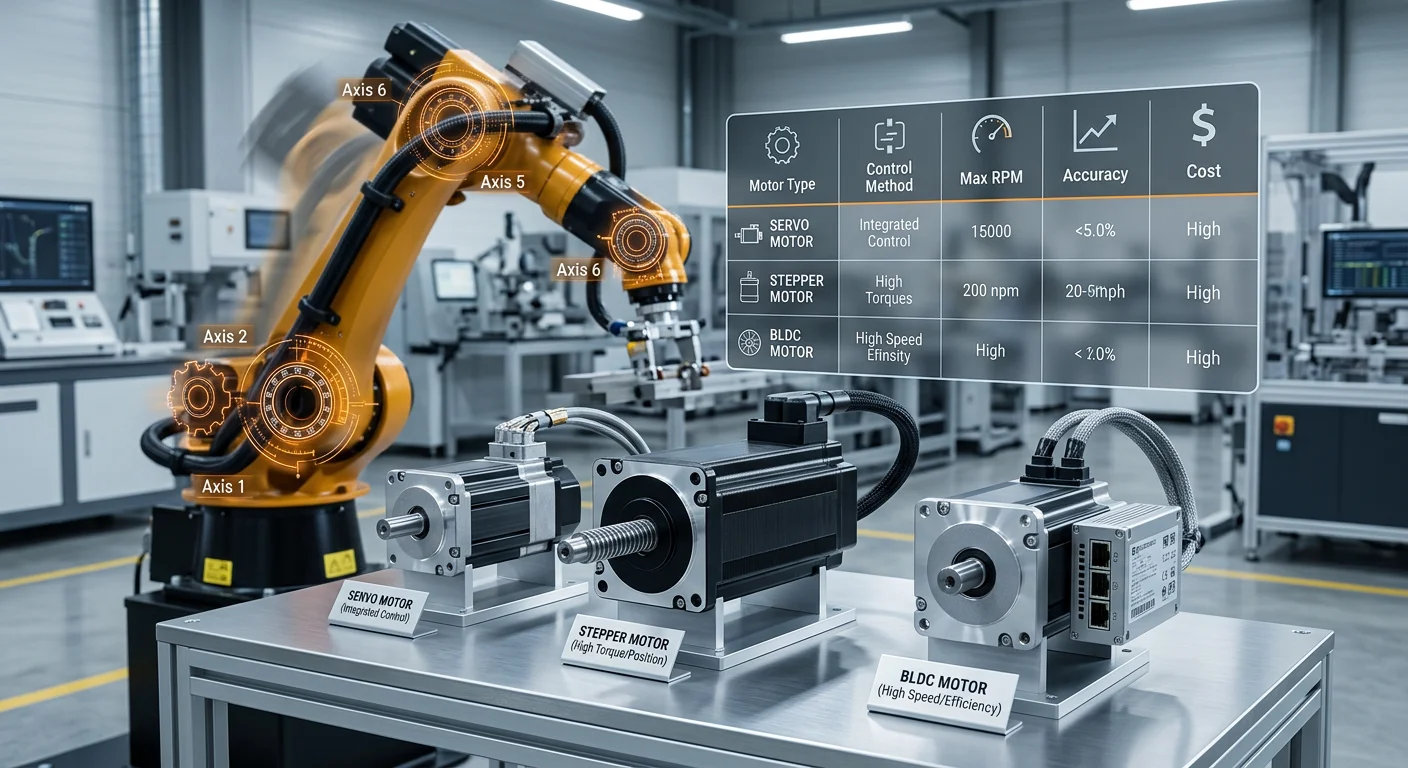
Three motor types run most robot arms today — servo, stepper, and BLDC. Each one fills a specific role, and the choice is never random.
Servo motors take over joints that need precision under changing loads. The closed-loop encoder feedback keeps positioning accurate even as the load shifts mid-movement. Companies like FANUC and Yaskawa pair them with harmonic-drive gearboxes. You get zero-backlash repeatability across millions of cycles.
BLDC motors handle joints that run 24/7. Brushes wear out fast in non-stop production environments. BLDC skips that problem entirely — no brushes, no maintenance downtime.
Stepper motors fit educational platforms and entry-level builds well. They’re simple, affordable, and need no feedback system. That works fine for light loads. Push the load too hard, though, and steps start dropping.
In 6-axis arms, here’s how the split breaks down:
-
Axes 1–3 (base, shoulder, elbow): These joints carry the most weight. They use stepper or high-torque servo motors to handle the load.
-
Axes 4–6 (wrist, hand): These joints move fast and need to stay light. Compact servo motors work best here, prioritizing speed and low inertia.
Joints closer to the base carry more torque. Joints closer to the tip focus on precision and keeping weight low. That pattern holds across most robot arm designs.
How Each Motor Type Works in a Robot Arm Joint
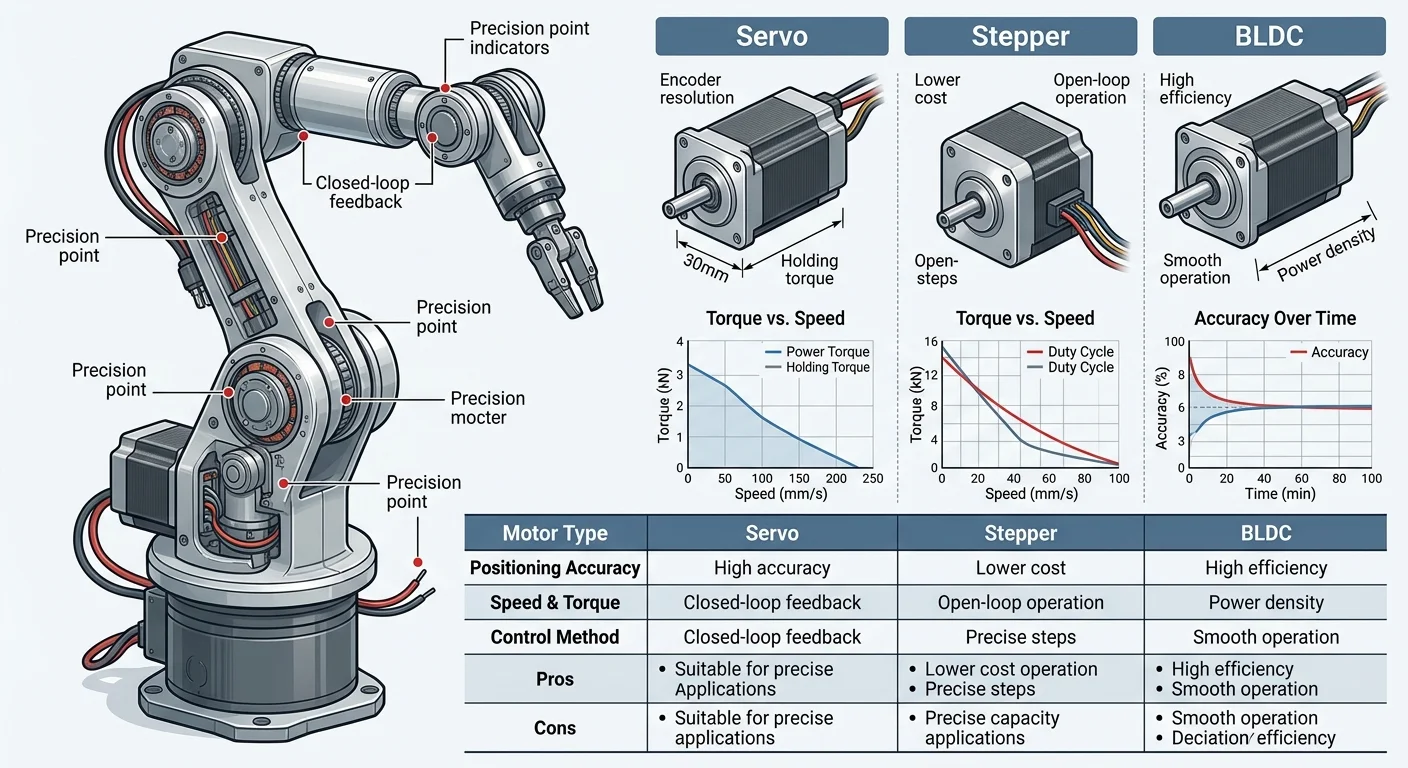
The physics inside each robotic joint actuator tells you everything. Three electrical strategies. Three mechanical outcomes. The gap between them matters more than most robot builders and automation engineers expect.
Servo Motors: Closed-Loop Correction at Every Step
A servo motor doesn’t just move to a position. It verifies it got there.
The controller sends a PWM signal. The motor rotates. The encoder reads the actual angle and reports back. The joint is off by even 0.1°? The PID algorithm — sampling at 10kHz — fires a correction in under 1ms. That feedback loop runs non-stop, adjusting torque in real time as loads shift.
A joint stalls under unexpected force. The servo pushes back with up to 5x its continuous torque rating to recover position. That’s what makes it reliable in dynamic environments — not just its accuracy, but its ability to fight back.
Stepper Motors: Holding Ground Without Feedback
Steppers operate on a different principle. No encoder. No correction loop. Just a pulse train telling electromagnetic coils to fire in sequence — 1.8° per full step, 0.9° in half-step mode.
What they do well: holding torque at low speed.
– Below 300 RPM, a stepper out-holds a same-size BLDC by 2–5x.
– That self-locking behavior stops joint droop without any active feedback.
– This makes steppers useful for base and shoulder joints carrying static loads.
What breaks the logic:
– Push past 500 RPM and torque collapses by 70%.
– Miss steps under a load spike above 5%, and the joint loses position. There’s no recovery mechanism.
BLDC Motors: Electronic Commutation, Sustained Output
BLDC motors swap brush contact for electronic phase switching. Hall sensors — or back-EMF detection in sensorless designs — track rotor position and fire stator coils every 60° of electrical rotation.
The result: consistent torque from 0 to 5000 RPM, with efficiency running 85–95%. Joints like the shoulder or wrist get full, steady output across the entire speed range.
The CubeMars AK70-16 (KV41) shows what’s possible at the top end: 50–300 Nm torque at ≥25 Nm/kg power density. Those are shoulder-joint numbers that same-size servo motors can’t often match.
No encoder means BLDC runs open-loop. Add one, and it crosses into servo territory. Most industrial robot joint actuators pair BLDC motors with harmonic drives at 1:50–150 ratios. That combination delivers the low-speed precision the raw motor lacks on its own.
Servo Motors for Robot Arms: Precision at a Price
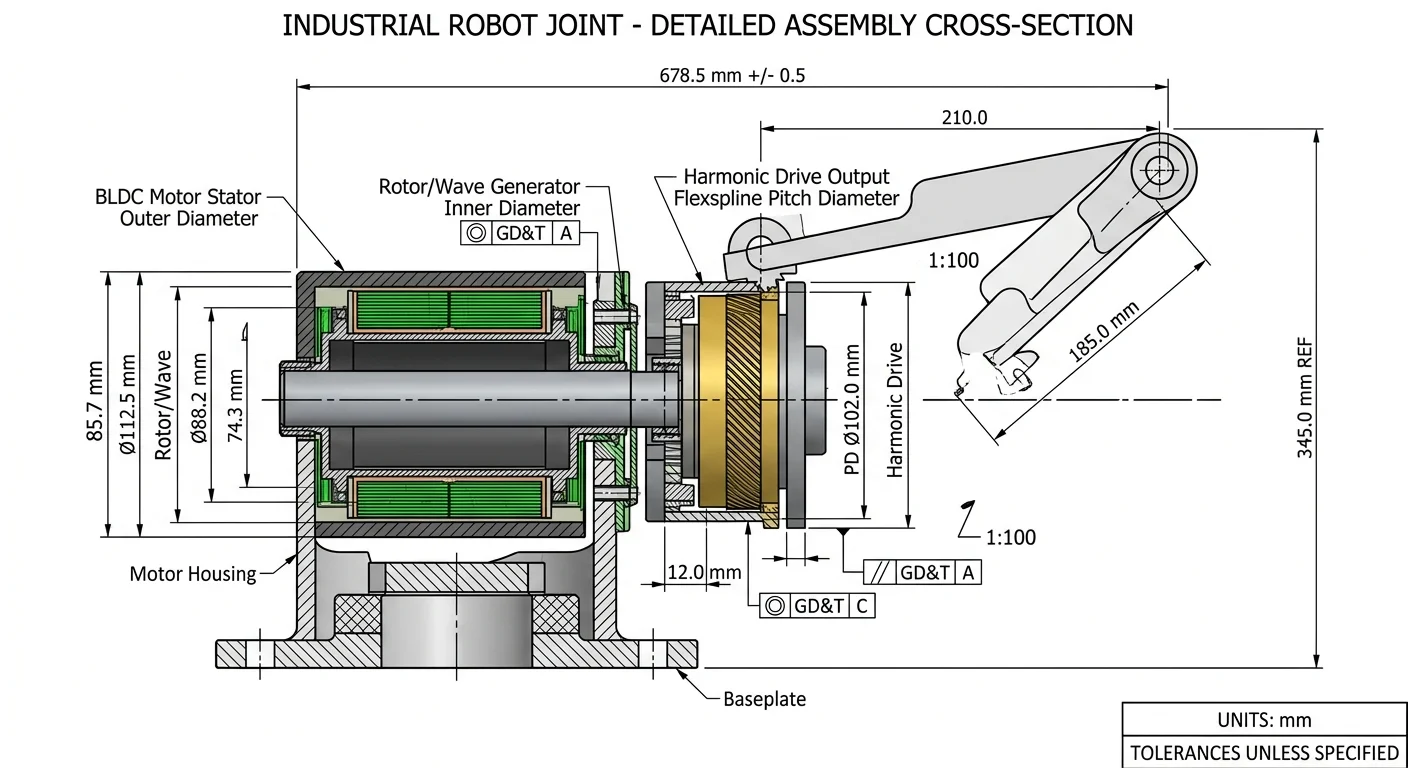
Servo motors are the default answer in precision robotics — and there’s a solid reason that answer keeps coming up.
The core mechanism is a feedback loop that never stops working. An encoder reads the actual joint angle. The controller compares it against the target. A correction fires in under 1ms. That cycle repeats thousands of times per second. Positioning error stays inside a fraction of a degree, even as loads shift mid-movement. 17–22 bit encoder resolution is standard in 6-axis builds. That level of detail is what “micro-level control” looks like in practice.
Where Servos Pull Ahead
Compare servos to steppers, and the gap is clear. You get no missed steps under load spikes, consistent torque output across the full speed range, and a recovery mechanism when the joint gets pushed off position. Stack them against brushed DC motors, and the advantage grows — higher torque density, better efficiency, longer service life.
For wrist and forearm joints, compact servo DC motors are the go-to choice. The Niryo educational arm splits it this way: steppers on the base and shoulder for raw holding torque, servo motors on the forearm, wrist, and hand for speed and overload capacity. That pairing logic shows up across a lot of real-world builds.
Standard builds pair servos with harmonic strain-wave reducers at 1:50–1:150 gear ratios. The reducer handles backlash. The servo handles everything else. Together, they cover the 10–100 RPM range that precise, repeatable cobot motion needs.
The Real Cost
The precision comes with three friction points:
-
Procurement cost runs high — premium hardware for premium feedback
-
Encoder tuning takes real expertise. Resolution and feedback loop setup are not plug-and-play
-
Driver and controller compatibility matters. PWM specs, signal timing (1ms = −90°, 1.5ms = 0°, 2ms = +90°), and professional controllers are non-negotiable for stable operation
DIY builders on tight budgets often stop here. The control system integration work is real. For simpler axes, a stepper works fine. Servos earn their cost on joints where dynamic load variation, high repeatability, and sustained duty cycles all hit at once.
Stepper Motors for Robot Arms: The Budget-Friendly Workhorse
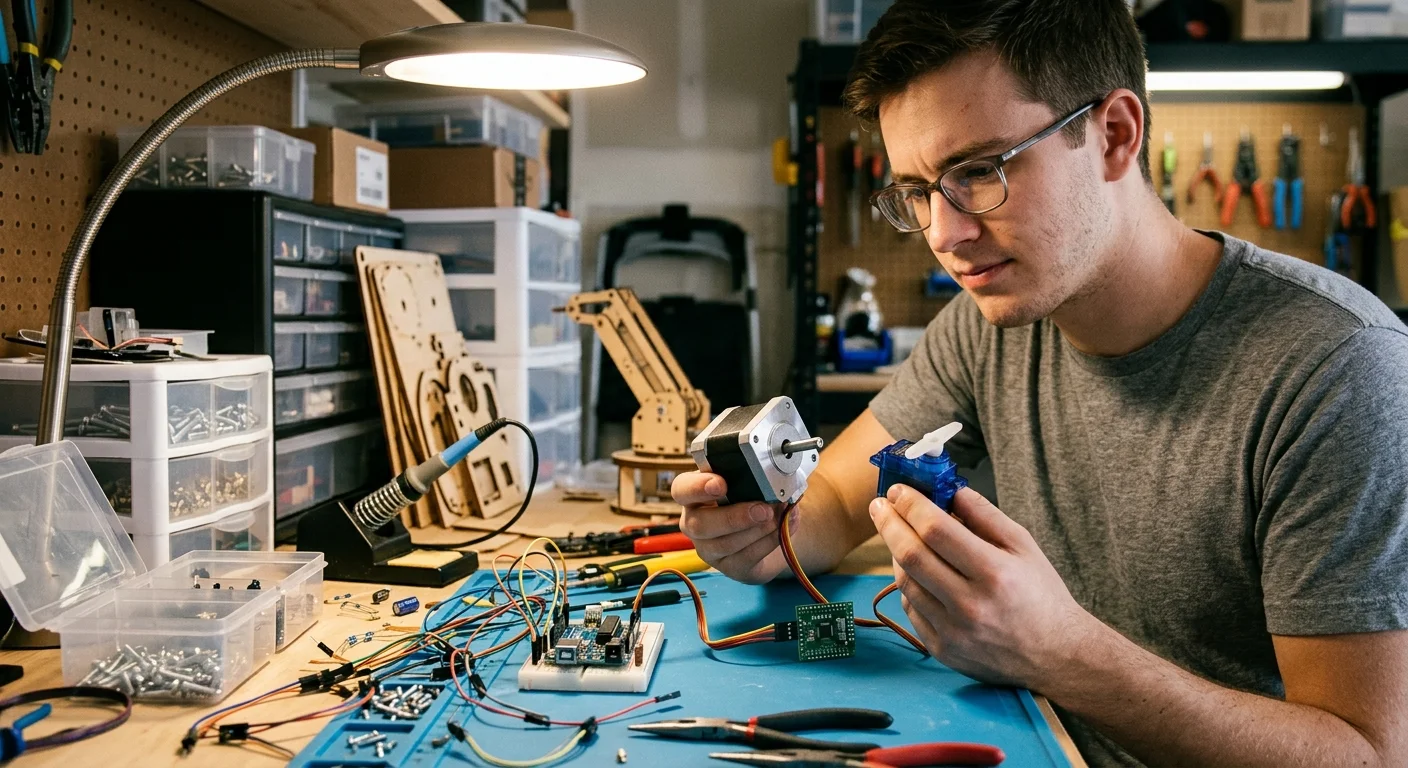
Steppers earn their reputation the hard way — not through sophistication, but through solid reliability at a price that doesn’t hurt. In the broader discussion of servo vs stepper motor robot arm design, steppers represent the simplest and most cost-effective path for many builders.
The math is simple. Standard NEMA 17/23 steppers run 1.8° per step — 200 steps per revolution. No encoder. No feedback loop. Just a pulse train moving the joint to a position and holding it there. That open-loop simplicity is both the feature and the limitation. For joints carrying predictable loads at low speeds, it’s enough. Loads that shift without warning are a different story — that’s where open-loop becomes a real problem.
The holding torque is real. Below 200 RPM, a geared NEMA stepper holds position with authority. The Haisheng 42HS hits 1.5 Nm — enough for base and shoulder joints in a mid-size DIY arm. The AR4 open-source 6-DOF arm uses NEMA 17/23 steppers across all joints. Builders have made it work well for structured pick-and-place tasks. It’s a proven setup for that kind of work.
Where the Logic Holds — and Where It Breaks
Add a 1:15–1:30 gear reduction and a belt drive to a stepper. You get torque multiplication plus smoother movement. That combo covers base, shoulder, and elbow joints in light-duty builds. The control side stays simple — no complex feedback needed.
Push past 200 RPM under load, and things go south fast. Torque drops. Heat climbs. Steps start dropping with nothing to catch them.
Stepper motors work best under controlled conditions:
– Known payload weights
– Low-speed joint movements
– Structured tasks with repeatable trajectories
– Budget builds where encoder cost is too high
For DIY builders running a six-axis arm through its first year of prototyping, steppers keep the entry cost low. You don’t give up enough precision to matter — as long as the tasks stay predictable. Just don’t ask them to improvise.
BLDC Motors for Robot Arms: Efficiency Meets Versatility
Brushless DC motors don’t compromise — they just ask more from your control system in return. In modern BLDC motor robot arm systems, that trade-off is exactly what enables higher efficiency, longer lifespan, and better dynamic performance.
That trade-off is worth knowing. BLDC motors convert over 90% of electrical energy into mechanical output. No brush friction eating into your power budget. No voltage drops from worn contacts. In battery-powered robot arms, the efficiency gap between BLDC and brushed motors is real — you get longer runtime and less heat across every joint.
The other number that matters: no brush replacement, ever. In continuous-duty environments where the arm runs shifts without stopping, that means a lower total cost of ownership over time. The savings add up fast.
Where BLDC Motors Fit Best
The reference cases tell a consistent story:
-
Small collaborative robots pair BLDC with harmonic drives to hit under 0.2° position resolution. Real-world positioning errors stay below 0.5° across 95% of cycles.
-
Exoskeleton joints need precise torque and speed regulation through motor encoder feedback for safe, dynamic human interaction.
-
Seven-axis service robot arms use sensorless BLDC control with Hall sensors and current compensation. This achieves over 90% force calculation accuracy in real time.
-
Drone-mounted arms lean on BLDC’s compact size and high torque density. Every gram counts here.
The Control Reality
Raw BLDC torque runs lower than you’d expect at the joint. The standard fix: pair it with a harmonic reducer at high gear ratios. That combination handles the torque amplification the motor can’t deliver on its own.
For low-gain human-safe arms, the control stack runs like this:
-
Hall-effect sensors plus current sensors manage sensorless position and current tracking.
-
A simplified dynamic force compensator feeds into the current controller loop.
-
Tuning targets under 10% current error across varying speeds and loads.
-
The harmonic drive amplifies output torque to usable joint levels.
Robotic arm actuator selection favors BLDC most for 24/7 duty cycles, high IP-rated environments, and consistent torque delivery along complex motion paths. The initial hardware cost runs higher than steppers. The long-term maintenance math, though, tends to close that gap fast.
Head-to-Head Comparison: Servo vs. Stepper vs. BLDC for Robot Arms
Numbers settle arguments faster than opinions do. Here’s what the data shows with all three motor types side by side.
|
Dimension |
Stepper |
Servo |
BLDC |
|---|---|---|---|
|
Control |
Open-loop, step/direction |
Closed-loop, encoder + PID |
Closed-loop via ESC |
|
Positioning |
±0.1° with microstepping |
Sub-0.1°, holds under load |
±0.1° with feedback |
|
Speed Range |
~600 RPM max |
4,000–6,000 RPM |
High; beats brushed DC |
|
Peak Power |
~120W |
~350W |
Superior efficiency |
|
Weight (Nema23) |
1.05 kg |
0.63 kg |
Compact, high density |
|
Cost |
Lowest |
Highest |
Moderate |
|
Complexity |
Simplest |
High |
High (ESC required) |
What the Benchmarks Mean
A Nema23 stepper delivers 1.9–2.4 Nm holding torque — solid on paper. A ClearPath BLDC servo hits 2.7 Nm at 6,000 RPM. It weighs 40% less and puts out close to 3x the peak power. Same frame size. Totally different performance ceiling.
That gap shows where each motor fits in a real arm:
-
Base and shoulder joints — high static torque demand, lower speed. Steppers hold here.
-
Wrist and gripper — precision matters more than raw power. Servos take over.
-
5–6 DOF continuous-duty arms — BLDC’s efficiency edge builds up across every cycle.
The Honest Trade-Off
Your joints stay under 600 RPM? Open-loop control works fine? Steppers keep your build simple and your budget intact. Add dynamic loads to the mix — or push precision below 0.1° — and closed-loop servo motor torque control becomes the only real option. BLDC earns its place when runtime, weight, and long-term maintenance costs all matter at once.
Power density tells a clear story. Servo and BLDC deliver 30%+ more torque in the same frame size. You also get about 3x the usable power output.
How to Choose the Right Motor for Your Robot Arm Project

Three numbers decide your motor choice: torque, speed, and precision. Nail those three, and the rest falls into place — regardless of which robot arm motor types you’re evaluating.
Calculate Before You Shop
Start with the torque formula — T = Force × Distance from the joint. A 5 kg payload at 0.2 m from the joint needs at least 1 Nm. Add 20–25% on top as a safety buffer. That buffer covers friction, voltage drops, and real-world variance. Skip it, and you’ll be reordering parts.
Speed matters too, but each joint has different demands. Educational arms don’t need more than 10–100 RPM in most cases. What counts is consistency — the motor must hold that speed across the full range of motion, not just at peak.
Match Motor Type to Joint Position
Each joint’s position in the arm shapes what it needs most.
-
Shoulder joint (50–300+ Nm): This carries the highest load in the system. It needs self-locking or an emergency brake to stop droop. Cooling is a must — no exceptions.
-
Elbow joint (40–80 Nm): Balance is the priority here. You want moderate torque, fast response, and precise control. Dual encoders help. Chasing “strongest” is the wrong target at this joint.
-
Wrist joint (1–20 Nm): Speed and precision matter more than raw torque at this position. Space is tight. Compact servo DC motors are the practical choice here.
Match Motor Type to Project Type
|
Application |
Motor Choice |
Why |
|---|---|---|
|
DIY / Educational |
Stepper (base, shoulder, elbow) |
Low cost, adequate torque, simple control |
|
Precision / CNC |
Servo |
Sub-0.9° positioning, closed-loop feedback |
|
Compact / Lightweight |
Servo DC (wrist, forearm) |
Small form factor, good overload handling |
|
Continuous-duty / Fast |
BLDC |
Efficiency, high speed, zero brush wear |
One Rule That Cuts Through Everything
Joints under 600 RPM with a predictable load? Go with steppers. Dynamic loads or sub-0.1° precision in the mix? Servos are the answer. The arm runs around the clock and long-term maintenance cost matters? BLDC wins that race.
Power density benchmark: 1–2 kW/kg covers most educational and mid-range builds. Push above that, and you’re in industrial servo territory. That means harmonic drives, tighter encoder specs, and a bigger driver budget.
Pick the gearbox at the same time as the motor — not after. Harmonic drives suit servo and BLDC systems well. Belt drives pair better with steppers in lower-cost builds. That pairing sets both your acceleration ceiling and your precision floor at once.
Real-World Robot Arm Examples by Motor Type
Three arms. Three motor choices. Three different outcomes — and each one makes sense once you see the reasoning.
Dorna LBR (Stepper Motors): This open-source 6-axis arm carries 2–5 kg across a 600–800 mm reach. Price range: $2,500–$5,000. NEMA 17/23 steppers handle every joint. No encoders. No feedback loop. That simplicity cuts controller costs by 50–70% compared to servo equivalents. At under 100 mm/s, you get 0.1–0.5 mm accuracy. That’s more than enough for structured pick-and-place work. The trade-off is real: step loss under unexpected loads. For amateur use, that’s not a concern worth losing sleep over.
FANUC M-10iA/12 (AC Servo + Harmonic Drives): Payload 12 kg. Repeatability ±0.07 mm. Built for 10 million cycles. Closed-loop feedback holds ±0.02 mm even under 100 kg loads. The ~$50K price tag reflects the demands of 24/7 welding and production work. You get zero-backlash harmonic drives, grid-compatible AC servos, and efficiency above 90%. Every dollar goes toward keeping this arm running without stopping.
ABB IRB 1200 (BLDC + Harmonic Drives): Seven axes. ±0.02 mm repeatability. Built for shared human workspaces. No brushes means 80% less maintenance across its lifetime. Hall sensors push position resolution to 0.01 mm at variable speeds. That’s precise enough for electronics polishing — and safe enough to run alongside people on the floor.
The pattern is clear: stepper for budget and simplicity, servo for precision under dynamic load, BLDC for continuous-duty efficiency. Industrial arms like FANUC and ABB hold around 60% of the articulated robot market. Servo and BLDC systems earn that position by justifying their cost across millions of cycles. Amateur builds go with steppers for the opposite reason — lower cost matters more than peak performance.
FAQ: Common Questions About Robot Arm Motors
Here are the answers engineers and builders are searching for — no filler, just the specifics.
Should I use a stepper or servo motor for a 6-axis robot arm?
Servos win on precision, speed, and overload recovery. The Niryo arm takes a hybrid approach: NEMA steppers on axes 1–3 (base, shoulder, elbow) for holding torque, DC servos on axes 4–6 (forearm, wrist, hand) for responsiveness. Each motor type handles what it does best. That split works well at the educational level.
Can a BLDC motor replace a servo in a 6-axis arm?
Not as a straight swap. Servos include integrated feedback and gearboxes built for closed-loop positioning. BLDC motors deliver strong torque density. But without encoders and matched drivers, they can’t match servo-level control. Add the feedback hardware, and the performance gap shrinks by a lot.
How much torque does each joint need?
Educational cobots need 0.2–0.5 Nm at the base and shoulder. Industrial builds are a different story. The Kawasaki KF121 runs 7.8 Nm at the wrist alone. Use τ = F × r to size each joint before ordering anything.
How fast should robot arm joints move?
Educational arms run at 10–100 RPM. Industrial joints push much harder. The Omron TM5 hits 180°/s on axes 1–3 and 225°/s on axes 4–6. Kawasaki’s J6 reaches 720°/s. Gear ratio is what gets you to those numbers.
Conclusion
Choosing the right motor isn’t about what’s “best” — it’s about what actually fits your load, speed, and precision.
Servo for accuracy. Stepper for simplicity. BLDC for performance.
Most robot arm failures don’t come from code — they come from choosing the wrong motor.
Tell us your payload, arm length, and precision requirement.
We’ll recommend the right motor, torque range, and actuator setup.